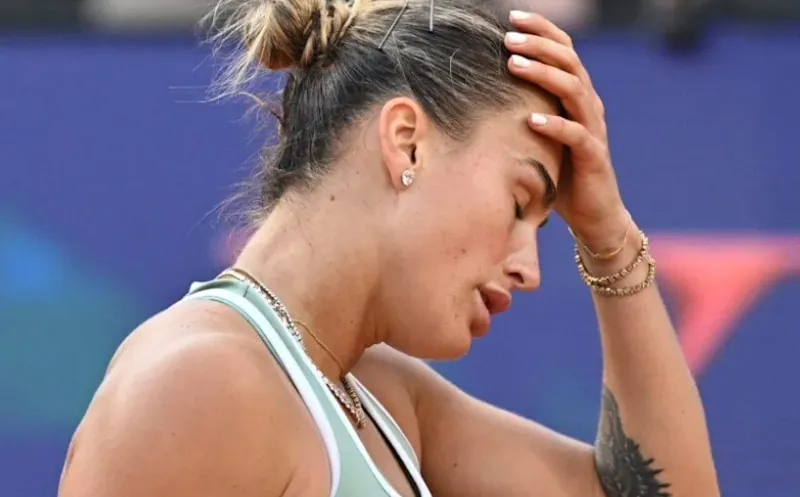

Aryna Sabalenka’s road to the French Open has suddenly become far less comfortable after a dramatic third-round defeat at the Italian Open. The world No. 1 lost 2-6, 6-3, 7-5 to Sorana Cîrstea in Rome on Saturday, a result that ended her tournament far earlier than expected and raised fresh concern over her fitness just weeks before Roland Garros begins on May 24.
For most of the opening hour, there was little sign of an upset. Sabalenka looked powerful, composed and in control, taking the first set 6-2 before moving 2-0 ahead in the second. At that point, the match seemed to be heading toward another routine win for a player who has made early exits almost disappear from her schedule.
Instead, the afternoon turned sharply. Cîrstea, the 36-year-old Romanian playing with freedom in what has been described as her final season on tour, refused to fade. She began reading Sabalenka’s serve better, stepped closer to the baseline and forced the Belarusian into longer, more uncomfortable rallies.
The result was Sabalenka’s earliest tournament exit in 15 months. Before this defeat, she had not lost earlier in an event since the Qatar Open in February 2025. She had also not missed a quarterfinal since the Dubai Tennis Championships that same month, which shows just how unusual this result was for the current world No. 1.
Cîrstea Changed the Match After Sabalenka’s Fast Start
The biggest shift came on serve. Sabalenka won 68 percent of her first-serve points in the opening set, but that number dropped to 39 percent in the second. By the end of the match, she had won only 59 percent of first-serve points, her lowest mark of the season.
That statistic tells the story of the match. When Sabalenka’s serve is working, she usually controls the tempo immediately. Against Cîrstea, that weapon became less reliable, and the pressure moved back onto her ground game. The more the Romanian returned with depth, the more Sabalenka tried to finish points too quickly.
Errors followed. Some were forced by Cîrstea’s clean hitting, while others came from Sabalenka pushing for too much when a steadier rally ball might have been enough. It was the kind of erratic spell that has become rare in Sabalenka’s game since her rise into one of the most consistent champions in tennis.
Cîrstea deserves huge credit for making that happen. She did not win because Sabalenka simply collapsed. She kept taking the ball early, hit with depth from both wings and showed no fear of the pace coming from the other side of the net. Her attitude was just as important as her ball-striking.
The Romanian has long been known as one of the tour’s fiercest competitors. Earlier this year at the Australian Open, she drew attention for complaining about Naomi Osaka saying “come on” between first and second serves, then exchanged a cold handshake after losing. In Rome, that same edge helped her stand up to the aura of the world No. 1.
The final set became a battle of nerves. Cîrstea broke early, Sabalenka broke back, and the Romanian broke again. Sabalenka grew increasingly frustrated, at one stage asking her team for more encouragement as the match began slipping away.
Read More
Medical Timeout Adds French Open Concern
The most worrying moment for Sabalenka came after she held for 4-3 in the deciding set. She called for a medical timeout and appeared to receive treatment for a lower-back problem. When she returned to the court, she looked uncomfortable and was visibly wincing between points.
That moment will matter more than the scoreline in the days ahead. Clay-court tennis demands heavy movement, long rallies and constant recovery after slides. Any back issue this close to Roland Garros is something Sabalenka and her team will have to monitor carefully.
Even with the physical concern, Sabalenka nearly escaped. Cîrstea had a chance to serve out the match at 5-4 and reached 30-30, only for Sabalenka to produce one final push and level the set at 5-5. It was a reminder of why many view her as one of the toughest competitors in the sport.
But Cîrstea did not let the missed opportunity break her. She earned another break, gave herself a second chance to close the match, and this time made no mistake. After two hours and 12 minutes, a Sabalenka backhand drifted long, completing one of the biggest wins of Cîrstea’s career.
The victory also carried historical weight. Cîrstea became the oldest woman to defeat a world No. 1 on clay, a major achievement for a player who is trying to enjoy the final stretch of her long career. She will next face world No. 13 Linda Nosková in the fourth round on Monday.
For Sabalenka, the timing is uncomfortable. She also lost in the Madrid Open quarterfinals to Hayley Baptiste last week, meaning she has now lost two of her last three matches. That kind of run would not create panic for most players, but Sabalenka’s standards are different because of how dominant she has been over the past year.
According to The Guardian, the defeat was one of the biggest shocks of the Italian Open and came after Sabalenka had looked on course for a straightforward win.
Sabalenka is still expected to be among the leading contenders in Paris. She reached last year’s French Open final before losing to Coco Gauff, and her power game remains capable of overwhelming almost anyone when she is healthy and confident.
But Rome has changed the mood around her French Open build-up. Instead of heading to Roland Garros with clean momentum, she now has to answer questions about form, first-serve reliability and physical condition.
This was not just another early-round loss. It was a rare moment of vulnerability from the world No. 1 at the worst possible time of the clay season. Whether it becomes a minor setback or a serious warning sign will depend on how quickly Sabalenka recovers before Paris.

Make Swikblog your go-to source on Google for reliable updates, smart insights, and daily trends.