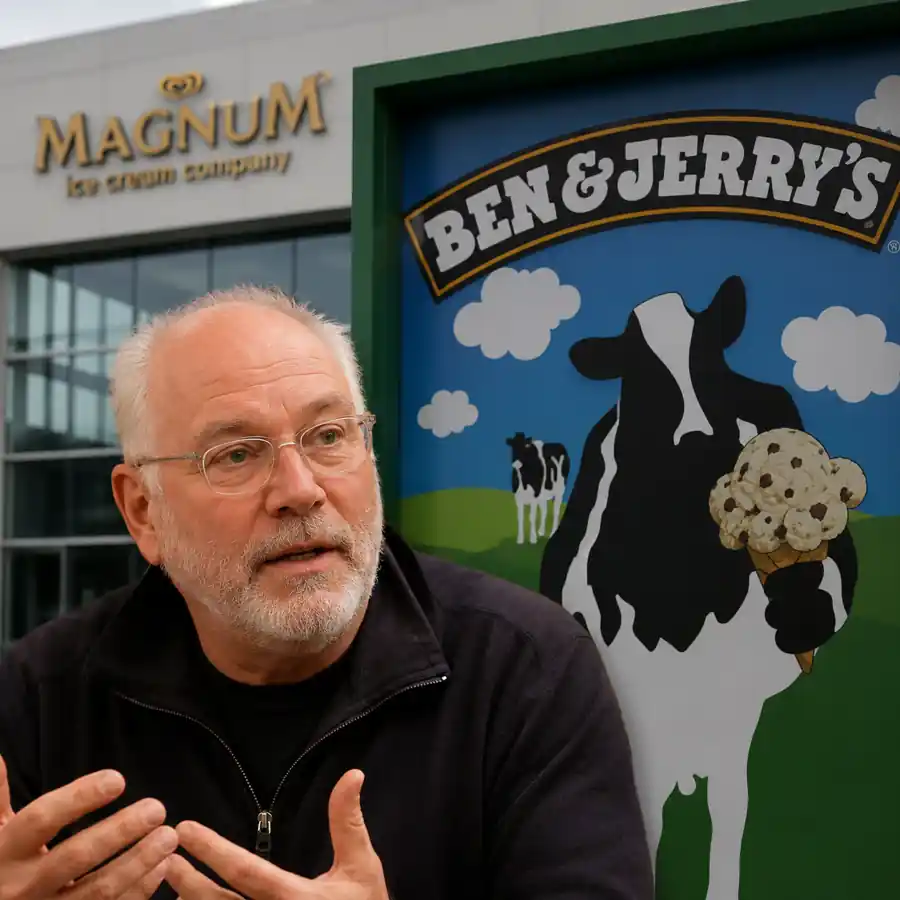

Ben & Jerry’s is no longer just fighting over ice cream. The Vermont-born brand has become the center of a high-stakes corporate dispute about whether a buyer can inherit a company’s name, factories and revenue while slowly weakening the values that made the brand famous in the first place.
The dispute goes back to 2000, when Ben Cohen and Jerry Greenfield sold Ben & Jerry’s to Unilever for a reported $326 million. That deal was not structured like a typical consumer-brand takeover. The founders negotiated a rare protection: Ben & Jerry’s would keep an independent board responsible for guarding the company’s social mission and brand integrity.
That condition mattered because Ben & Jerry’s had never been built as a quiet packaged-food label. From its early years, the company tied its identity to activism, progressive causes, fair business practices and public campaigns on social issues. The independent board was designed to make sure that mission would not disappear after the company became part of a global corporate group.
For years, the arrangement appeared to hold. Ben & Jerry’s continued to speak publicly on issues that many large companies would rather avoid. Its brand voice remained political, direct and sometimes uncomfortable for corporate owners. But that independence is now being challenged after Unilever separated its ice cream division into The Magnum Ice Cream Company, the owner of Magnum, Breyers, Klondike, Talenti and Ben & Jerry’s.
The core allegation from Ben & Jerry’s independent board is that Magnum moved to strip away the very governance structure created to protect the company’s mission. Reports say that by January 2026, Magnum had removed all of the independent directors except one Unilever-appointed director and the company’s CEO. The board has sued, arguing that the move violates the original merger agreement.
Magnum has pushed back, saying it acted within its contractual and legal rights. The company’s position is that some directors became ineligible because of term limits or alleged misconduct, meaning the action should not be viewed as an improper board purge. Ben & Jerry’s independent board sees it differently, calling the move a direct attack on the brand’s protected independence.
Ben Cohen has now taken the fight outside the courtroom. He has called on Magnum to sell Ben & Jerry’s to investors who are aligned with the company’s values. He has also warned that consumers could boycott Magnum-owned products if the company refuses to change course. That threat matters because Ben & Jerry’s customer loyalty has always depended on more than flavor. Many buyers see the brand as a statement of values.
The legal fight has widened beyond the board itself. The Ben & Jerry’s Foundation was allowed to join the lawsuit after alleging that Magnum stopped providing approved funding. According to Vermont Business Magazine, the foundation argued that funding commitments connected to the original deal were being undermined.
Why this fight matters beyond Ben & Jerry’s
The case is important because it tests how much weight a mission-protection clause carries after ownership changes. Many companies now use social responsibility, sustainability and purpose-driven branding to attract loyal consumers. But Ben & Jerry’s shows the difficult question behind those promises: who protects the mission when the founder is gone and the owner’s priorities change?
For Magnum, the issue is not only legal. It is commercial. Ben & Jerry’s is valuable partly because it has a clear public identity. If customers believe that identity is being controlled or weakened by corporate management, the brand could lose the trust that separates it from ordinary ice cream rivals.
Read More
- Visit Swikblog Homepage
- Marvel’s Wolverine Release Date PS5: September 2026
- CSIRO to Slash 350 Jobs Despite $387 Million Federal Funding Boost
- Palantir’s Viral $239 Chore Coat Sparks Backlash
- IKEA Garlic Press Recall Over Metal Fragment Risk
- Sydney Chinatown Golden Water Mouth Sculpture Removal Raises Heritage Concerns
The timing also creates pressure for investors. Magnum has been under market scrutiny following its separation from Unilever, and reports in the original coverage noted that its shares had fallen roughly 25% from February highs while trading near a 52-week low before its first shareholder meeting as a public company. Governance disputes can become especially damaging when investors are already questioning a company’s direction.
The business argument for protecting mission-led brands is not weak. Companies such as Patagonia and Dr. Bronner’s have shown that strong ethical positioning can support long-term growth when it feels authentic. Ben & Jerry’s supporters argue that the brand’s activism is not a distraction from business performance. It is part of the reason consumers recognize and trust the company.
There is also a wider lesson for mergers and acquisitions. Buyers often pay premium prices for brands with loyal communities, but those communities are built on expectations. If a brand known for social courage suddenly appears cautious or controlled, customers may notice. That makes mission protection not just a moral issue, but a financial one.
Swikblog recently covered how large consumer companies are facing investor attention as they reshape portfolios and pursue major strategic moves, including Unilever’s broader restructuring and deal activity. The Ben & Jerry’s dispute fits into that larger trend, where corporate simplification can collide with brand identity.
For consumers, the question is simple: when they buy a pint of Ben & Jerry’s, are they still buying the company that promised to stand for something? For investors, the question is sharper: can a global owner preserve a valuable activist brand without silencing the voice that made it valuable?
A court will decide whether Magnum breached the original agreement. But the reputational battle is already underway. Cohen wants Ben & Jerry’s returned to owners who will protect its social mission. Magnum wants to keep control of a major ice cream asset. Between those two positions is a warning for every company buying a purpose-driven brand: a promise made at acquisition can still matter decades later.

Make Swikblog your go-to source on Google for reliable updates, smart insights, and daily trends.