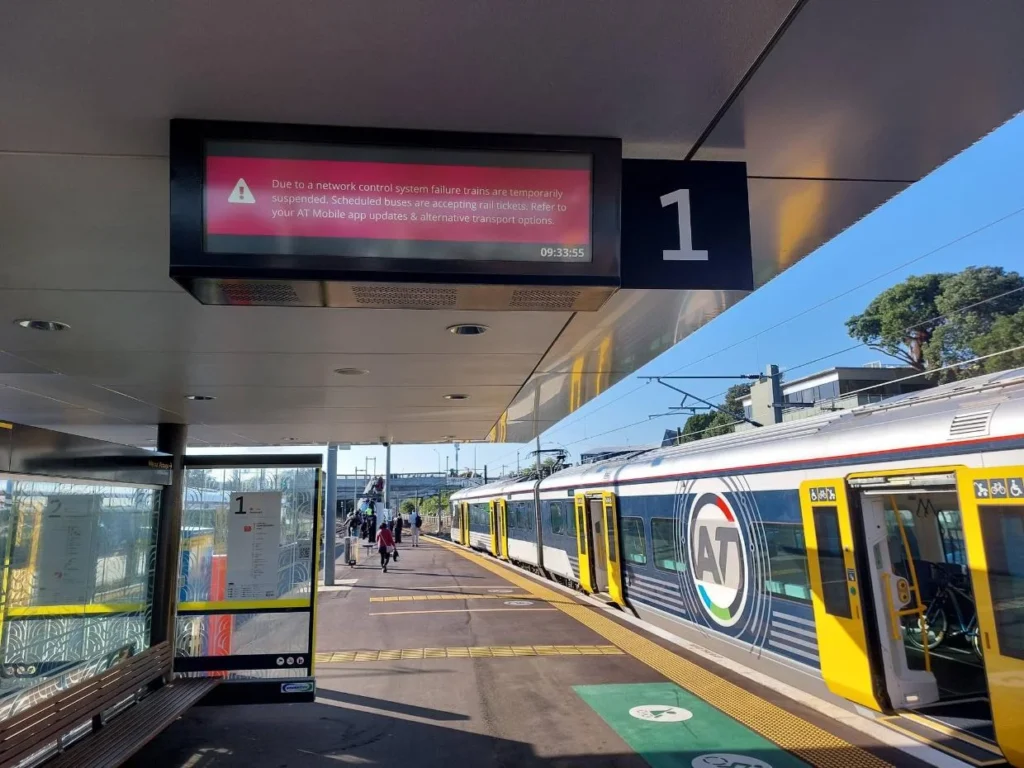

Auckland’s rail network ground to a halt on Thursday morning after a nationwide control system failure forced the suspension of all train services, stranding passengers, overcrowding buses, and disrupting the daily commute across the city. The outage, which hit during peak hours, exposed just how dependent the system is on centralised control infrastructure.
Auckland Transport (AT) confirmed that services were stopped shortly after 9am due to what it described as a “nationwide outage of the system used to safely manage train movements.” Alerts issued around 9.20am warned passengers of widespread delays and cancellations across all lines, leaving thousands scrambling for alternatives.
The disruption was not limited to Auckland. Wellington’s Metlink network also reported issues, with services facing delays of up to five minutes due to a signal fault, highlighting the scale of the technical problem affecting rail systems across New Zealand.
Passengers stranded as trains halt and stations shut
As the system failure unfolded, trains across Auckland were brought to a controlled stop. Some passengers remained onboard for extended periods, while others were instructed to disembark once it became clear the issue would not be resolved quickly. Major stations were temporarily closed, adding to the confusion.
One commuter, Ray Chen, described being stuck on a train at Ōrākei for about 25 minutes. Initially told the train would resume shortly, passengers were later informed the issue would take longer to fix and were asked to leave. Trains in both directions were halted at the station, with announcements pointing to a signalling issue.
Across the network, similar scenes played out. Some passengers waited onboard for over an hour, hoping services would resume, while others quickly sought alternative routes. With trains suspended, many turned to buses, but that solution quickly became overwhelmed.
Social media posts highlighted the scale of disruption, with commuters reporting packed double-decker buses and long queues at stations. In Ellerslie, buses were already full before completing their routes, while near Ōrākei, people were seen waiting for rideshare services as demand surged.
To ease the situation, AT allowed passengers to use train tickets on buses serving affected routes. However, the sudden influx of rail commuters put pressure on the bus network, particularly in areas with limited connectivity such as Papakura and Pukekohe. AT said it was working to organise alternative transport options for those regions.
The disruption was further complicated by the failure of real-time information systems. The AT Mobile App’s live departure feature and customer information displays were also affected, leaving passengers without accurate updates. Even by around 11.15am, live departure information had not fully returned, adding to commuter frustration.
Services resume, but delays linger into peak hours
Train services began resuming from around 10.15am, with Auckland Transport confirming that plans were underway to restore operations to normal timetables ahead of the afternoon peak. However, officials warned that delays and cancellations would continue as the network recovered.
KiwiRail’s Chief Infrastructure Officer Siva Sivapakkiam said the technical issue impacted train networks nationwide for approximately 30 minutes, while Auckland experienced disruptions for closer to an hour. He noted that safety systems functioned as intended, ensuring trains were guided safely to the nearest platforms during the outage.
“When this occurs, there are robust systems in place to manage the network safely,” Sivapakkiam said, while also confirming that the incident is now under investigation to prevent a repeat.
Despite the relatively short duration of the fault, the timing amplified its impact. Occurring during the busiest part of the morning commute, the outage disrupted work schedules, delayed appointments, and created ripple effects across the city’s transport network.
Auckland Transport acknowledged the inconvenience caused and apologised to passengers, thanking them for their patience while emergency measures were put in place. The agency also encouraged commuters to continue using bus services where possible while train schedules stabilised.
The incident has once again raised questions about the resilience of New Zealand’s rail infrastructure. While safety systems ensured there were no immediate risks to passengers, the outage demonstrated how a single technical failure can shut down an entire network.
For many commuters, the experience was less about the technical explanation and more about the disruption to daily life — missed connections, overcrowded alternatives, and uncertainty during an already busy morning.
As investigations continue, transport authorities will face pressure to provide clearer answers and stronger safeguards. With public reliance on rail growing, ensuring consistent service is becoming increasingly critical.
Passengers seeking updates on service status can visit the official Auckland Transport website, though many will be watching closely to see whether lessons from this outage translate into a more resilient system in the future.
You may also like: Canada Lotto 649 Results for April 1, 2026
Make Swikblog your go-to source on Google for reliable updates, smart insights, and daily trends.