
Published: Dec 21, 2025 • By Swikblog Desk| Australia
A minute of silence, half-mast flags, and thousands of small flames: a country tried to find a shared language for grief — quietly, together, and in public.
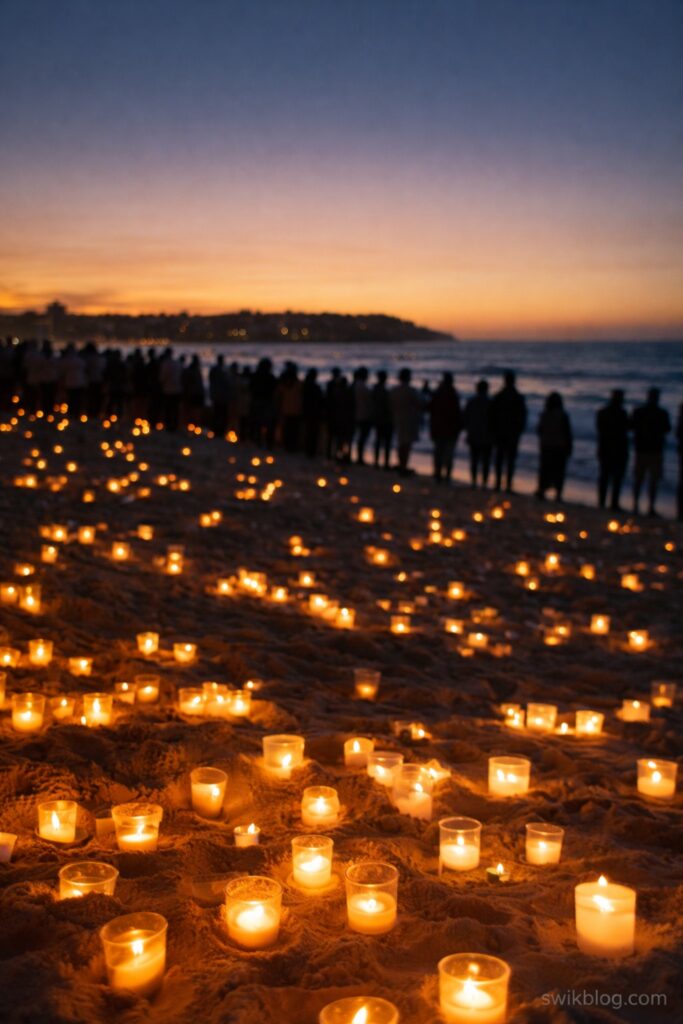
The beach is usually loud — gulls, surf, weekend chatter — but on Sunday evening, Bondi felt held in a different kind of sound. People arrived in ones and twos, some in groups, some with children in tow, many carrying nothing more than a candle and a hesitation at the edge of a crowd that didn’t feel like a crowd at all.
Across Australia, the same simple instruction travelled faster than speeches ever do: light a candle. At 6.47pm, households paused in living rooms and at front windows. Others gathered on beaches and in city spaces for a vigil that asked for almost nothing — only a small, steady flame and a few minutes of attention.
If you’re searching “light a candle for Bondi vigil”Many Australians chose to mark the national day of reflection by placing a candle in a window or joining a local vigil at the same time as the minute’s silence.
The day had been declared a national day of reflection, with flags on government buildings flown at half-mast and Australians encouraged to observe a minute of silence at 6.47pm. The focus wasn’t on retelling the week’s events in detail — it was on recognising the victims, the families, and the communities whose normal has been abruptly rewritten. ABC News coverage throughout the day captured how people were honouring the moment in different ways, from photographs to personal messages shared from around the country. ABC’s live blog also showed the scale of the memorial gathering at Bondi itself.
What made Sunday’s vigils resonate was how little they demanded. No one needed the right words. No one needed to arrive with a statement. People stood shoulder-to-shoulder without performing closeness. They waited. They watched candles flicker in the sea breeze. They looked down at flowers and small notes left behind — the sort of messages written when language fails but silence feels too empty.
For some, the candle became a ritual of protection: a way of saying, I see you, to strangers who are now woven into the country’s shared memory. For others, it was an attempt to steady the mind — to mark time, to put a boundary around grief so it doesn’t spill endlessly into every hour. And for many, it was simply the only gesture that felt possible: a small light against a very large sadness.
At Bondi, there were moments of visible emotion and moments of frustration too — the kind that can rise when public mourning meets public leadership. Prime Minister Anthony Albanese attended the commemoration, and reports from the scene noted mixed reactions as he arrived. The broader message from organisers and attendees, though, remained consistent: the day was about remembrance, not debate.
In the background, the federal government announced a review into law enforcement and intelligence processes related to the lead-up to the attack — a development reported by Reuters alongside the nationwide commemorations. Reuters reporting described the day’s candlelight vigils and the national minute of silence as Australia marked one week since the tragedy.
But the emotional centre of Sunday didn’t live in policy announcements. It lived in the ordinary details: a parent explaining to a child why everyone is being quiet; a friend holding another friend’s hand without speaking; a stranger offering a tissue and then stepping back, respecting the boundary of someone else’s grief.
Bondi, of all places, carries symbolic weight — not just as a famous stretch of sand, but as a shared cultural postcard. It’s where locals run before work, where visitors learn the shape of the coastline, where families return year after year. When something shatters in a place that feels universally familiar, the shock travels farther. That’s part of why “Bondi memorial Sunday” became a search term — people weren’t only looking for information. They were looking for a way to understand what the day meant.
As the light faded, candles remained — rows of small flames refusing to become background. The ocean kept moving. People stayed a little longer than they needed to. And then, gradually, they began to leave the way they arrived: quietly, carefully, carrying the moment home.
If you’re reading this after the vigils, the most important thing to know is that remembrance doesn’t have an expiry time. A candle lit late is still a candle. A message written days after is still a message. Grief is not a deadline — it’s a distance we travel together.
You May Also Like

Make Swikblog your go-to source on Google for reliable updates, smart insights, and daily trends.