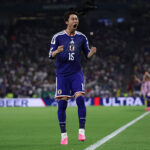
Ayase Ueda gave Japan’s landmark World Cup night a sharper edge with the kind of finish that has defined his rise in Europe. The Feyenoord striker scored Japan’s second goal against Tunisia in Monterrey, adding to Daichi Kamada’s early opener and pushing the Samurai Blue into control of a match carrying unusual historical weight.
The goal came after Japan broke quickly, with Ko Itakura helping launch the move before Ueda struck a right-footed shot from outside the box into the bottom-left corner. It was not just a striker’s tap-in. It was a clean, confident finish from a forward whose reputation has been built on sharp movement, early shooting decisions and ruthless penalty-area instincts.
Japan had already taken the lead through Kamada in the 4th minute, and his form has become one of the major storylines of Japan’s tournament after Daichi Kamada’s decisive World Cup scoring run carried from the Netherlands match into the Tunisia game. Ueda’s second changed the mood again, leaving Tunisia chasing a match Japan were controlling with calm passing, quick transitions and better attacking timing.
Match summary: Japan started fast against Tunisia in the 1,000th match in World Cup history. Kamada scored early to put Japan ahead, before Ueda doubled the lead with a right-footed finish from outside the box after a fast break involving Ko Itakura. The goal gave Japan breathing room in Group F after their opening draw with the Netherlands, while Tunisia were left chasing the game after entering the match under heavy pressure from their earlier loss to Sweden.

Ayase Ueda’s rise from university football to Japan’s No. 9 stage
Ayase Ueda is a Japanese striker born in Mito, Ibaraki, on 28 August 1998. He plays for Feyenoord in the Netherlands and has become one of Japan’s most reliable centre-forward options, a role that has not always been easy to fill for the national team.
Ueda’s route to this level is different from many modern forwards. He did not move straight from a famous academy into European football as a teenager. After youth spells with Yoshidagaoka SSS, Kashima Antlers and Kashima Gakuen High School, he played for Hosei University, where his scoring form helped push him into the national conversation.
That university background became part of his early story. In 2019, Japan called him up for the Copa América while he was still a university player, a rare step that showed how highly Hajime Moriyasu’s staff rated his finishing potential. He later joined Kashima Antlers, where he turned promise into senior-level goals and built the base for his move abroad.
His first European step came with Cercle Brugge in Belgium in 2022. That move mattered because it proved his goals could travel. Ueda scored consistently in the Belgian league, finishing the regular season with 18 league goals and becoming one of the division’s most efficient finishers before Feyenoord moved for him.
At Feyenoord, Ueda initially had to compete for minutes, but his profile kept growing. His official Feyenoord profile lists him as a forward for the Rotterdam club, where he has added European experience, domestic silverware and a sharper tactical education to his game.
His achievements in the Netherlands have made him more than just another overseas Japanese forward. Ueda won the KNVB Cup with Feyenoord in 2023-24 and later added the Johan Cruyff Shield. In the 2025-26 season, he produced his strongest scoring campaign, finishing as the Eredivisie’s top scorer with 25 goals, a landmark achievement for a Japanese striker in one of Europe’s best-known attacking leagues.
He also made history that season by being named Eredivisie Player of the Month for October 2025, becoming the first Japanese player to win that specific monthly award. That recognition mattered because it reflected more than one strong match. It confirmed Ueda had become a week-to-week difference-maker in Dutch football.
Japan impact, scoring record and the timing of his Tunisia goal
Ueda’s Japan career has had its own turning points. He made his senior international debut in 2019 and was part of Japan’s squad at the 2022 World Cup, where he started against Costa Rica but struggled to make a major impact. For many players, that kind of tournament experience can become a difficult memory. For Ueda, it became part of a longer climb.
His first senior goal for Japan came in 2023 in a 6-0 win over El Salvador. Later that year, he scored his first international hat-trick in a World Cup qualifying victory over Myanmar, showing the finishing instincts that had made him so dangerous at club level.
That is why the Tunisia goal fits his wider career arc. Ueda has moved from a player trying to prove he could lead the line for Japan to a striker trusted to finish important chances in tournament football. His goal was not simply a second on the scoreboard; it was a sign that Japan’s attack now has a genuine No. 9 who can score from different situations.
Ueda’s strengths are clear. He is quick across short distances, strong enough to hold off defenders, sharp in the air and unusually clean when shooting early. He does not need a long touch sequence to become dangerous. Against Tunisia, that mattered because Japan’s fast break created a brief window, and Ueda took it before the defence could recover.
The goal also carried extra meaning because of the match itself. Tunisia vs Japan was being marked as the 1,000th World Cup match, a rare historical milestone nearly a century after the tournament began in 1930. Kamada scored the first Japanese goal of the night, but Ueda’s strike added the separation Japan needed and put his own name into that milestone fixture.
For Japan, the timing could be important beyond one match. The draw against the Netherlands showed resilience, especially through Kamada’s late equaliser, but Japan needed a win to strengthen their position in Group F. Ueda’s second goal gave the team control, confidence and a clearer route through a demanding group.
His scoring touch also connects naturally with Japan’s broader attacking rise. Kamada has supplied composure from midfield, Takefusa Kubo offers creativity, and Ueda gives the team a more traditional finishing reference point. In the same Group F picture, the Netherlands have also leaned heavily on forwards in form, with Cody Gakpo’s two-goal burst against Sweden showing how quickly the group’s attacking balance can shift.
For readers following Japan’s World Cup story, Ueda is no longer just the Feyenoord striker with strong club numbers. He is now part of a historic World Cup night, a forward who turned a fast break into Japan’s second goal and added another chapter to a career built on patient development, European goals and a growing role as Japan’s central finisher.

Make Swikblog your go-to source on Google for reliable updates, smart insights, and daily trends.