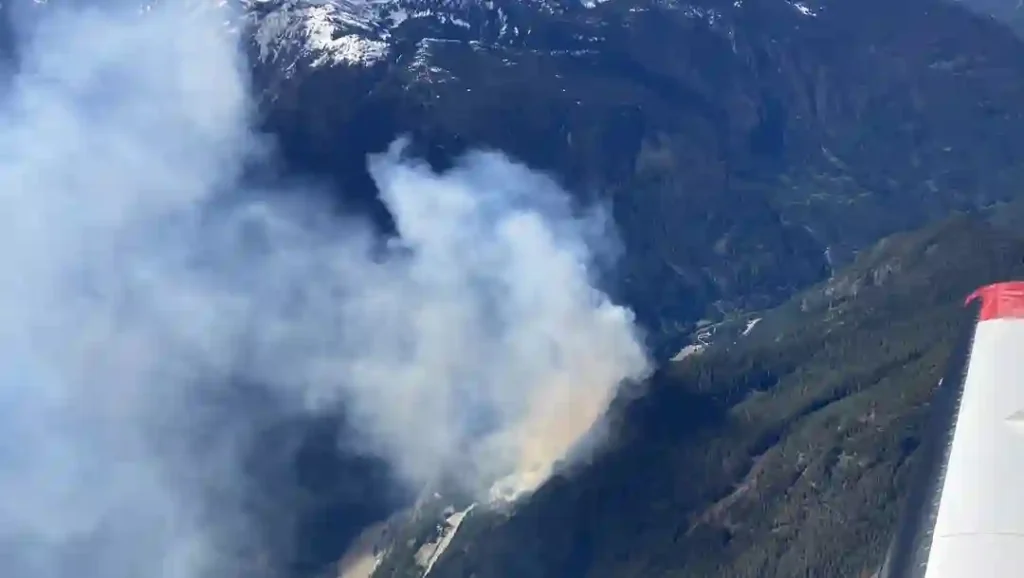

British Columbia is seeing an early reminder of how quickly wildfire conditions can shift, after a blaze near Hell’s Gate expanded to 40 hectares and drew a major response from provincial fire crews.
The fire, known as the Ferrabee Wildfire, is burning about 2.5 kilometres southeast of Hell’s Gate in the Fraser Canyon. It was first spotted around midday Thursday and has since been classified as out of control, meaning officials do not yet consider it contained or stable.
Although no homes or buildings were immediately threatened, the location of the fire has made it difficult to ignore. Flames are burning upslope from Highway 1 through steep terrain, and smoke and aircraft activity may be visible to drivers moving through the corridor.
Firefighters have been attacking the blaze with ground crews, response officers, helicopters carrying water buckets, and heavy equipment. DriveBC had not listed travel impacts at the time of the latest update, but officials warned that traffic could be briefly affected if crews need room to work near the highway.
The Ferrabee fire is believed to have been caused by human activity. In wildfire reporting, that classification is used when investigators determine a fire was not started by lightning. The cause remains important because early-season fires are often preventable, especially during dry and windy periods.
The timing has added to concern across the province. British Columbia had 22 active wildfires on Friday, including 10 that began within a single 24-hour period. Since the start of the year, officials have recorded 68 wildfires in B.C., with roughly 15.5 square kilometres burned so far.
Most of those fires have not been linked to lightning. Provincial figures indicate 62 of the 68 wildfires reported this year are believed to be human-caused, a striking number as officials urge residents and travellers to be extra careful with campfires, burning, tools, vehicles, and discarded cigarettes.
The Coastal Fire Centre has also warned people in southwest British Columbia to use caution with open flames. While no open fire prohibition was in effect for the region at the time of the advisory, forecasters expected an early spring outflow pattern, light to moderate winds, and a sharp drop in relative humidity.
Those conditions can make even small flames harder to control. Low humidity dries grass, brush, and forest debris, while wind can push flames into new fuel or carry embers beyond the main burn area. In steep terrain such as the Hell’s Gate area, fire can move uphill faster as heat rises and preheats vegetation above it.
The early activity comes after three difficult wildfire years in Canada, leaving emergency officials and residents alert to signs that 2026 could bring another challenging season. A warmer winter and ongoing drought in parts of British Columbia have already been flagged as factors that could increase fire risk as spring moves toward summer.
For people travelling through the Fraser Canyon, the main message from officials is to stay aware and avoid interfering with response work. Drivers should not pull over near the fire to take photos or videos, as stopped vehicles can create hazards and block emergency access for crews and equipment.
Residents should also follow verified information rather than relying on rumours or unconfirmed posts online. The B.C. Wildfire Service wildfire map remains the official source for current fire size, status, location, and response updates.
The Ferrabee blaze is not the only fire drawing attention. In the Cariboo region, the Konni Lake wildfire is burning out of control about 180 kilometres west of 100 Mile House. That fire has grown to 252 hectares since being discovered Thursday and has prompted an evacuation alert for 10 properties issued by local First Nations and regional authorities.
Like the Hell’s Gate-area fire, the Konni Lake blaze is also believed to be human-caused. Its rapid growth shows how quickly spring fires can become serious when dry fuels and wind combine, even before the hottest part of the year arrives.
Emergency officials continue to stress that public behaviour can make a major difference in the weeks ahead. Anyone lighting a campfire or using an open flame should check local rules, keep water and tools nearby, never leave flames unattended, and fully extinguish embers before leaving an area.
People using machinery outdoors should be alert to sparks, hot exhaust, and dry grass. Vehicles parked over dry vegetation can also create ignition risks, especially during warm, windy conditions. These precautions may seem basic, but officials say they are critical when so many fires are already being linked to human activity.
For now, crews remain focused on slowing the Ferrabee Wildfire and preventing it from spreading toward areas of greater risk. Its growth to 40 hectares is not the largest fire burning in British Columbia, but its location near a major highway and its early-season timing have made it a clear warning sign.
British Columbia’s wildfire season is still at an early stage, yet the number of active fires, the share believed to be human-caused, and the weather outlook are already creating concern. The coming days will test how well crews can contain new starts before they become larger emergencies.
The situation near Hell’s Gate is a reminder that wildfire risk does not wait for midsummer. In a province shaped by forests, mountains, highways, and rural communities, a single spark under the wrong conditions can quickly become a serious challenge for firefighters and the public alike.
You may like: Cohere and Aleph Alpha Sign $20B AI Deal as Sovereign AI Push Accelerates

Make Swikblog your go-to source on Google for reliable updates, smart insights, and daily trends.