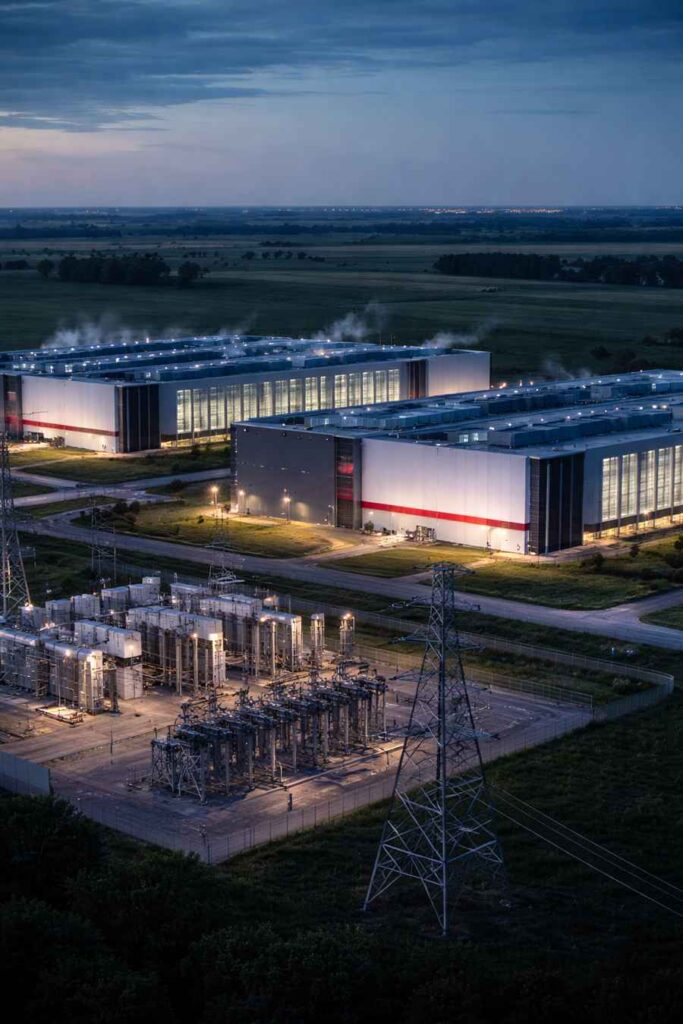

BCE stock gained 1.09% to $35.03 after Bell Canada announced plans to build a massive 300-megawatt AI data centre in Saskatchewan, marking one of the company’s most ambitious infrastructure projects tied to artificial intelligence and digital services. The announcement has quickly drawn attention from investors because it positions BCE not only as a telecom giant but also as a key player in Canada’s emerging AI infrastructure ecosystem.
The project will be located in the Rural Municipality of Sherwood, just outside Regina. According to the company, construction is scheduled to begin in the spring of 2026, with the data centre expected to come online in stages. The first phase is projected to begin operations during the first half of 2027.
Bell Canada said the 300MW facility will play a central role in supporting sovereign AI compute through its Bell AI Fabric initiative. Sovereign AI refers to infrastructure that allows countries to host and process artificial intelligence workloads domestically, ensuring greater control over data security, privacy, and national digital capabilities.
BCE Stock Gains as Bell Announces One of Its Largest Investments
The Saskatchewan data centre represents the largest investment Bell has ever made in the province. BCE chief executive officer Mirko Bibic described the project as a transformational development that could help strengthen Canada’s competitive position in the global AI economy.
“This investment represents a transformational step forward for Bell AI Fabric and for Canada’s AI future,” Bibic said while announcing the project. He added that the development will bring significant economic benefits to Saskatchewan while also creating new opportunities for businesses and communities across the region.
For investors watching BCE stock, the project highlights a broader strategic shift taking place within the telecom sector. Telecommunications companies have long provided the connectivity backbone of the digital economy, but the rise of artificial intelligence is pushing them deeper into cloud infrastructure, data centres, and enterprise technology services.
By investing in a hyperscale-level AI facility, Bell is signaling that it intends to participate directly in the growing demand for compute infrastructure rather than simply providing network connectivity.
$12 Billion Economic Impact Expected
Bell estimates the project could generate up to $12 billion in economic value for Saskatchewan. The development is expected to create substantial employment opportunities during both the construction phase and long-term operations.
During construction, the project is expected to support at least 800 trades and engineering jobs. Once the data centre becomes fully operational, the company says it will create a minimum of 80 permanent full-time roles.
In addition, Bell estimates that as many as 750 additional jobs could be created in the surrounding community as the facility drives local economic activity, infrastructure investment, and business growth.
Large-scale data centre projects often have a multiplier effect on regional economies because they require extensive power infrastructure, cooling systems, engineering services, and long-term operational support. As global demand for AI computing capacity accelerates, regions that attract these facilities can benefit from new investment and digital ecosystem growth.
Sovereign AI Compute Becoming a Strategic Priority
A key aspect of Bell’s announcement is that a significant portion of the facility’s power capacity will support sovereign AI workloads. Governments and enterprises around the world are increasingly focused on keeping critical AI infrastructure and sensitive data within their own national borders.
This trend is being driven by data privacy regulations, geopolitical considerations, and the need for secure domestic computing infrastructure. Major technology firms, telecom operators, and cloud providers are racing to build new AI-ready data centres capable of handling the enormous processing demands of modern machine learning models.
According to industry analysts, AI workloads require far more power and computing density than traditional cloud applications. As a result, next-generation facilities are being designed with massive power capacity and advanced cooling systems to handle high-performance computing clusters.
Bell’s 300MW project places it within this global trend toward hyperscale AI infrastructure. Industry research has highlighted how AI is dramatically accelerating demand for data centre capacity worldwide, as outlined in analysis from McKinsey.
Partnership With SaskTel Adds Commercial Opportunity
Another notable component of the announcement is Bell’s partnership with SaskTel. The two companies will act as go-to-market partners, offering AI-powered products and services to SaskTel customers once the infrastructure is operational.
This partnership suggests the facility could play a role not only in infrastructure hosting but also in expanding enterprise technology services across the region. Telecom operators are increasingly bundling connectivity with cloud, edge computing, and AI capabilities to create integrated digital solutions for businesses.
If successful, this strategy could allow Bell to expand its enterprise revenue streams while helping Canadian organizations adopt artificial intelligence technologies more easily.
Why Investors Are Watching BCE Stock
BCE has traditionally been viewed as a stable telecom dividend stock rather than a high-growth technology company. However, the company’s move into AI infrastructure may gradually change that perception.
Investors have been rewarding companies involved in artificial intelligence supply chains, from chip manufacturers and cloud providers to data centre operators and power infrastructure companies. Bell’s investment suggests it wants to capture part of that growing market.
At the same time, telecom companies face ongoing pressure to invest heavily in infrastructure while maintaining shareholder returns. Large projects like the Saskatchewan AI data centre require substantial capital spending, which means investors will closely monitor execution, timelines, and potential revenue opportunities.
Long-Term Impact for BCE
While BCE stock rose modestly following the announcement, the long-term impact of the project will depend on how successfully Bell can translate the facility into enterprise services, AI hosting contracts, and digital infrastructure partnerships.
The phased rollout scheduled to begin in 2027 means the project will take several years to reach full scale. However, if demand for sovereign AI computing continues to accelerate, the facility could become one of the most important pieces of digital infrastructure in Western Canada.
For now, the announcement has added a new growth narrative around BCE stock. Bell’s investment in a 300MW AI data centre highlights how the telecom sector is evolving alongside artificial intelligence, positioning traditional network operators to play a larger role in the next generation of digital infrastructure.
More details about the project and its role in Bell AI Fabric can be found in the company’s official announcement on the BCE corporate news page.
You May Also Like
TSX Rises 217 Points Today as Canada Inflation Hits 1.8% and Bank Stocks Gain

Make Swikblog your go-to source on Google for reliable updates, smart insights, and daily trends.