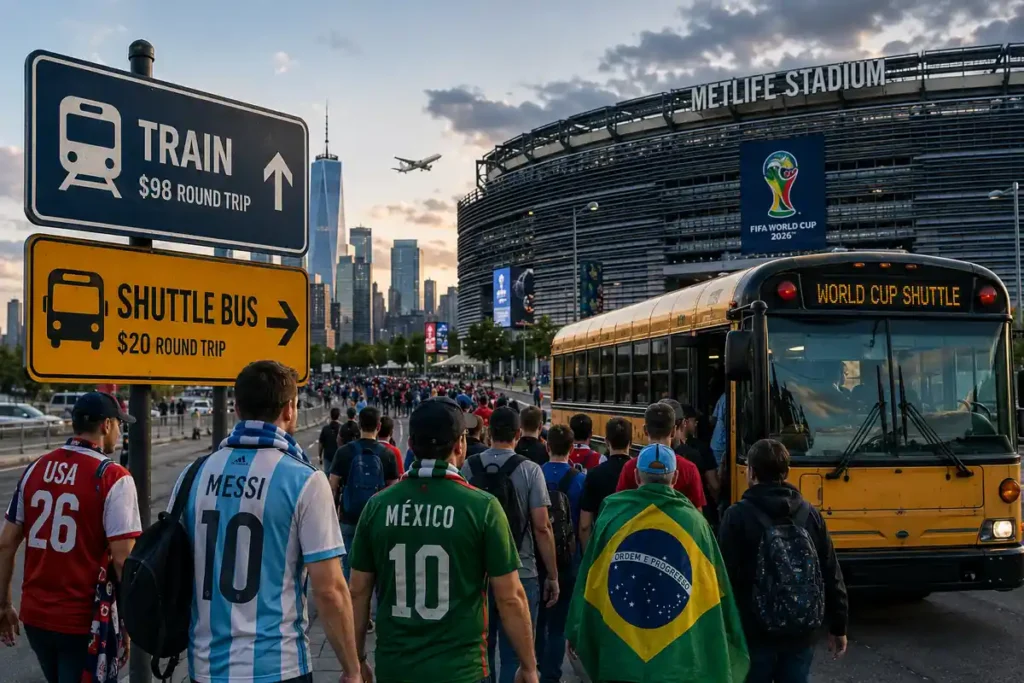

The 2026 World Cup is arriving in North America with record scale, global attention and a travel problem that may become impossible to hide. The tournament will feature **48 teams**, run from **June 11 to July 19, 2026**, and spread matches across **16 cities** in the United States, Canada and Mexico. For fans, that means more football than ever. For U.S. host cities, it means a live stress test of roads, rail, buses, airports and stadium access.
The concern is not whether the United States has the stadiums. It does. The concern is whether fans can reach them easily, affordably and safely without depending on cars. Many international supporters will arrive from cities where stadium travel is part of the football culture: metro lines, regional trains, walkable streets and crowded but predictable matchday routes. In several U.S. cities, the experience will feel very different.
MetLife Stadium in East Rutherford, New Jersey, has become the clearest example. It will host the World Cup final, yet it sits in a car-heavy Meadowlands landscape shaped by highways, parking lots and controlled access roads. On a map, the venue appears close to New York City. In practice, it is not a simple walk from Manhattan, nor does it offer the kind of direct urban subway access fans might expect for the biggest match in world football.
The transport pricing debate has already turned into a headline issue. Round-trip rail fares to the stadium were cut to **$98** after backlash over higher proposed matchday costs. Official shuttle buses from Manhattan were reduced to **$20** after criticism of an earlier **$80** price. The cheaper bus fare is useful, but the image is still powerful: fans attending the World Cup final may reach the venue through special shuttles rather than a modern, high-capacity rail link built for mass football crowds.
That is why this story has moved beyond a simple fan complaint. The American Society of Civil Engineers gives U.S. infrastructure an overall **C** grade, while public transit remains one of the weakest categories. The group’s national infrastructure report points to years of underinvestment, ageing systems and funding gaps that affect everyday commuters long before tourists arrive for a major event.
The World Cup will make those weaknesses more visible because visitors will compare cities in real time. A fan who travels through Philadelphia may find a clearer transit route to the South Philadelphia sports complex, with SEPTA service and free Broad Street Line rides home after matches. In Los Angeles, officials are preparing enhanced Metro connections and shuttle operations around SoFi Stadium. Houston has focused on fan movement through transit links, pedestrian corridors and public-space upgrades tied to NRG Stadium and downtown fan activity.
Those plans show that the U.S. is not facing one single transport story. Some host cities are using the tournament to improve crowd movement and leave behind useful upgrades. Others are leaning more heavily on temporary buses, controlled routes and event-day fixes. The difference matters because fans do not experience infrastructure as a policy grade. They experience it as a fare, a queue, a delayed train, a blocked sidewalk or a long ride after midnight.
Ticket prices are adding another layer of pressure. High match costs, dynamic pricing concerns and expensive travel options risk making the tournament feel like a premium entertainment product rather than a public football celebration. Swikblog has also covered the wider debate around FIFA World Cup 2026 ticket prices, where rising costs and access concerns have already become part of the planning headache for supporters.
The bigger issue is legacy. Major sports events often promise long-term benefits, but the most useful improvements are rarely the temporary ones. A shuttle that disappears after July solves a tournament problem. A safer station, better bus corridor, improved airport link, wider sidewalk or more reliable rail service solves a city problem. That is the test facing U.S. host cities now.
The United States has hosted major events before, but the 2026 World Cup is different because it is spread across a huge geography and a record number of teams. Fans may fly between cities, move between countries, attend fan festivals without tickets, and create unpredictable travel patterns that go beyond the stadium gates. That makes transport planning harder than a compact tournament where venues sit close together.
For American cities, the tournament could still be a success. The airports are large, the stadiums are ready, and the commercial demand is enormous. But the fan experience will not be judged only by the spectacle inside the venues. It will be judged by the hours before and after the match, when supporters are trying to get from hotels to stations, from fan zones to stadiums, and from packed venues back into the city.
World Cup 2026 may therefore become more than a football tournament. It may become a public demonstration of how infrastructure shapes a country’s global image. When millions of fans arrive, they will see the stadium lights, flags and shirts. They will also see the roads, buses, trains, sidewalks and price tags that carry them there.

Make Swikblog your go-to source on Google for reliable updates, smart insights, and daily trends.