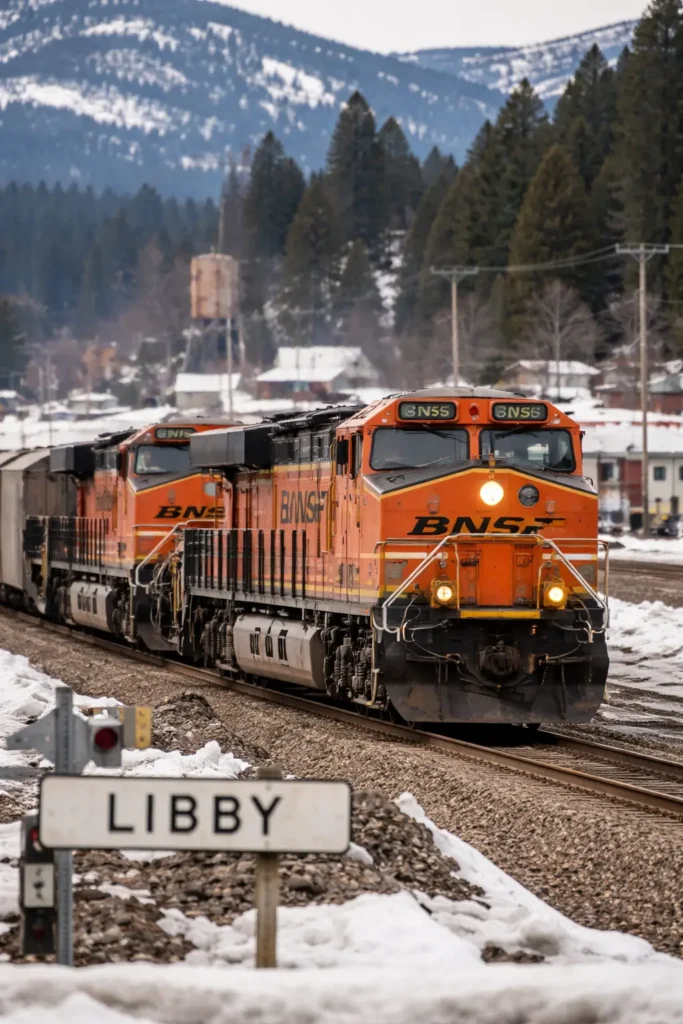

BNSF Railway has won a major appeals court ruling after the 9th U.S. Circuit Court of Appeals overturned an $8 million verdict tied to two asbestos-related deaths in Libby, Montana.
The court ruled that BNSF could not be held strictly liable because it was acting as a common carrier, a railroad legally required to transport lawful freight offered by customers.
The overturned verdict had awarded $4 million each to the estates of two Libby residents who died in 2020 after asbestos exposure linked to contaminated vermiculite.
Why the Court Sided With BNSF
The case focused on asbestos-contaminated vermiculite that moved through BNSF’s rail yard in downtown Libby for decades.
Families of the victims argued that asbestos dust accumulated at the rail yard and spread into the surrounding community.
The appeals court found that the alleged hazardous condition was connected to BNSF’s federally required duty to transport freight.
Because of that common-carrier protection, the court said the railroad could not be held strictly liable under the theory used at trial.
More details on the ruling are available in this Montana Free Press report on the BNSF Libby asbestos case.
$8 Million Verdict Reversed
In 2024, a Montana jury awarded a combined $8 million in compensatory damages after finding that contamination connected to the rail yard contributed to the deaths.
The jury did not award punitive damages because it did not find that BNSF acted intentionally or with reckless disregard.
The appeals court decision removes that award and gives BNSF a major legal win in one of the most watched Libby asbestos cases.
How Libby Became an Asbestos Disaster
Libby is a small town in northwestern Montana near the Canadian border. It became known nationally because vermiculite mined nearby was contaminated with asbestos fibers.
The material was shipped across the United States for use in insulation and construction products.
Residents have long argued that dust from mining, processing, loading and transport exposed people in and around Libby to dangerous asbestos.
The contamination has been linked to hundreds of deaths and thousands of illnesses. In 2009, the U.S. Environmental Protection Agency declared Libby the nation’s first public health emergency under the Superfund program.
W.R. Grace and the Mine’s Role
Most historical responsibility for the contamination has centered on W.R. Grace & Co., which operated the Libby vermiculite mine until it closed in 1990.
The company later entered bankruptcy proceedings and funded compensation for many victims through settlement programs.
Federal prosecutors charged W.R. Grace and several executives in 2005 in connection with asbestos contamination, but they were acquitted in 2009.
BNSF has argued that it transported the material after being told by W.R. Grace that the shipments were safe.
What the Ruling Means Now
The decision may affect other lawsuits involving BNSF and Libby’s asbestos legacy.
Future plaintiffs may try to focus on conduct beyond the railroad’s required transportation role, but those claims could face closer legal scrutiny after this ruling.
BNSF is owned by Berkshire Hathaway, which acquired the railroad in 2010, years after the Libby mine stopped operating.
The ruling reduces BNSF’s exposure in this specific case, but it does not end all litigation connected to Libby’s long-running asbestos crisis.
For related coverage of asbestos safety concerns, see this report on the children’s play sand recall after asbestos was found in Australia.

Make Swikblog your go-to source on Google for reliable updates, smart insights, and daily trends.