
Latest Bald Range Wildfire Update — August 9 at 7:24 a.m., 2026
- The Bald Range wildfire is estimated at approximately 10,360 hectares, equivalent to 103.6 square kilometres.
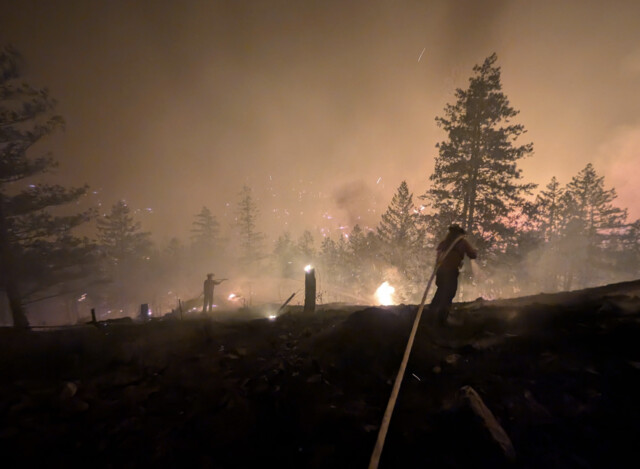
- Officials say the fire has shown little additional growth following its explosive expansion, although it remains active and dangerous.
- Approximately 10,000 properties remain under evacuation orders, while another 3,300 properties are under evacuation alerts.
- Evacuation orders remain in effect across Summerland, Faulder, parts of the Peachland area, Penticton Indian Band lands and nearby communities.
- More than 50 trapped residents were rescued by helicopter after flames blocked road access.
- Significant losses of homes and other properties have been confirmed, but authorities have not released an official damage total.
- RCMP officers are investigating a reported wildfire-related death west of Summerland. The death has not yet been officially confirmed.
- The cause of the Bald Range wildfire remains under investigation.
- Highway 97 remains affected between Summerland and Peachland. Drivers should check current road conditions before travelling.
- The Penticton evacuation reception centre is operating at the Penticton Trade and Convention Centre, 273 Power Street.
Safety notice: Evacuation boundaries and road closures can change quickly. Residents should follow official emergency alerts and avoid using navigation apps to access unapproved forest roads.
Scenes from Summerland, B.C., as the entire town was evacuated from the fast-moving Bald Range wildfire Friday night.#bcwildfire pic.twitter.com/hfLwFXFIuB
— The Weather Network (@weathernetwork) August 9, 2026
More than 20,000 people have been ordered to leave their homes after the fast-moving Bald Range wildfire swept through British Columbia’s Okanagan region, destroying properties, trapping residents and prompting a provincial state of emergency.
The evacuation covers Summerland, a community of about 12,000 people, and approximately 8,000 residents in Peachland and surrounding areas. Officials have confirmed significant structural losses, but dangerous conditions have prevented teams from determining how many homes were destroyed.
Bald Range fire grew rapidly overnight
🇨🇦 This video from the Bald Range fire near Summerland is really hard to watch.
— Mario Nawfal (@MarioNawfal) August 10, 2026
The fire moved in so quickly that an 80-year-old woman lost her life while trying to escape her home in Meadow Valley.
And the devastation didn’t stop there. Homes were completely destroyed,…
The wildfire was first reported on Friday evening. It expanded to roughly 50 square kilometres within hours before growing beyond 100 square kilometres, or 39 square miles.
The blaze travelled about 15 kilometres from the Faulder area toward Summerland and Okanagan Lake. Erick Thompson, an emergency official with the Regional District of Okanagan-Similkameen, called it one of the quickest-moving and fastest-growing fires the region had experienced.
The danger became so immediate that Thompson had to leave the emergency operations centre and evacuate his family. Roads were already filling with vehicles as residents attempted to escape south.
Hot temperatures, strong winds and prolonged drought contributed to explosive conditions. The fire became powerful enough to generate its own localized weather and lightning, increasing the risk of sudden changes and new ignitions.
The emergency follows earlier signs of a difficult season. A wildfire near Hell’s Gate highlighted British Columbia’s early fire risk as dry conditions began affecting different parts of the province.
Homes burned as thousands escaped
Evacuation orders were issued overnight as flames approached populated neighbourhoods. Videos appeared to show homes burning and residents driving along roads with fire visible on both sides.
Summerland resident Anette Boulet described the approaching blaze as looking like “doomsday.” She fled before dawn with her family and five dogs without knowing whether her home remained standing.
Some residents considered staying to defend their properties, but shifting flames, heavy smoke, falling trees and power failures can close escape routes with little warning. An evacuation order means people must leave immediately.
Similar pressures were experienced when a fast-moving wildfire forced evacuations near Whitecourt, Alberta, where rural roads and emergency services also faced sudden demand.
Aircraft rescued more than 50 people
Some residents became trapped as the fire advanced. British Columbia Forests Minister Ravi Parmar said 18 firefighting aircraft rescued more than 50 people. Search-and-rescue crews continued looking for anyone who may have been unable to escape by road.
The Royal Canadian Mounted Police was also investigating a possible wildfire-related death near Summerland. Authorities could not immediately confirm it because hazardous conditions prevented investigators from reaching the location.
Residents from two Summerland long-term-care facilities were among those relocated. Moving medically vulnerable people requires accessible transportation, suitable accommodation, medication management and additional health support.
Highway 97 closure disrupts travel
Highway 97 was closed between the Peachland and Penticton areas after the wildfire reached the transportation corridor. The road is one of the Okanagan’s main north-south routes and is important for residents, tourists, commercial vehicles and emergency crews.
Drivers should follow official directions and avoid unverified shortcuts. Forest roads may be unsuitable for some vehicles or could lead toward active firefighting operations.
Penticton activated its Emergency Operations Centre and began receiving evacuees. An Emergency Support Services reception centre was established at 550 Eckhardt Avenue West, where displaced residents could register and seek temporary accommodation and other assistance.
Read More
Why British Columbia declared an emergency
Premier David Eby declared a provincial state of emergency as more than 100 wildfires burned across British Columbia, with nearly half considered out of control.
The declaration gives the province additional powers to coordinate resources, restrict travel when necessary and secure accommodation for displaced residents. It does not place every British Columbia community under an evacuation order; those decisions are issued for specific areas by local governments, regional districts or First Nations.
An evacuation alert means residents should prepare to leave quickly. An evacuation order means the danger is immediate and people must leave. Current instructions are available through the official Bald Range wildfire emergency update.
Information residents need during the evacuation
Evacuees should carry identification, prescription medication, essential documents, phones, chargers, water and clothing. Families should also bring supplies for children, older relatives and pets.
Residents should use designated routes, keep roads clear for emergency vehicles and avoid stopping to photograph the fire. People outside evacuation areas should avoid unnecessary travel toward Summerland and Peachland.
Smoke may affect communities far from the flames. Children, older adults, pregnant people and those with heart or lung conditions can be particularly vulnerable. Limiting strenuous outdoor activity and keeping windows closed may reduce exposure during heavy smoke.
Fire-size estimates, evacuation boundaries and road closures can change quickly. Official emergency alerts should take priority over older maps, forwarded messages or unverified social-media posts.
More than 20,000 people were ordered to leave their homes overnight in western Canada as a fast-moving wildfire grew rapidly and raced toward towns along British Columbia’s Okanagan Lake, destroying homes in its path. https://t.co/ceRSu04Zba pic.twitter.com/jDBNJo6jRF
— CNN International (@cnni) August 8, 2026
August 7-8, 2026
Summerland, British Columbia, Canada
The Bald Range wildfire was detected west of Summerland County in British Columbia, Canada. Hot, dry weather and gusty winds caused the fire to grow to 50 square kilometers in size within hours.#Climate #news #Canada
Make Swikblog your go-to source on Google for reliable updates, smart insights, and daily trends.
Get the Swikblog AppStay updated with breaking news, trending stories and the latest updates—all in one place. Free download for Android devices