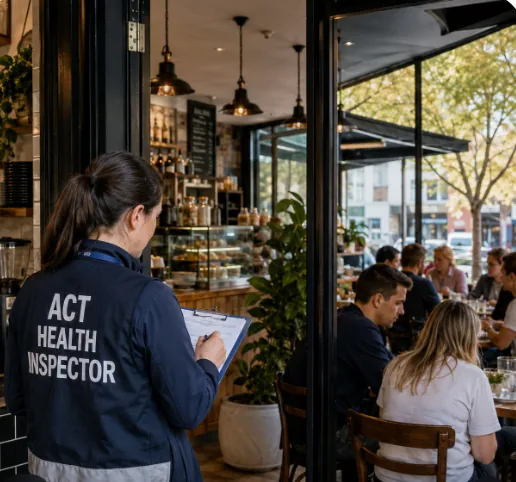

Canberra’s food-safety crackdown remains in focus after the latest reporting showed warnings issued to cafes, restaurants and pubs have doubled over two years. ACT Government guidance confirms that critical food-safety breaches can lead to a Prohibition Order, forcing a business to close until it is considered safe. The most common inspection problems include inadequate hand-washing facilities, cleaning failures, temperature-control issues and pest control. As of the latest ACT Government update, there are currently no businesses or individuals listed on the ACT Register of Food Offences; the last published proven offence expired on February 15, 2026.
Hundreds of Canberra cafes, restaurants and pubs have been issued official food safety warnings, with the number of warnings doubling in two years as ACT authorities continue enforcement across the hospitality sector.
The scale of the action was reported on August 16, 2026, with the latest figures showing a clear rise in formal food-safety enforcement across the capital. The report also said dozens of closure orders had been made during the previous 12 months, adding to concerns about hygiene, food handling and compliance at venues serving the public.
The available information does not identify every affected business or provide a complete public list of venues behind the warnings. That distinction matters for diners: receiving a warning is not the same as being ordered to close, and it should not automatically be treated as evidence that a venue caused food poisoning.
Why Canberra food safety enforcement is drawing attention
The latest figures follow a sharp increase in serious enforcement action recorded a year earlier. ACT Health issued 26 prohibition orders during the 2024-25 financial year, compared with seven in 2023-24. Those orders represented about 1% of all food-safety inspections during 2024-25, compared with roughly 0.2% a year earlier.
Common problems identified during inspections included inadequate hand-washing facilities, cleaning and sanitising failures, poor temperature control, maintenance issues and inadequate pest control. These are practical food-safety controls rather than cosmetic standards. Failures can increase the risk of contamination or allow potentially hazardous food to be stored under unsafe conditions.
ACT law gives regulators powers that go beyond a routine warning. Under the Food Act 2001, enforcement can include improvement notices and prohibition orders when legal requirements are not being met. Critical breaches can lead to a Prohibition Order that restricts the use of premises or equipment, or stops specified food-handling activities until the required conditions are satisfied.
For businesses, the impact can extend beyond the immediate inspection. Temporary closure can mean lost trading days, wasted stock and reputational damage, while corrective work may involve cleaning, repairs, pest treatment, staff retraining or changes to food-handling procedures.
Compliance pressure is not limited to Canberra. A recent case involving an Australian restaurant facing a possible $24,000 seafood fine highlighted how sourcing and traceability can become serious issues when food sold to the public cannot be supported by a lawful supply chain.
What the warnings mean for diners and hospitality operators
For customers, the doubling of warnings is significant, but the number alone does not prove that Canberra’s entire hospitality sector has become less safe. Inspection volumes, follow-up action, regulatory changes and the way businesses respond to earlier notices can all influence enforcement totals.
Health officials have said prohibition orders are used when a business presents a significant and imminent public-health risk or has failed to comply with an earlier improvement notice. That makes a closure order materially more serious than an initial direction to fix a problem.
The latest ACT guidance also makes clear that not every breach results in closure. Businesses may be given a period to correct less serious problems, while critical breaches can trigger immediate restrictions until inspectors are satisfied that the premises can operate safely.
Operators are also dealing with broader compliance obligations. An Australian compliance blitz involving cafes, restaurants and fast-food outlets showed how hospitality businesses can face scrutiny across record-keeping, employment and tax obligations as well as food regulation.
For diners, many of the most important safeguards remain out of sight: correct refrigeration temperatures, separation of raw and ready-to-eat food, effective hand washing, clean preparation surfaces, pest management and proper storage. A dining room can appear clean while food-safety failures exist behind the counter or in storage areas.
Why the two-year increase needs careful interpretation
The strongest signal from the August 2026 figures is not that every Canberra venue is unsafe, but that food-safety compliance is generating substantially more formal regulatory action than two years ago. The additional detail that dozens of closure orders were made over the latest 12-month period shows that some cases progressed beyond warnings to more serious intervention.
At the same time, the absence of a complete venue-by-venue list in the information currently available means individual restaurants or cafes should not be labelled unsafe without specific evidence. Canberra also does not operate a broad public online breach register comparable with some other jurisdictions, making it harder for diners to identify every business represented by headline enforcement figures.
The current ACT Register of Food Offences does not list any businesses or individuals, with the last published proven offence having expired on February 15, 2026. That register is separate from routine warnings and prohibition orders, so its empty status does not mean enforcement activity has stopped.
The trend puts a clear responsibility on hospitality operators to maintain food-safety systems every day, not simply when an inspector arrives. For Canberra diners, it also provides useful context for why official warnings, improvement requirements and temporary closures can appear more frequently even when the underlying breaches differ from business to business.

Make Swikblog your go-to source on Google for reliable updates, smart insights, and daily trends.