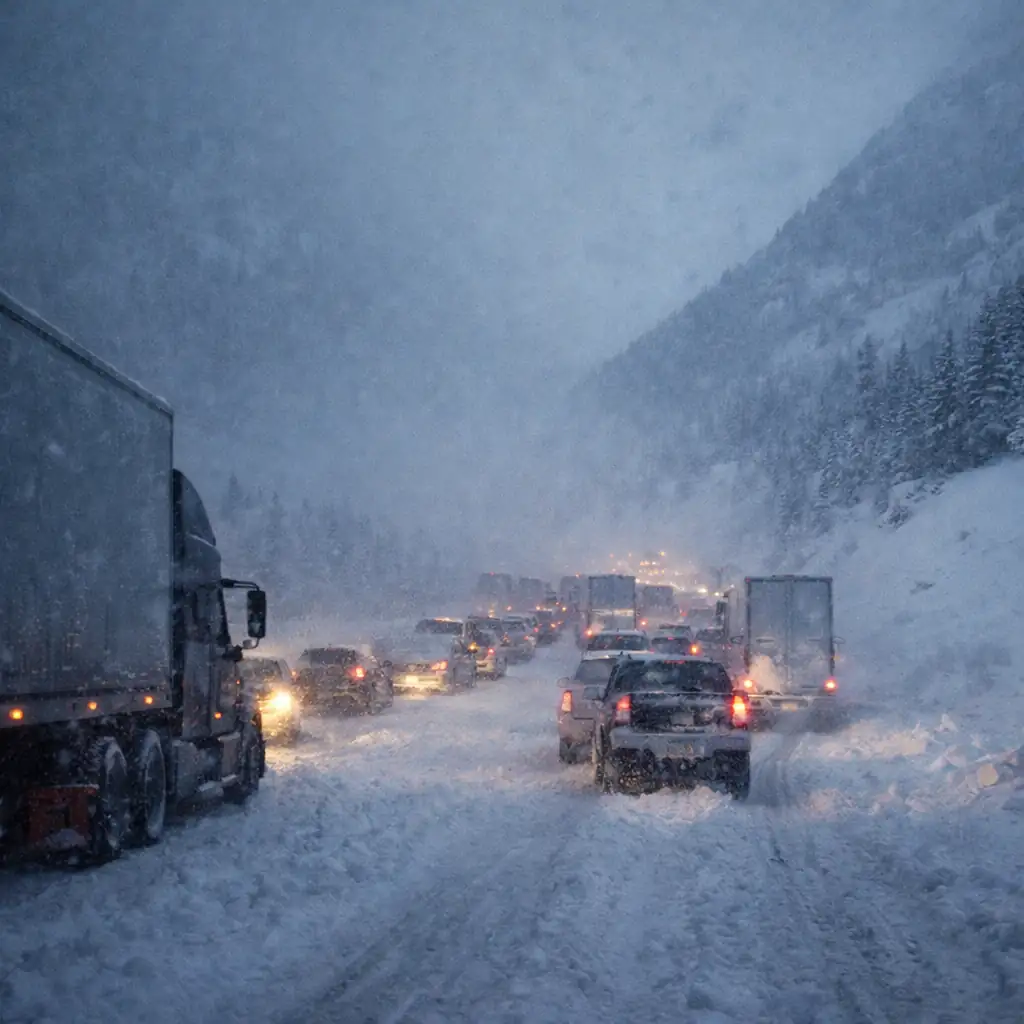

A powerful late-season winter storm has brought travel across British Columbia to a near standstill, as the Coquihalla Highway (Highway 5) was closed in both directions between Hope and Merritt following heavy snowfall, multiple incidents, and safety concerns involving commercial vehicles.
With up to 15 cm of snow forecast and rapidly deteriorating visibility, the situation escalated throughout the day on March 25 and into the night, turning one of B.C.’s most critical transportation routes into a high-risk corridor.
Full Closure Confirmed Between Hope and Merritt
According to the latest update, the Coquihalla Highway is now fully closed in both directions. Southbound traffic has been stopped between the Zopkios brake check and Mine Creek Road exits due to a vehicle incident, while northbound lanes are shut between Zopkios and Portia exits.
Officials confirmed that one of the key reasons behind the northbound shutdown is “non-compliant commercial vehicles at mandatory chain-up locations”, a recurring issue that has contributed to several major highway disruptions in recent winters.
Timeline: How the Situation Escalated
The chaos on the Coquihalla did not happen instantly—it built up over several hours as conditions worsened:
Afternoon (3:50 p.m.): Initial delays were reported in the Box Canyon area after multiple semi trucks spun out, causing traffic backups. Crews were dispatched to clear stalled vehicles.
Early Evening (6:29 p.m.): Traffic briefly resumed after earlier incidents were cleared, but winter driving conditions remained. Drivers were warned about slushy, slippery sections between Portia and Coldwater Road.
Evening (8:25 p.m.): New delays emerged near the Coquihalla Summit, once again linked to chain-up compliance issues and worsening road conditions.
Night (8:49 p.m. – 9:17 p.m.): The situation escalated rapidly, leading to a full closure in both directions as new incidents and unsafe conditions made travel impossible.
This timeline highlights how quickly mountain highway conditions can shift from manageable to dangerous within just a few hours.
Heavy Snowfall and Visibility Concerns
Environment Canada issued a snowfall warning for the region, forecasting approximately 15 cm of snow. The agency also warned of sudden visibility reductions, particularly in higher elevations like the Coquihalla Summit.
Drivers reported near-whiteout conditions in some areas, making it difficult to see lane markings or vehicles ahead. Combined with compact snow and icy patches, this created extremely hazardous driving conditions.
Officials emphasized that mountain weather is highly unpredictable, and conditions can deteriorate rapidly even when forecasts appear moderate.
Chain-Up Failures Trigger Major Disruptions
A key factor in this closure was the presence of non-compliant commercial trucks at mandatory chain-up locations. These vehicles are required to install tire chains during severe winter conditions to maintain traction on steep grades.
When trucks fail to comply, the consequences can be immediate and severe. Vehicles may lose control, block lanes, or become stuck, triggering chain-reaction delays and increasing the risk of accidents.
In this case, chain-up failures contributed to traffic stoppages near Portia and Zopkios, eventually playing a major role in the full highway shutdown.
Alternative Routes and Travel Advisory
Drivers are being advised to avoid the Coquihalla and consider alternate routes. According to DriveBC, detours are available via:
- Highway 1 (Trans-Canada Highway)
- Highway 5A connecting to Highway 3
However, these alternate routes are also experiencing winter conditions, and motorists should be prepared for slower travel, delays, and potential congestion.
Officials strongly recommend checking live updates before travelling and avoiding unnecessary trips until conditions improve.
Regional Impact Across Southwestern B.C.
The storm is not limited to the Coquihalla alone. Reports indicate that southwestern British Columbia is being hit by a broader winter system, affecting multiple routes and communities.
Several traffic incidents have already been reported across the region, and authorities warn that conditions are unlikely to improve significantly until later Thursday morning.
The disruption highlights how a single major highway closure can ripple across the province, affecting logistics, commuting, and emergency travel.
What Happens Next
While conditions are expected to gradually improve, reopening the highway depends on several factors, including snow clearing, removal of stalled vehicles, and safety inspections.
Even after reopening, drivers should expect:
- Reduced speeds
- Lingering snow and ice
- Possible intermittent closures
Motorists planning travel through the region should carry winter essentials, including proper tires, chains, emergency supplies, and fully charged devices.
The Coquihalla Highway closure is a stark reminder that winter conditions in British Columbia can still cause major disruption—even in late March. With 15 cm of snowfall, poor visibility, vehicle incidents, and chain-up violations all converging at once, the result has been widespread travel chaos.
For now, drivers are urged to stay off the route unless absolutely necessary, monitor official updates, and prepare for rapidly changing conditions across the region.

Make Swikblog your go-to source on Google for reliable updates, smart insights, and daily trends.