
Denmark woke to disturbing scenes on Thursday after two local passenger trains collided head-on on a railway line north of Copenhagen, leaving at least 17 people injured and four in critical condition. The crash happened on a route between Hillerod and Kagerup, a line relied on every day by commuters, students and local residents. What should have been an ordinary early-morning journey instead turned into a major rescue operation marked by ambulances, helicopters and a heavy emergency response in a wooded stretch of North Zealand.
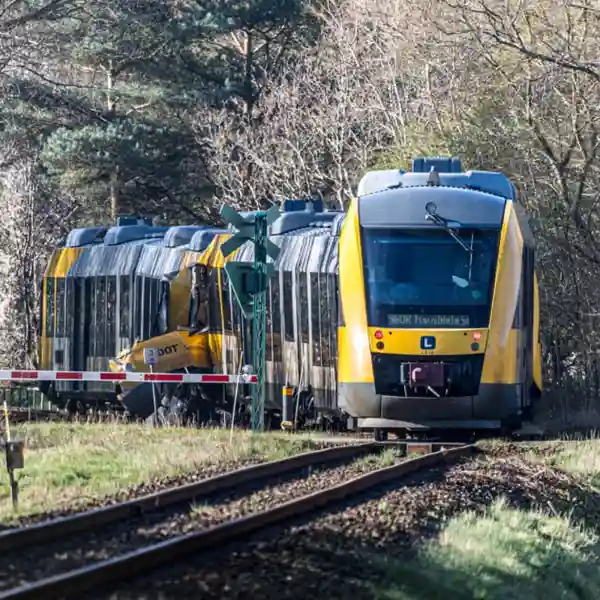
The first alarm was raised at around 6:30 a.m. local time, setting off a rapid mobilisation of police, firefighters and medical teams. Images from the site showed two yellow-and-grey local trains facing each other with visible damage at the front, a stark sign of the force of the impact. While rail incidents anywhere in Europe draw attention, this one has struck a particularly sensitive chord because Denmark is widely seen as a country with a strong transport safety culture and a modern, dependable rail network.
Emergency officials said one of the most important early developments was that every passenger had been brought out of the trains and no one was trapped inside. In a crash involving multiple carriages and serious front-end damage, that detail matters. It meant responders could focus immediately on stabilising the injured, clearing the area and moving those in need of urgent treatment to hospitals. Several of the more seriously hurt passengers were transported by helicopter, underlining the seriousness of the situation even as rescuers avoided an even more devastating outcome.
The line involved is not an obscure or rarely used service. It forms part of the daily rhythm of life for the communities it connects. That is part of why the collision has resonated so deeply. These were not passengers on a special excursion or an isolated freight corridor; they were people on a normal local service, travelling through a region where public transport is woven into work, education and family life. When an accident occurs on that kind of route, the shock spreads beyond the immediate casualty figures because it disrupts something people trust without thinking twice.
Why this crash feels bigger than a single morning accident
Rail travel carries a certain psychological promise. Passengers board expecting order, fixed timetables and layered safety systems working quietly in the background. A head-on collision cuts directly against that expectation. It naturally leads to questions not only about what happened in those few moments before impact, but about the safeguards that are supposed to prevent such a scenario from becoming possible in the first place.
So far, authorities have focused on the facts that can be confirmed: the collision involved two local trains, it happened north of Copenhagen, and multiple passengers were injured, with four in critical condition. What remains unknown is the point that now matters most to the wider public: how did two trains end up facing each other on the same stretch of track? That answer will determine whether this is remembered as a tragic but isolated failure or as an event that prompts broader concern around signalling, route control, operational procedures or human oversight.
Modern rail networks are designed with layers of protection. Track allocation, communication systems and signalling protocols exist to stop opposing trains from occupying the same section of line. When a crash like this still happens, the public response shifts quickly from shock to scrutiny. Investigators will be expected to explain not just the sequence of events, but the exact point where the system ceased to protect the people relying on it.
There is also a human dimension that can get lost once technical investigations begin. For the injured passengers and their families, the story is no longer about transport policy or rail management. It is about interrupted lives, emergency phone calls, hospital corridors and the uncertainty that follows a serious accident. Critical injuries are not simply dramatic words in a headline. They point to a much longer and more personal aftermath, one that continues well after images from the scene disappear from television screens.
Emergency response, local shock and the road to answers
The response on the ground appears to have been swift and extensive. Large resources were sent to the crash site, and the injured were moved away by ambulances and helicopters as officials worked to secure the area. The fact that no one was trapped inside either train likely reduced the complexity of the rescue effort, but it did not lessen the gravity of what unfolded on the tracks. Eyewitness visuals of emergency crews gathered around damaged trains in a forested corridor captured the scale of the disruption and the seriousness with which the incident was treated from the start.
Local reaction has reflected both disbelief and distress. The route is part of everyday life in the area, and that makes the accident feel immediate to the people who live nearby. A train line people associate with routine movement suddenly became the centre of a crisis. That contrast between the familiar and the catastrophic is often what makes transport stories linger in public memory.
Denmark has seen deadly rail incidents before, including a major crash in 2019 and another serious train collision last year involving a vehicle at a crossing. Those events are not proof of a pattern on their own, but they do add context to the national conversation that will now follow. Once the immediate medical emergency eases, attention will turn to accountability, safety reviews and whether any operational changes are needed to reassure passengers.
For now, the country is left with a morning of unanswered questions and a rail line transformed by wreckage, flashing lights and uncertainty. The most urgent concern remains the condition of those critically injured and the wellbeing of everyone caught up in the crash. Readers can follow our broader coverage of transport safety in Europe for continuing context, while international reporting on the incident is also available from Reuters.
You may also like: London Tube Strike Today: Second 24-Hour Walkout Disrupts Services.

Make Swikblog your go-to source on Google for reliable updates, smart insights, and daily trends.