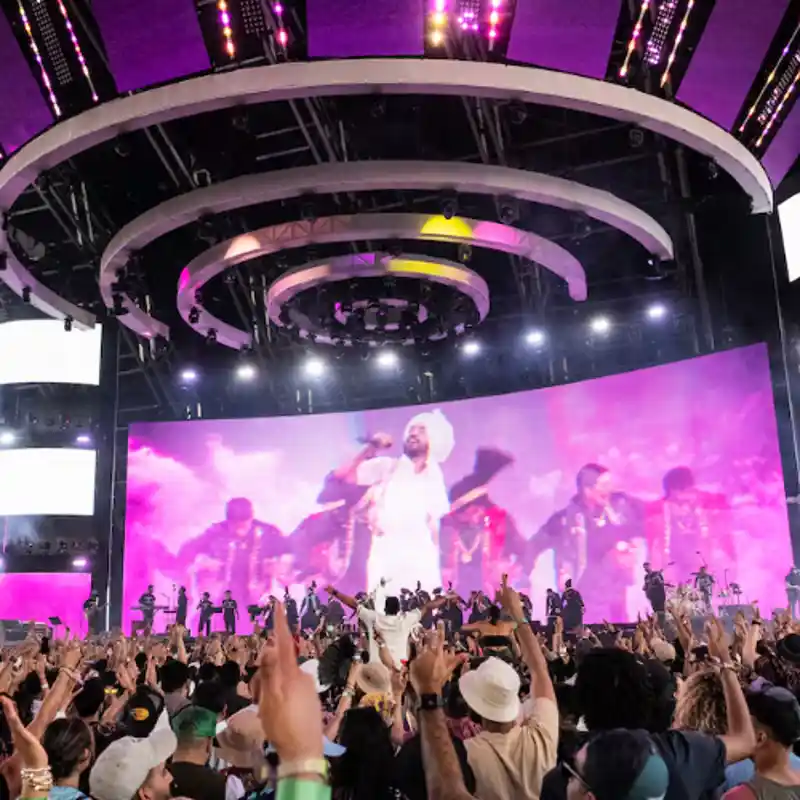

Punjabi music’s rise in Canada is no longer a niche entertainment story. It has become a serious business, culture and audience story, and Diljit Dosanjh’s latest tour demand is one of the clearest signs yet. As the Canadian leg of his Aura World Tour opens in Vancouver, the conversation is not only about a popular singer arriving for another run of arena dates. It is about how a Punjabi-language artist has grown into a stadium-level draw in one of the world’s most competitive live music markets, with premium tickets reaching as high as $1,800 and fan demand stretching across multiple cities.
That level of pricing instantly changes how the market views an artist. Expensive resale or premium seats are common around the biggest names in English-language pop, hip-hop and rock. Seeing similar numbers attached to a Punjabi act shows how far this category has moved from the margins. It also reflects something larger than fandom. Audiences are no longer treating Punjabi concerts in Canada as community events alone. They are treating them as major live spectacles worth planning around, travelling for and spending heavily on.
Diljit Dosanjh is arriving at that moment with unusual momentum. Over more than two decades, he has built a reputation not only as a hitmaker in Punjabi music but also as a performer whose appeal crosses generations. Older listeners know the consistency of his catalogue. Younger audiences connect with his image, stage presence and global visibility. He has managed to become a mainstream cultural figure without losing the identity that first made him stand out, and that balance is one reason his audience continues to grow instead of plateauing.
Why Canada has become central to Punjabi music’s global expansion
Canada holds a special place in this story because the market has both the scale and the cultural foundation to support it. South Asians are the country’s largest racialized group, accounting for 7.1 per cent of the population according to Statistics Canada. That demographic strength matters, but numbers alone do not explain what is happening now. Punjabi music has long been present in homes, weddings, clubs, college events and community celebrations across cities such as Vancouver, Calgary, Edmonton, Winnipeg and Toronto. What has changed is the size of the stage.
The genre has shifted from being deeply rooted in community life to becoming a commercial force that can fill Canada’s largest venues. That transition does not happen only because of heritage audiences. It happens when an artist begins reaching casual listeners, younger fans who discover music through short-form video, and mainstream concertgoers who respond to energy and cultural relevance even when the lyrics are not in English. Canada has become one of the clearest examples of that transition because it combines a strong diaspora base with a broader multicultural audience that is increasingly open to non-English music.
This is also why promoters now compare demand for top Punjabi acts with leading mainstream names. In practical terms, that means quicker sales, bigger venue confidence and a stronger willingness from event companies to back ambitious runs. Karan Aujla’s upcoming Canadian dates offer another example. His back-to-back arena nights in Vancouver and Toronto show that Punjabi live music is not relying on one breakout superstar. It is developing into a deeper touring ecosystem with more than one headline act capable of moving major numbers.
Streaming numbers are turning into real-world spending
The digital side of the story is impossible to ignore. Diljit Dosanjh has crossed more than five billion views on YouTube, while Karan Aujla has passed four billion. Those are not vanity figures. They help explain why promoters and ticketing companies are seeing real confidence in the market. When artists attract that level of repeat listening, it creates a base that is already emotionally invested before a tour is even announced.
Streaming has also changed the geography of Punjabi music. Songs no longer depend on one national radio market or one physical distribution network. They can travel instantly across Canada, the U.K., the U.S., Australia and beyond. Spotify has highlighted that international streams of Indian artists increased sharply between 2019 and 2023, a sign that global discovery is no longer an exception but a core part of the market. That report matters because it supports what promoters are now seeing on the ground: online growth is converting into offline spending, including premium tickets, travel bookings and surrounding hospitality activity. For reference, Spotify’s artist economy data gives useful context on how international reach has accelerated in recent years in music markets beyond English-language pop: Spotify Loud & Clear.
The financial ripple effects are becoming more visible as well. Oxford Economics estimated that Dosanjh’s 2024 tour generated about $63 million in concert-related spending across 13 North American dates. That kind of impact moves the discussion beyond chart success. It places Punjabi music inside the wider live entertainment economy, where concerts support hotels, restaurants, local transport, retail spending and city tourism. With stronger pricing and another wave of demand in Canada this year, the broader economic effect could attract even more attention from venue operators and sponsors.
That matters for long-term authority in the genre. Once artists prove they can create not just buzz but measurable economic value, the industry starts treating them differently. More marketing dollars follow. Better venue windows become available. Partnerships expand. Media coverage grows deeper. That is often how a genre secures its place in the mainstream business rather than remaining a periodic trend.
Diljit Dosanjh’s current run also says something about how global stardom is changing. For years, non-English artists were often treated as crossover exceptions. Today, audiences are far more comfortable building deep attachments across language lines. They do not need a song to be in English to stream it repeatedly, quote it online or show up in large numbers for a live event. We have seen that pattern with Latin music and K-pop, and Punjabi music is increasingly claiming its own place in that wider shift.
Dosanjh stands out in that environment because he is not limited to one lane. His work in Punjabi and Hindi cinema, his international visibility, and his ability to project authenticity without becoming inaccessible have all widened his appeal. He represents Punjabi culture confidently on the world stage, but he also understands how to operate as a modern entertainment brand. That combination is rare, and it helps explain why his tour demand feels bigger than a short-term spike.
In Canada, this moment carries extra significance. The market is not only consuming Punjabi music at scale. It is validating it publicly, commercially and culturally. The packed venues, premium prices and travel-driven demand all point to the same conclusion: Punjabi music is no longer trying to enter the mainstream. It is already there, and Canada is one of the places proving it most clearly.
You may like: Maura Higgins confirmed for Dancing With The Stars 2026 Season 35 cast

Make Swikblog your go-to source on Google for reliable updates, smart insights, and daily trends.