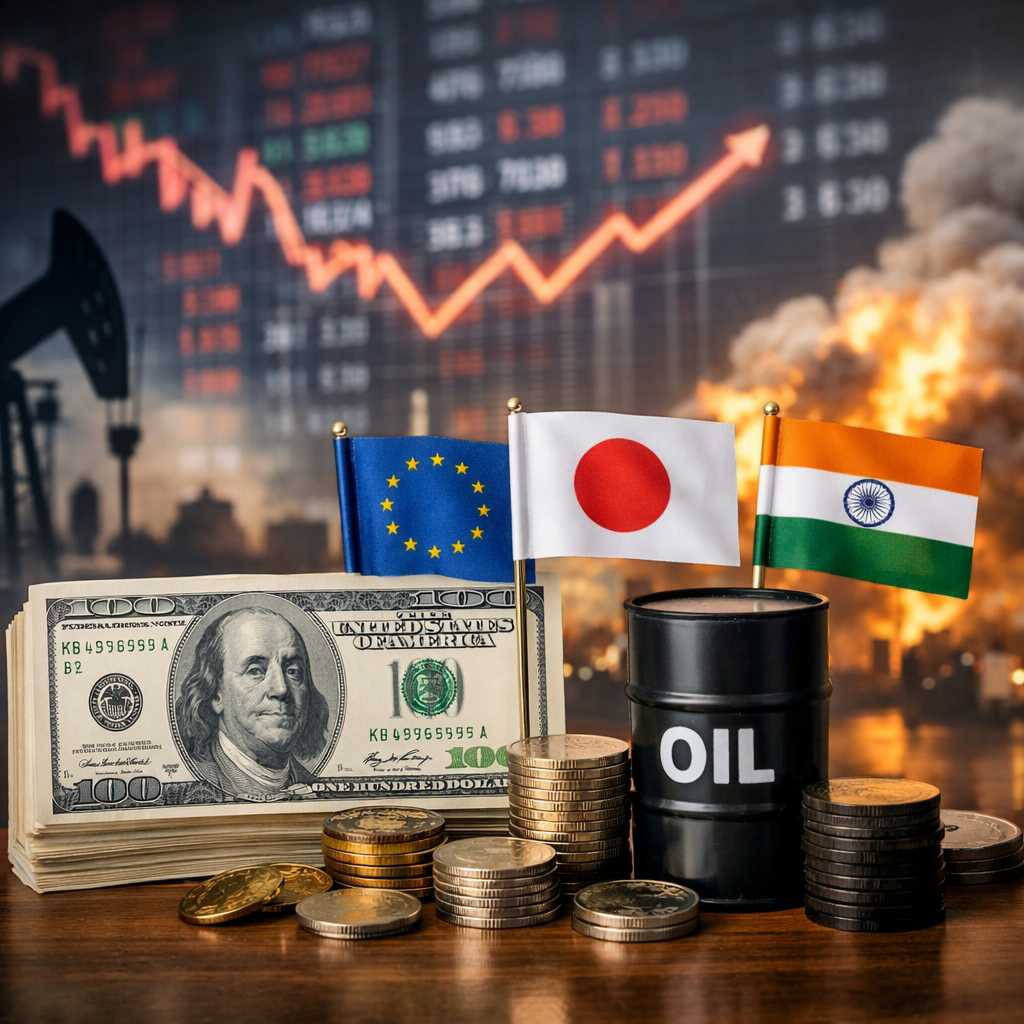

The global currency market is entering a high-pressure phase as the US dollar strengthens sharply, driven by escalating geopolitical tensions and rising oil prices. With the US Dollar Index (DXY) holding firmly above the 100 level, investors are once again rushing toward safe-haven assets, leaving currencies across the world struggling to keep pace.
The latest trigger has been the growing risk of a wider Middle East conflict. Reports of potential US military escalation and sharp warnings from Iran have pushed markets into a risk-off mode. In such environments, the dollar tends to dominate—and that pattern is clearly playing out again. The DXY recently hovered near 100.15 after touching a two-week high of 100.35, signaling sustained strength despite minor pullbacks.
This dollar surge is not happening in isolation. Oil prices have climbed above $102 per barrel, reflecting fears of supply disruptions. That rise in crude is feeding directly into inflation concerns, which in turn is reshaping expectations around central bank policies. Traders who were previously expecting rate cuts from the Federal Reserve have now almost completely priced them out. In fact, markets are even starting to price in the possibility of rate hikes later this year.
That shift is critical. Higher interest rates in the US make dollar assets more attractive compared to other economies, especially those facing slower growth or higher energy import costs. As a result, capital flows back into the dollar, intensifying pressure on global currencies.
Emerging markets are feeling the impact most sharply. India has taken aggressive steps to defend the rupee, with the Reserve Bank of India reportedly spending nearly $30 billion this month to stabilize the currency. Authorities have also imposed a $100 million cap on onshore position sizes for local banks in an effort to curb excessive volatility. These moves highlight the seriousness of the pressure, as policymakers try to prevent disorderly depreciation.
Across other emerging markets, similar concerns are building. Countries heavily dependent on imported energy are facing a double hit—a stronger dollar and rising oil prices. This combination increases inflation risks and forces central banks to consider tough options, including rate hikes, direct currency intervention, or tighter financial regulations.
Developed markets are also under strain. The euro remains vulnerable as the European Central Bank appears cautious about rushing into rate hikes. Market expectations for an April rate increase have dropped significantly, from around 85% to nearly 50%, after policymakers signaled a more measured approach. This hesitation is leaving the euro exposed, especially if energy prices continue to rise.
In Japan, attention has turned to the Bank of Japan after the release of hawkish meeting minutes. Policymakers acknowledged that monetary policy may be “falling behind the curve,” raising speculation about potential rate hikes. While a 25 basis point increase is currently expected, discussions around a larger 50 basis point move have also emerged, adding to market uncertainty.
Meanwhile, China has taken a different path. The People’s Bank of China is maintaining tight control over the yuan, keeping USD/CNY stable near 6.90. This stability is being viewed positively by global investors, especially as other currencies experience sharper declines. The yuan has even strengthened against several major currencies, including the yen and the euro, during this period.
Currency performance over the past week clearly reflects the dollar’s dominance. The greenback has outperformed most major currencies, gaining over 2% against the Australian dollar and more than 1.5% against the New Zealand dollar. Even traditionally stable currencies like the Swiss franc and Canadian dollar have weakened against the dollar, underscoring the broad-based nature of the move.
What adds another layer of concern is the tightening in global dollar liquidity. Market indicators such as cross-currency basis swaps are showing early signs of stress. If dollar funding conditions tighten further, it could amplify pressure on global financial markets and risk assets.
For now, much of the market’s focus is shifting toward upcoming US economic data, particularly the labor market. Key releases this week include JOLTS job openings, ADP employment figures, and the highly anticipated Nonfarm Payrolls report. Current expectations point to job growth of around 60,000 and an unemployment rate of 4.4%.
If the data comes in stronger than expected, it could reinforce the case for a prolonged period of tight monetary policy in the US, further supporting the dollar. On the other hand, any signs of weakness may provide temporary relief to global currencies—but likely not enough to reverse the broader trend unless geopolitical risks also ease.
The bigger picture is becoming increasingly clear. The combination of war fears, rising oil prices, and shifting central bank expectations is creating a powerful environment for dollar strength. At the same time, it is forcing countries around the world to react—whether through intervention, policy adjustments, or regulatory measures.
This is no longer just a currency move. It is a global financial shift that is influencing inflation, investment flows, and economic stability across regions. As long as uncertainty remains high and energy prices stay elevated, the pressure from a strong dollar is unlikely to fade anytime soon.
Investors looking to track this trend can follow updates from the Federal Reserve’s policy outlook and monitor real-time movements in the US Dollar Index, both of which will play a key role in shaping the next phase of global markets.
You May Like: Lloyds Shares Slide to 90p as Dividend Growth Forecast Draws Attention

Make Swikblog your go-to source on Google for reliable updates, smart insights, and daily trends.