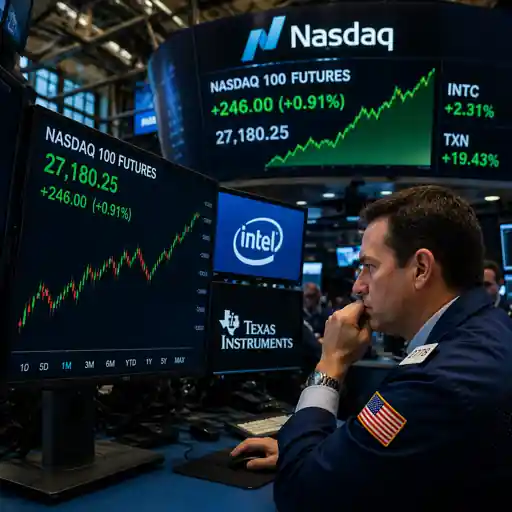
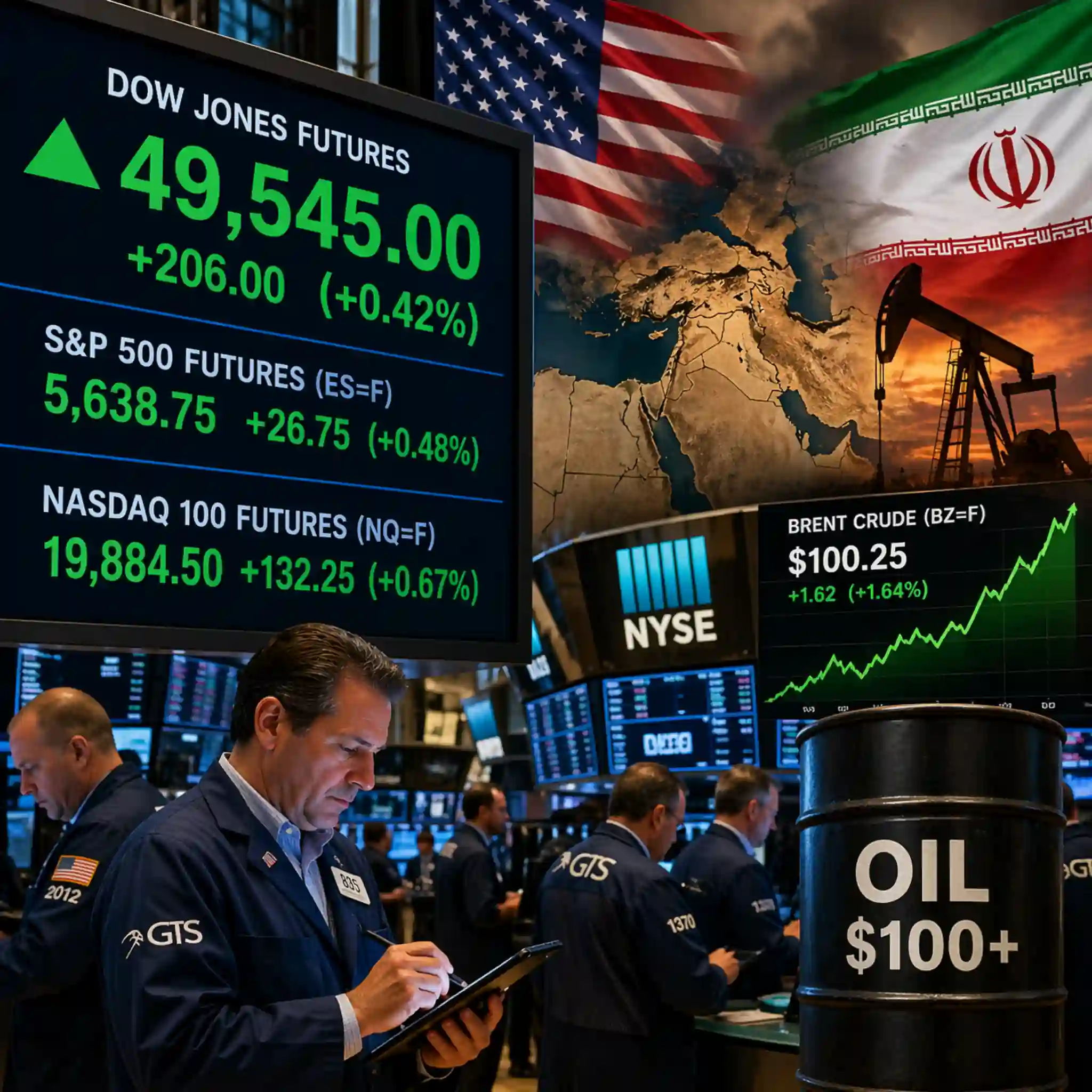
Wall Street headed into Friday under heavy pressure as the latest oil shock collided with escalating Middle East war fears, pushing traders back into a defensive mood before one of the week’s most important economic releases. Dow futures were down 329 points, or 0.7%, while S&P 500 futures fell 0.7% and Nasdaq 100 futures dropped 1%, setting up another uneasy session for U.S. equities after a punishing selloff on Thursday.
The biggest driver was crude. West Texas Intermediate futures moved above $86 a barrel, touching their highest level since April 2024, while Brent crude traded above $89. In the latest delayed quote snapshot, ICE Brent Crude for May 2026 was at $89.36, up $3.95 or 4.62%. The jump in energy prices came as investors weighed the fallout from the U.S.-Iran war and the growing risk that disruptions around the Strait of Hormuz could hit global supply more severely in the days ahead.
That fear intensified after Qatar’s energy minister warned that Gulf producers could soon be forced to declare force majeure, potentially shutting down production and exports if tanker traffic remains blocked. The warning added a far more extreme scenario to the market’s calculations: oil climbing toward $150 a barrel. For investors, that is no longer just a headline risk. It is a direct threat to inflation expectations, transport costs, corporate margins and household spending power all at once.
The Strait of Hormuz sits at the center of that anxiety. It is the only maritime route into and out of the Persian Gulf, and in 2025 more than 14 million barrels per day of crude moved through the waterway, accounting for roughly one-third of all oil exported by ship worldwide. With ship traffic already under strain, traders are rapidly repricing the idea that this may not be a short-lived geopolitical shock but a supply event with global economic consequences.
Oil shock ripples across key stocks
The pressure was visible across sectors most exposed to fuel costs and consumer weakness. Royal Caribbean, already down more than 9% for the week, fell another nearly 2% in premarket trading. Caterpillar was down about 1%, while retailers including Walmart and Costco edged lower as traders worried that more expensive gasoline could squeeze shoppers and weaken discretionary spending.
Thursday’s cash session had already shown how fragile sentiment had become. The Dow Jones Industrial Average lost nearly 785 points, or 1.6%. The S&P 500 fell about 0.6%, and the Nasdaq Composite slipped nearly 0.3%. That left the Dow on course for its worst week since October and its second straight weekly decline, while the broader market continued to absorb the combined weight of geopolitical instability and rising commodity prices.
For the week, the damage has been uneven but significant. The S&P 500 is on pace to lose 0.7%, while the Dow is down 2.1%. The Nasdaq has outperformed, still heading for a modest 0.4% weekly gain, but even that resilience has looked increasingly vulnerable as oil prices move higher and inflation worries return to the center of the market conversation.
Inflation fears are back in focus
The market’s concern is not only that oil is rising quickly, but that it is doing so at a moment when investors had been hoping price pressures would continue easing. A renewed energy spike changes that picture. Higher crude can feed through to gasoline, freight, air travel, shipping and a wide range of consumer goods, raising the risk that inflation stays sticky just as growth begins to slow.
That is why the latest strategist commentary has resonated. Edward Jones senior global investment strategist Angelo Kourkafas said markets remain in risk-off mode as investors worry about both the duration of the conflict and the possibility of broader energy supply disruption. He also noted that the oil surge is adding to inflation concerns that could eventually pressure consumer spending.
At the same time, he argued that the U.S. economy is structurally less vulnerable to an oil shock than it once was. In his view, oil would likely need to stay above $100 a barrel for an extended period to materially slow economic growth. The reasoning is straightforward: the United States has been a net exporter of oil since 2019, and the economy is less energy-intensive than in earlier decades. That does not eliminate the risk, but it does suggest markets may be reacting first to fear and only later to the actual duration of the disruption.
Jobs report becomes the next market test
Friday’s next major catalyst is the February nonfarm payrolls report due at 8:30 a.m. ET. Economists polled by Dow Jones expect the U.S. economy to have added 50,000 jobs in February, sharply below the 130,000 added in January. The unemployment rate is expected to hold at 4.3%.
That report now matters even more because markets are trying to assess two competing risks at once. On one side is a weakening labor market and slowing growth. On the other is a new oil-driven inflation threat coming from overseas conflict. A soft jobs number could intensify fears that the economy is losing momentum just as energy costs rise. A stronger number, meanwhile, may calm recession worries but could also reinforce the idea that inflation pressures will remain difficult to tame.
For now, the balance of risks still points to volatility. Oil is rising, shipping risk in the Gulf remains severe, and equities are struggling to absorb the possibility that a geopolitical conflict could become a much broader macroeconomic shock. Until there is greater clarity on the Strait of Hormuz and the durability of the latest energy spike, investors appear likely to stay cautious.
Read more from Swikblog
For broader oil-market coverage, traders are also watching reporting from Reuters as supply disruption risks continue to evolve across the Gulf.

Make Swikblog your go-to source on Google for reliable updates, smart insights, and daily trends.