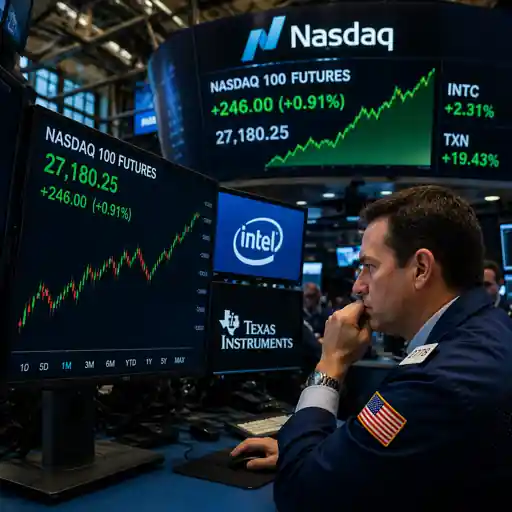
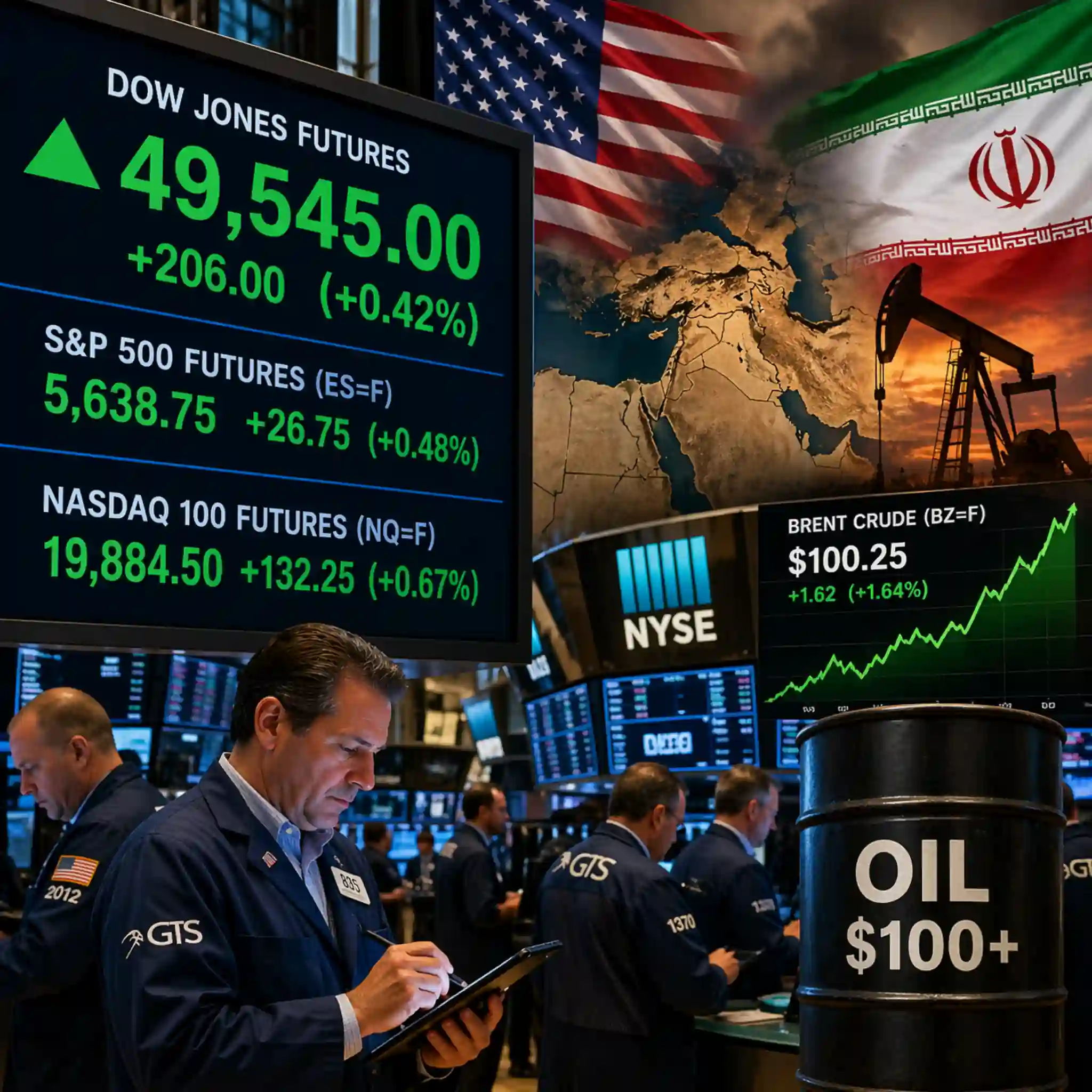
The Dow Jones Industrial Average fell sharply on Thursday, extending a volatile week on Wall Street as investors pulled back from risk-heavy trades. By midday trading, the Dow was down more than 400 points, while the Nasdaq Composite slid for a third straight session, marking its steepest three-day decline since April 2025. The sell-off comes as mounting concerns over artificial intelligence spending, weakening labor data, and falling cryptocurrency prices converge into a broad risk-off move across U.S. markets.
According to live market data, the Dow traded near 49,075, down roughly 0.8% on the day, after touching session lows close to a 700-point drop. The S&P 500 and Nasdaq were each down about 0.8%, with the Nasdaq briefly falling nearly 2% at its weakest levels. Technology stocks once again led declines as investors reassessed valuations tied to artificial intelligence growth and future profitability.
📉 U.S. Market Snapshot — Midday
Dow Jones Industrial Average: 49,075.87 (−425 points, −0.86%)
S&P 500: 6,816.43 (−0.96%)
Nasdaq Composite: 22,655.03 (−1.09%)
VIX volatility index climbed above 22, its highest level since November.
Pressure intensified after Alphabet projected a sharp increase in artificial intelligence spending, unsettling investors already uneasy about returns on massive AI capital expenditures. Alphabet shares fell around 5%, while Qualcomm slid more than 7% after issuing a weaker-than-expected forecast tied to a global memory shortage. The turbulence has triggered aggressive selling across software and chip stocks, pushing a key software ETF into bear-market territory after eight consecutive losing sessions.
Despite the broader weakness, not all AI-linked names moved lower. Shares of Broadcom rose nearly 4%, while Nvidia edged higher, suggesting investors are becoming more selective rather than abandoning the artificial intelligence theme outright. Market strategists noted that discerning winners and losers may ultimately support healthier market dynamics after months of near-unchecked exuberance.
Beyond equities, risk assets continued to unravel. Bitcoin dropped below $67,000, breaking what many traders viewed as a critical psychological support level. Silver prices plunged as much as 16% during the session, extending an extraordinary stretch of volatility that has erased nearly a third of the metal’s value since last week. Gold also fell despite its traditional role as a safe haven, underscoring the depth of the current deleveraging cycle.
Adding to investor unease, new labor market data painted a weakening economic picture. U.S. employers announced more than 108,000 layoffs in January, the highest total for that month since the global financial crisis. Job openings fell to their lowest level since September 2020, while initial jobless claims rose more than expected, reinforcing fears that the labor market is finally cracking after years of resilience.
These developments arrive ahead of the delayed January jobs report from the Bureau of Labor Statistics, now expected next week following the recent government shutdown. Investors are increasingly debating whether softening labor conditions could push the Federal Reserve toward earlier interest rate cuts, potentially as soon as March or April, if economic momentum continues to fade.
Market sentiment indicators reflect growing anxiety. The CBOE Volatility Index surged more than 20%, while momentum-focused ETFs suffered their worst sessions since early April. Retail trading data suggests investors are selectively buying dips in mega-cap technology while stepping away from crypto, semiconductors, and precious metals, signaling a cautious recalibration rather than panic-driven liquidation.
Wall Street’s current challenge lies in determining whether the Dow Jones pullback represents a temporary correction after record highs or the early stages of a deeper repricing driven by slowing growth, elevated valuations, and uncertainty around artificial intelligence returns. With earnings season ongoing and macro data turning less supportive, volatility is likely to remain elevated as markets search for a clearer direction.
Live market coverage and intraday updates on today’s Dow Jones sell-off can be followed through CNBC’s live markets feed, where traders are closely tracking labor data, AI earnings fallout, and shifts in Federal Reserve expectations.

Make Swikblog your go-to source on Google for reliable updates, smart insights, and daily trends.