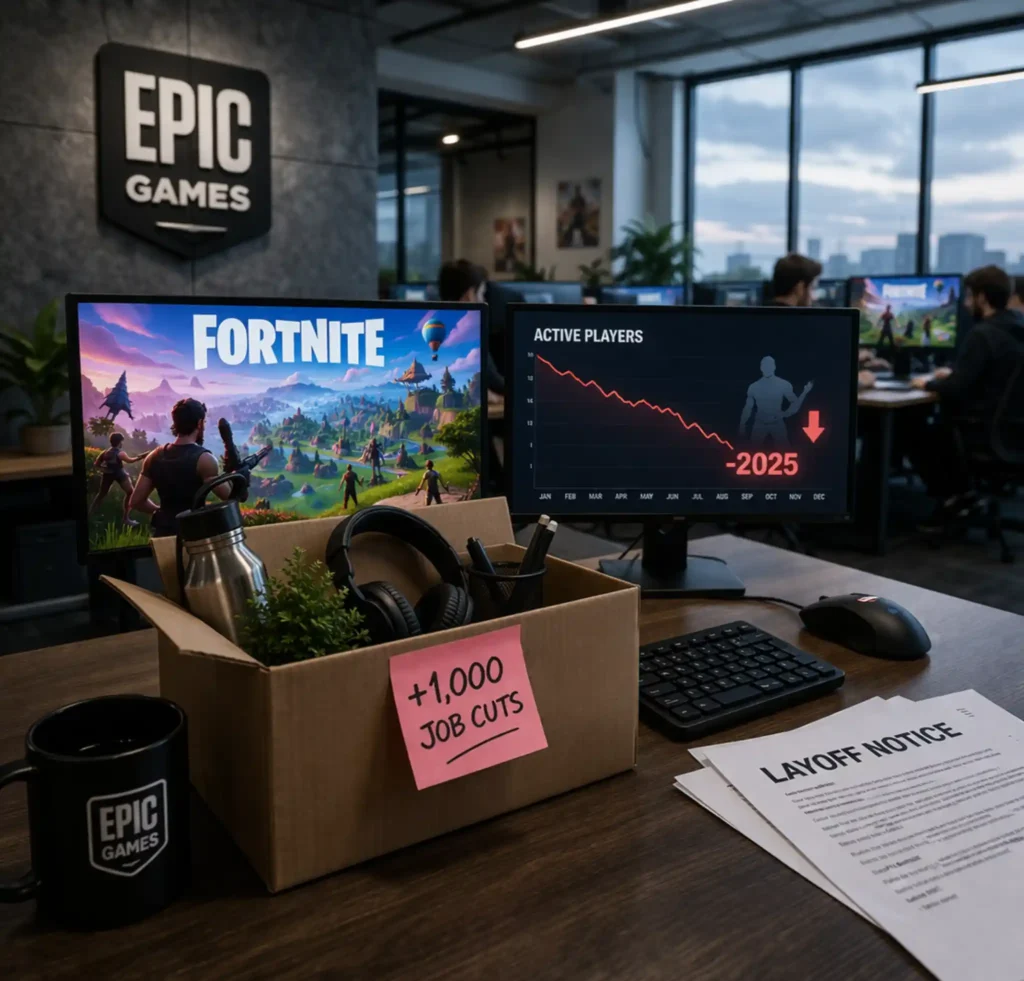

Epic Games is cutting more than 1,000 jobs after a sharp decline in Fortnite usage left the company spending far beyond what it was bringing in, according to comments shared by chief executive Tim Sweeney with employees on Tuesday, March 24. The move marks one of the most significant rounds of layoffs in the gaming sector this year and signals a major financial reset at the company behind one of the world’s best-known video game franchises.
The decision is especially striking because Fortnite has been more than just a successful title for Epic Games. It has served as the company’s biggest traffic engine, one of its strongest revenue pillars, and a central part of its broader entertainment and creator ecosystem. But once player usage began to fall in 2025, the economics behind that model became much harder to sustain.
In his message to staff, Sweeney said Epic had been spending “significantly more than we’re making” since Fortnite usage started to decline last year. That line captures the seriousness of the company’s position. This was not framed as a small operational adjustment or a temporary trim. It was presented as a response to a widening gap between costs and revenue, driven by weakening engagement in Epic’s flagship game.
Fortnite slowdown hits the company’s core business
Fortnite has been one of the defining digital entertainment products of the last decade, blending gaming, online community, live events, creator tools and branded collaborations in a way few other titles have matched. For years, that gave Epic a powerful commercial base. But the company is now facing the downside of relying so heavily on one dominant hit.
Once usage began to slide in 2025, Epic’s financial pressure appears to have intensified quickly. Lower player engagement can affect everything tied to a live-service title, from in-game purchases and seasonal participation to brand partnerships, creator activity and broader expectations around future growth. When that happens, a company built around scale can suddenly find that its spending levels no longer match demand.
The layoffs suggest Epic now sees that mismatch as serious enough to require sweeping action. Cutting more than 1,000 roles is not a marginal change. It is a sign that the company believes the fall in Fortnite activity is meaningful enough to reshape its operating structure.
More than $500 million in savings targeted
The job cuts are only one piece of Epic’s wider cost-reduction plan. Sweeney said the layoffs, together with more than $500 million in savings from other measures, would help reduce the company’s costs. That additional savings target is expected to come from cuts to contracting, lower marketing spending, and leaving roles unfilled.
Those details matter because they show Epic is not relying on layoffs alone. The company is pulling multiple levers at the same time in an attempt to bring expenses under control. Contracting reductions point to tighter use of outside support. Marketing cuts suggest a more cautious spending approach around growth and promotion. Leaving roles unfilled signals that Epic is freezing or slowing hiring rather than immediately replacing departures across the business.
Taken together, these actions reflect a company moving away from aggressive expansion and toward discipline. They also indicate that the gap between revenue and spending was large enough to require a broader restructuring, not just a one-off workforce reduction.
As reported by Reuters, Epic linked the cost-cutting program directly to the decline in Fortnite usage and to the company’s need to lower spending after operating above its means.
A major reality check for Epic Games
Epic has long been viewed as one of the gaming industry’s boldest companies, helped by Fortnite’s global popularity and the wider influence of its game development ecosystem. That reputation made the latest announcement more jarring. A company associated with scale, ambition and cultural reach is now publicly acknowledging that its finances were under strain after usage in its biggest product softened.
The language used by Sweeney also gives the layoffs a more urgent tone. By telling employees that Epic had been spending significantly more than it was making, he was not presenting the situation as a soft slowdown. He was describing a deeper imbalance. For investors, workers and industry observers, that signals that Fortnite’s slowdown has had a direct and material impact on Epic’s internal planning.
This matters beyond one company. The gaming business has become increasingly dependent on long-running live-service models that require constant updates, marketing, support teams and content investment. That structure can work extraordinarily well while engagement remains high. But when player attention shifts, the fixed costs of maintaining those ecosystems can become a major burden.
Why this moment matters for the industry
Epic’s move is likely to be read as a warning sign across the broader games sector. It shows that even the biggest titles are not guaranteed to hold their audience forever, and that large-scale entertainment platforms can still face abrupt financial pressure when usage weakens. The company’s decision to combine layoffs with savings from contracting, marketing and unfilled roles shows how seriously management is treating the situation.
For Epic, the next chapter will depend on whether it can steady Fortnite, manage costs more effectively and keep its broader ecosystem attractive to players, creators and partners. The company still has enormous brand value and deep influence in digital entertainment. But this round of layoffs makes clear that past success is no protection when the numbers start moving in the wrong direction.
More than 1,000 jobs are being cut, more than $500 million in additional savings are being targeted, and Fortnite’s 2025 usage decline is now reshaping one of gaming’s biggest companies. That combination makes this one of the defining gaming business stories of 2026 so far.
Investors tracking sharp moves in small-cap and healthcare names may also like EnVue Medical Feed Stock Jumps 35% After Hospital Deal, another stock story that highlights how corporate updates can quickly reshape market sentiment.

Make Swikblog your go-to source on Google for reliable updates, smart insights, and daily trends.