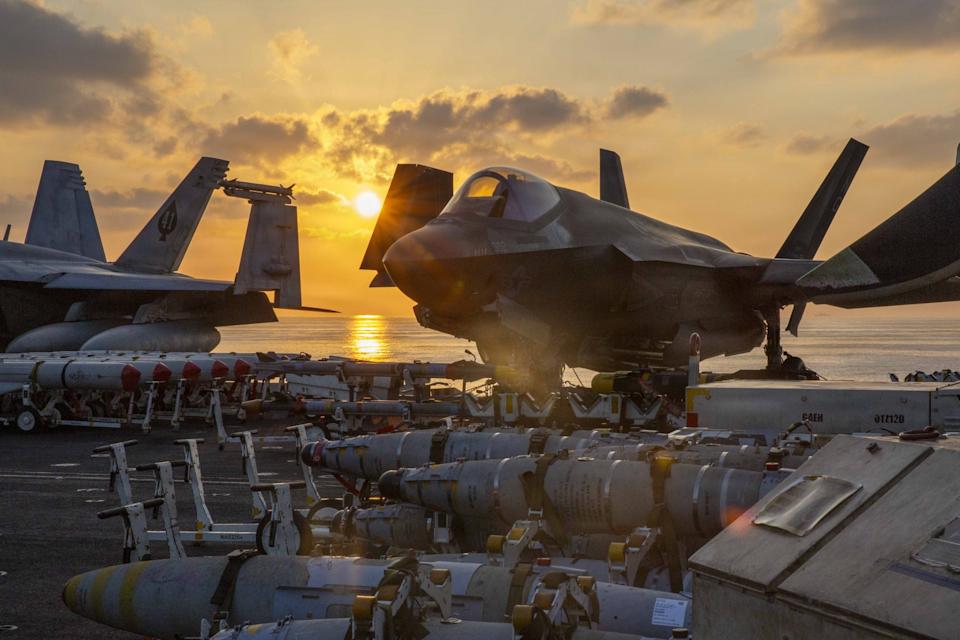

The F-35 stealth fighter was designed to dominate the skies through advanced sensors, networking, and powerful onboard software. But a new Pentagon testing report suggests the jet’s most critical modernization effort has stalled — even as US forces deploy the aircraft on missions linked to Iran.
The annual report from the Pentagon’s operational testing office found that attempts to deliver upgraded software for the F-35 fighter “stagnated” last year. The findings raise new concerns about the readiness and long-term capability of the United States’ most expensive weapons program.
Despite the software setbacks, Marine Corps F-35 jets continue to operate from the USS Abraham Lincoln aircraft carrier in missions tied to regional tensions involving Iran. Those aircraft, however, are running an earlier generation of software that lacks the capabilities expected in the next wave of upgrades.
Pentagon report says F-35 software upgrades stalled
The Pentagon testing office said the F-35 program showed “no improvement” in meeting schedules and performance timelines for developing and testing software upgrades. According to the report, the process of fixing deficiencies while adding new capabilities has effectively stagnated.
At the center of the problem is the program’s Technology Refresh-3 upgrade, commonly known as TR-3. The update is intended to modernize the jet’s computing architecture and enable future combat capabilities under the Block 4 upgrade roadmap.
However, testers said the TR-3 software was “predominately unusable” during most of the past year. Stability problems, capability shortfalls, and ongoing discovery of technical deficiencies prevented the system from operating reliably during testing.
Because of these issues, no new combat capability was delivered for the aircraft in the past year.
Jets flying missions still rely on older TR-2 software
The Marine Corps F-35 jets currently flying from the USS Abraham Lincoln are equipped with an earlier configuration known as TR-2. That software version lacks the additional computing power and expanded mission capabilities expected from the delayed TR-3 upgrade.
This means aircraft already flying real missions are not yet benefiting from the modernization features originally planned for the program.
The F-35 is often described as a “flying computer,” containing more than 20 million lines of code that control sensors, weapons integration, targeting systems, and communication networks. Because of this design, software upgrades are central to the aircraft’s combat effectiveness.
The upgrades under development would allow the fighter to carry more sophisticated weapons, improve targeting accuracy, strengthen communication with other aircraft and ground forces, and enhance cybersecurity defenses.
TR-3 promises massive computing upgrades
TR-3 is not a routine update. It represents a major overhaul of the aircraft’s digital infrastructure.
According to program details, the upgrade is designed to increase the F-35’s processing power by 37 times and expand onboard memory capacity by roughly 20 times compared with the jet’s current systems.
This computing leap is critical because it supports the next phase of F-35 development known as Block 4. That phase includes new weapons integration, advanced electronic warfare capabilities, improved sensor performance, and broader battlefield networking.
Without the TR-3 foundation, those planned upgrades cannot be fully implemented.
Cybersecurity testing also lagging
The Pentagon report also raised concerns about incomplete cybersecurity testing for the aircraft.
Of the nine planned cyber vulnerability tests for the F-35, only three were completed during the past year. Officials said the shortfall was caused primarily by a significant reduction in personnel and shifting funding priorities within the program office.
Even during the limited testing that did occur, additional deficiencies were discovered.
The remaining cybersecurity evaluations are expected to continue this year, but the delays highlight the growing complexity of securing modern military aircraft whose systems rely heavily on digital networks and software.
Staff cuts at Pentagon testing office add pressure
The testing challenges come after Defense Secretary Pete Hegseth reduced staffing at the Pentagon’s operational testing office last year.
The office produces the annual congressionally mandated report assessing major weapons systems including the F-35.
Reduced staffing may complicate the testing and oversight process at a time when the program is already facing schedule pressure and technical hurdles.
$2 trillion fighter program under scrutiny
The F-35 remains the most expensive weapons system in US history. The United States plans to purchase 2,470 aircraft for the Air Force, Navy, and Marine Corps.
Total program costs are estimated to exceed $2 trillion over the aircraft’s lifetime.
That figure includes roughly $485 billion in development and procurement spending and at least $1.5 trillion in long-term operations and sustainment costs over about 77 years.
As of September 30, a total of 812 F-35 jets had been delivered to US military forces.
The program is led by Lockheed Martin, which is responsible for developing the aircraft and delivering its evolving software architecture.
Modern warfare increasingly depends on software
The delays highlight a broader challenge facing modern defense systems. Unlike earlier generations of fighter aircraft, the F-35’s performance is closely tied to software development cycles.
Upgrades are expected to be delivered through an agile development framework intended to rapidly add capabilities and resolve technical problems.
But the Pentagon testing office said the program has struggled to deliver reliable, fully functional software in time for rigorous combat testing before installation on operational aircraft.
If modernization continues to lag, it could slow the rollout of new combat capabilities across the expanding global fleet of F-35 fighters operated by the US and its allies.
More details on the aircraft and its modernization roadmap can be found on the official F-35 program overview and the US Government Accountability Office reports reviewing the program’s cost and performance.
You may like

Make Swikblog your go-to source on Google for reliable updates, smart insights, and daily trends.