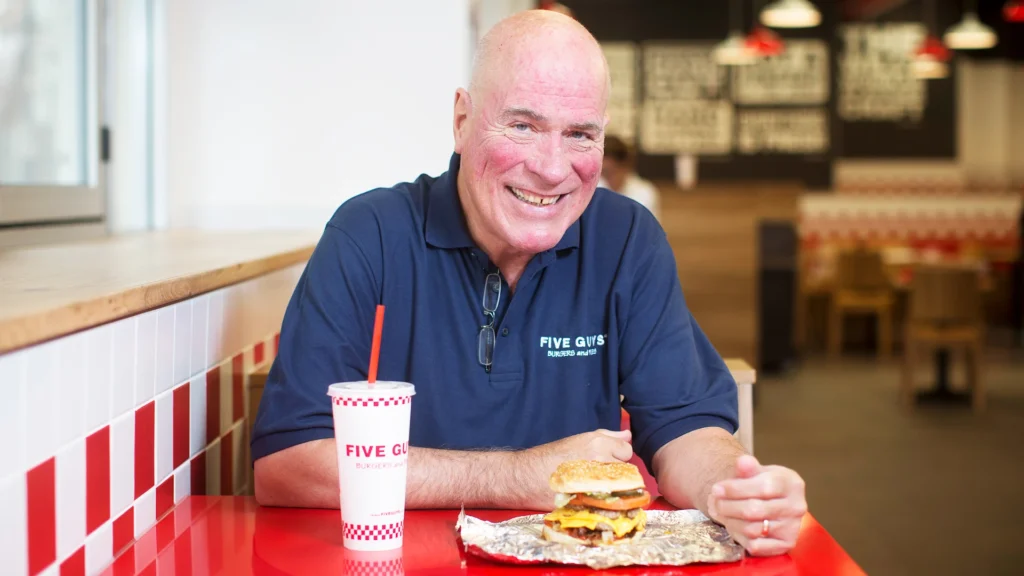

Five Guys founder Jerry Murrell is back in the spotlight after a birthday promotion meant to celebrate the chain’s 40th anniversary spiraled into a nationwide operational mess—and ended with a $1.5 million bonus payout that few restaurant leaders would have made.
The fast-food chain’s buy-one-get-one-free burger deal on February 17 drew an overwhelming response, leaving crews across the country scrambling to keep up. Some stores ran out of food, some had to close early, and customers also faced online and app ordering problems that made redeeming the offer even harder. What began as a milestone celebration quickly became one of the company’s most chaotic promotional rollouts in recent memory.
But instead of limiting the response to a corporate apology, Murrell chose a far more expensive and far more personal fix. He distributed about $1.5 million in bonuses to Five Guys store workers after the failed promotion overwhelmed staff, a move that instantly turned a brand misstep into a story about crisis leadership, accountability, and employee loyalty.
The Five Guys birthday BOGO deal that went wrong
Five Guys launched the one-day BOGO burger offer on February 17 to mark its 40th birthday. The company expected strong traffic, but not the kind of demand that followed. According to the company’s apology, the promotion “spread far beyond what we anticipated,” putting store teams in an extremely difficult position.
The surge exposed multiple pressure points at once. Locations ran low on product, lines built up quickly, and digital systems were unable to support the volume smoothly. In some places, stores shut down early because they simply could not keep up with the flood of orders. For customers, it was frustrating. For employees working grills, registers, and pickup counters, it was exhausting.
Murrell later admitted he was stunned by the scale of the response. He said he never believed BOGO deals worked that well, then watched this one take off in a way the company had not planned for. That disconnect between promotion and preparation is exactly what turned a celebratory campaign into a full-blown headache.
Jerry Murrell’s $1.5 million bonus decision
Rather than treating the disaster as just another marketing error, Murrell focused on the people who absorbed the damage in real time: store crews. He said he wrote checks covering roughly 1,500 employees, which worked out to about $1,000 each. That pushed the total to around $1.5 million.
Murrell’s explanation was blunt, honest, and memorable. He joked that he did not want anyone “shooting me in the back” after how badly the first day went, openly admitting the company had messed it up. He also delivered the quote that made the story travel even faster online: he said he was going to buy his wife a new fur coat, but spent the money on the employee bonus instead.
His wife, he joked, still looks at him like he is stupid. He, however, said it was worth it because the workers were hit so hard by the chaos. That quote gave the story something modern viral business news thrives on: a sharp money figure, a founder with personality, a failed promotion, and an emotional payoff centered on workers.
Why employees were stunned
There are plenty of brand apology stories. There are far fewer cases where a founder personally turns a bad promotion into a major financial thank-you for frontline staff. That is why the bonus resonated so strongly.
Employees were not just dealing with a busy shift. They were dealing with shortages, angry customers, app issues, and intense in-store pressure caused by a corporate campaign that exploded past expectations. In many businesses, that kind of strain is absorbed without any direct reward. Murrell’s move changed that.
Instead of asking workers to simply move on, he acknowledged their effort in the most tangible way possible: cash. That matters because it shifts the tone of the story from “Five Guys messed up” to “Five Guys messed up and then paid the people who carried the burden.”
Five Guys tried to fix the customer side too
The company did not stop with the bonuses. It also brought back the deal in a more controlled format, relaunching the promotion as a “40th Birthday After Party” that ran from March 9 through March 12. The idea was to spread demand over several days instead of forcing stores to handle everything in one burst.
That second rollout was positioned as Five Guys doing the promotion the right way. After admitting the original launch fell short, the company attempted to make good on the offer while giving locations a better operational chance to serve customers without repeating the same breakdowns.
You can read Five Guys’ official announcement about the relaunch here: Five Guys’ 40th Birthday After Party statement.
More than a promo failure
What makes this story bigger than a typical restaurant mishap is what it reveals about Murrell’s management style. He did not distance himself from the problem. He did not frame the issue as a one-off demand surprise and move on. He owned the mistake publicly and then spent real money to support the people most affected by it.
That response fits the broader image Five Guys has built over the years. The chain has emphasized community involvement and charitable giving, including donations tied to in-store community events and partnerships with nonprofit organizations. Murrell has also spoken about passing those values to future generations, with multiple members of his family involved in the business.
In that context, the bonus was not just damage control. It looked like a reflection of how he believes the company should operate when things go wrong.
Why this story is getting so much attention
The Five Guys story is spreading because it combines nearly every element that drives interest: a recognizable restaurant brand, a failed deal, a seven-figure number, a colorful founder quote, and an employee-first ending. It also lands at a time when consumers are paying close attention to how companies treat workers during high-pressure moments.
Murrell’s decision turned a promotion disaster into a brand character story. Yes, Five Guys underestimated demand. Yes, stores struggled. Yes, customers were frustrated. But the follow-through changed the narrative. Instead of becoming just another cautionary tale about a bad fast-food promo, it became an example of what visible accountability can look like.
Murrell summed it up best through action, not just words. He could have stopped at an apology. Instead, he put $1.5 million behind it.
For more reporting on Murrell’s comments and the employee bonus details, see USA TODAY’s coverage here: USA TODAY.
You may also like: Olympics 2028 Rule Shock: IOC Bans Transgender Athletes from Women’s Events Worldwide

Make Swikblog your go-to source on Google for reliable updates, smart insights, and daily trends.