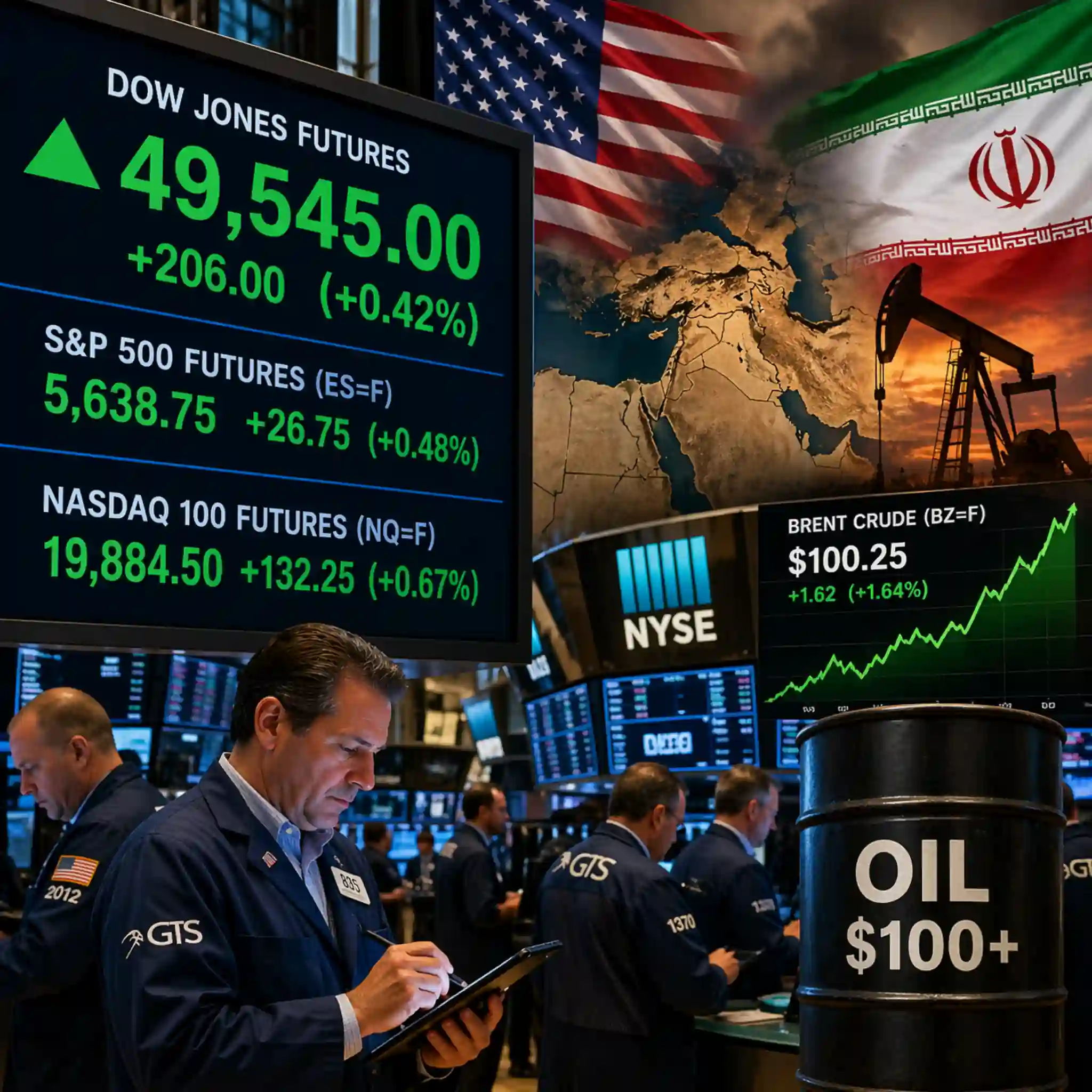
London stocks opened under pressure today as a renewed geopolitical shock hit risk appetite and pushed energy prices sharply higher. The FTSE 100 slid roughly 80 points in early trading to around 10,828, stepping back from last week’s close near 10,917 as investors moved quickly to reprice fuel costs, travel disruption and a potential inflation jolt.
The early tape looked like a classic cross-asset scramble: cyclicals and travel names down, banks weaker, defence and oil stronger, and safe-haven assets bid. The speed of the move mattered as much as the magnitude. When crude jumps in a single session, traders don’t wait for quarterly earnings to adjust assumptions — they adjust the discount rate, the margin outlook and near-term demand expectations in real time.
Oil spikes toward $80 as the risk premium returns
The biggest signal came from energy. Brent crude traded up close to 10% at points, sitting just under $80 a barrel, while US WTI climbed around 9% to just over $73. In the UK, natural gas was even more volatile, surging about 25% to roughly 98.5p per therm, a move that tends to ripple fast through inflation expectations and consumer confidence.
Traders focused less on immediate supply volumes and more on the price of uncertainty — insurance costs, rerouted shipping, and the risk of disruption at key transit lanes. Even without a sustained outage, the market can carry a higher premium for longer than equity investors expect, especially when energy is already higher versus recent months. Oil was described as up around 30% since last December, a backdrop that makes any fresh jump feel like a second shock rather than a one-off blip.
Gold and silver climb as investors hedge volatility
The defensive rotation spilled into precious metals. Gold rose more than 2%, trading above $5,400 an ounce and hovering not far from recent peaks, while silver pushed higher to roughly $95.4/oz. The move reinforced a broader theme: investors aren’t only hedging equity downside — they’re hedging the chance that energy-driven inflation proves sticky enough to complicate rate-cut expectations.
In that environment, the market’s attention shifts from “growth is cooling” to “policy flexibility is shrinking.” That’s why commodity spikes can feel disproportionately heavy for equities even if they don’t last: they change the conversation around inflation and rates quickly.
Travel and leisure lead decliners as fuel costs bite
On the FTSE 100, the pain concentrated in sectors directly exposed to higher fuel costs and disrupted travel corridors. British Airways owner IAG was the standout laggard, down close to 9.8% in early dealings. The selling reflected a double hit: rising jet fuel costs and a near-term demand question as travellers reassess routes and destinations.
Hotels and travel-linked names also fell sharply. InterContinental Hotels Group dropped around 5.3%, while other consumer-facing names traded lower as investors leaned away from discretionary spending risk. The market is not pricing an immediate collapse in demand; it’s pricing uncertainty, and uncertainty is expensive for travel operators because it shows up in forward bookings, pricing power and cancellation rates.
Banks slide as risk appetite fades
UK banks were also swept into the risk-off move. Several large lenders traded down more than 4% early on. The first-order read is positioning and sentiment — banks tend to be sold when volatility spikes — but there is also a macro layer. If higher energy prices lift inflation expectations, the policy path becomes harder to model, and credit risk can be repriced quickly even without a change in underlying loan performance.
That tension matters in the UK and Europe, where growth has looked sluggish. Energy costs behave like a tax. They pressure household budgets, squeeze smaller businesses and reduce the margin for error in already fragile demand.
Defence and oil majors provide a counterweight
The FTSE 100’s composition helped prevent a deeper slide. Defence names rallied strongly as investors rotated into companies aligned with higher security spending. BAE Systems surged about 7% in early London trading, pulling other defence-linked stocks higher as the market bet that procurement timetables could accelerate in a more unstable global environment.
Energy heavyweights also did their job. Shell and BP both rose more than 5% on the crude spike, helping offset losses elsewhere. This is one of the index’s defining features: when oil pops, the FTSE often finds support faster than markets dominated by sectors that are net consumers of energy.
Global markets turn defensive
The move in London fit a broader global pattern. Across Asia, major indices were down more than 2% in some cases, while US equity futures pointed lower, with Nasdaq futures indicated down around 1.8% and S&P 500 and Dow futures off roughly 1.5%. The combination of weaker futures and higher energy prices kept the tone cautious through the European morning.
The key point for investors is correlation. When equities, crude and gold all move sharply together, it usually signals positioning stress and headline sensitivity. That raises the odds of fast intraday reversals — especially if fresh updates soften the perceived risk to shipping and energy infrastructure.
UK housing stays steady as energy headlines dominate
Domestic UK data offered a steadier counterpoint. Nationwide reported annual house price growth holding at 1.0%, with prices up 0.3% month-on-month and the average home price at £273,176. The housing backdrop suggests a modest recovery tone compared with late 2025, even as investors weigh whether higher energy costs could eventually weigh on confidence and affordability. For the full data and commentary, see this Reuters report on Nationwide’s February house price reading.
Market focus shifts to volatility and spillover risk
For now, the market is trading the first-order effects: fuel costs, defensive positioning and the inflation impulse. If energy prices stabilise and transit routes remain functional, the most beaten-down travel names can rebound quickly and banks can retrace losses. If disruption broadens or insurance and shipping constraints tighten, the premium in crude and gas can stay embedded longer, keeping pressure on consumer and rate-sensitive sectors.
The FTSE’s internal tug-of-war is likely to stay visible: airlines, hotels and banks on one side; defence and oil on the other. With Brent near $80 and gold above $5,400, traders are treating this as a headline-driven week — one where positioning can shift fast, and where a single development can flip the market from fear to relief in a matter of hours.
You May Also Like

Make Swikblog your go-to source on Google for reliable updates, smart insights, and daily trends.