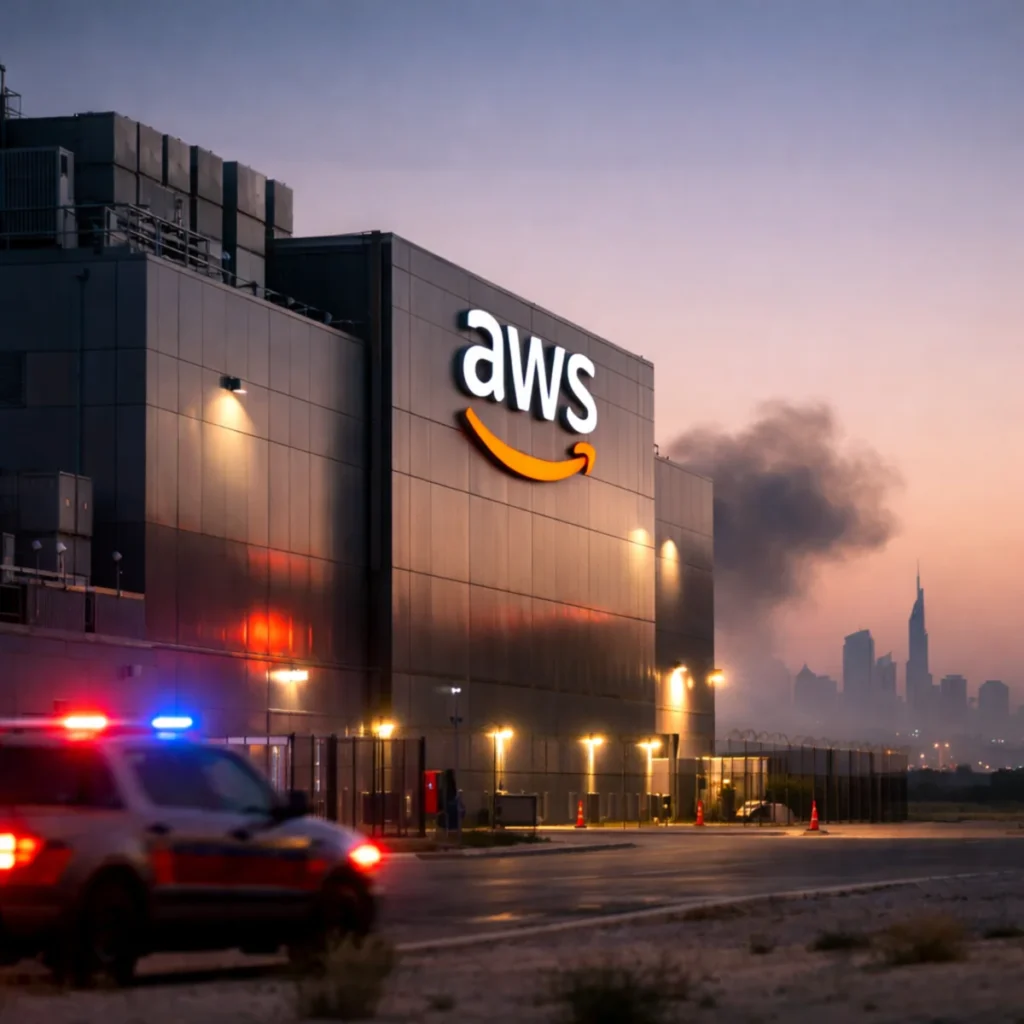

AWS suffered a disruption in the United Arab Emirates after an “objects” strike sparked a fire at one of Amazon’s data centers, forcing power to be cut while firefighters worked at the site. The incident landed at a tense moment for the Gulf, with the region absorbing a widening wave of missile and drone attacks tied to the rapidly escalating US–Iran conflict.
According to updates posted by Amazon Web Services, the disruption began around 4:30 p.m. Dubai time on Sunday and affected a single Availability Zone in AWS’s UAE region. The company said the facility was hit by objects that created sparks and ignited a fire, prompting the local fire department to shut off power to the building and backup generators as crews worked to extinguish the blaze.
Single-zone impact, regional ripple
AWS framed the incident as localized, emphasizing that other Availability Zones and regional groups of data centers were not impacted. The company said it was routing traffic away from the affected zone to reduce customer disruption, while warning that it did not have an estimated restoration time because it was still awaiting permission to safely restore power.
For cloud customers, the practical meaning of “one Availability Zone” can vary dramatically. Many modern applications are built to run across multiple zones, so a single-zone failure may register as a brief slowdown. But systems that were pinned to one zone or had incomplete failover protections can experience service interruptions that feel immediate to end users. In the Gulf, where AWS supports everything from retail and travel to fintech, logistics, and government workloads, even short outages can cascade into delayed transactions, disrupted booking flows, and degraded app performance.
Key details reported by AWS
- Incident involved objects striking the data center, causing sparks and a fire.
- Fire response required power and generators to be shut off during suppression efforts.
- AWS shifted traffic away from the impacted zone and said other zones were not affected.
- No firm restoration estimate was given at the time of the updates; customers were advised to rely on status communications via the AWS Health Dashboard.
Conflict backdrop intensifies infrastructure risk
While AWS did not confirm a link between the strike on the facility and the broader conflict, the timing raised immediate questions. The data-center fire occurred on a day when Iranian projectiles reportedly struck parts of the UAE as retaliation for US and Israeli strikes that killed Iran’s Supreme Leader Ayatollah Ali Khamenei and other senior officials. With the conflict spreading across the Middle East—touching US bases and allied countries—investors and business operators are suddenly reassessing the resilience of critical infrastructure that sits inside an active geopolitical theater.
Cloud data centers are designed with redundancy and layered security, but they are not immune to physical shocks. Even when the buildings themselves are hardened, power continuity remains a fragile point during emergency response. If local authorities require power-off conditions to manage a fire safely, the outage becomes less a “cloud” issue and more a straightforward physics problem: no electricity, no compute.
Amazon’s cloud scale, and the real-world limits of redundancy
AWS operates at immense global scale, with dozens of regions worldwide and a much larger count of Availability Zones. That breadth is supposed to give customers options: multi-zone architectures inside a region, or cross-region disaster recovery plans that can shift workloads if a geographic area becomes unstable.
Yet this event highlights a tension that cloud customers rarely feel until a crisis hits: the trade-off between performance and geographic diversity. Many companies prefer to keep workloads close to users for speed and compliance reasons, which can lead to regional concentration. In normal times, it makes perfect sense to run Gulf user traffic in the UAE region. In volatile times, that proximity can become an operational risk that boards and CIOs are forced to price in.
Market lens: AMZN attention on resilience and risk premium
For Amazon investors, the story is less about a single localized outage and more about the theme it represents. AWS has long been positioned as a dependable cash engine for Amazon, and stability is a key part of its brand promise. A disruption tied to physical impacts—especially amid geopolitical escalation—introduces a different class of risk than the routine software glitches markets have grown used to seeing.
In the near term, one Availability Zone going dark is unlikely to change Amazon’s fundamentals by itself. But the incident is a fresh reminder that cloud reliability is not purely technical. It’s also logistical, political, and physical—dependent on safe power access, secure supply lines for maintenance, and operational continuity within the host country.
Expect the next phase of the market conversation to center on customer behavior: whether companies accelerate multi-zone defaults, increase cross-region backups, or diversify critical workloads across multiple cloud providers. Those shifts don’t happen overnight, but moments like this are exactly what triggers new resilience spending—and changes the way risk is priced across the tech stack.
Read the original report on Yahoo Finance: https://finance.yahoo.com/news/amazon-cloud-suffers-outage-objects-041018117.html
You May Also Like
More breaking market and global news on Swikblog

Make Swikblog your go-to source on Google for reliable updates, smart insights, and daily trends.