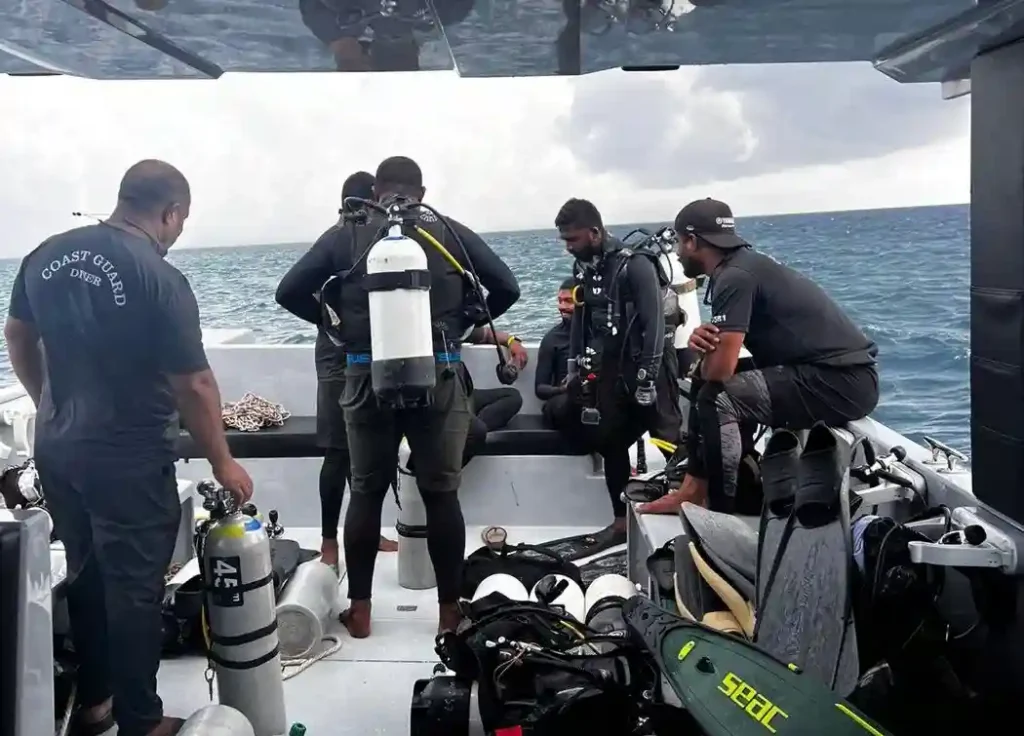

A deadly cave-diving accident in the Maldives has widened into a rescue tragedy after a Maldivian military diver died during efforts to recover four Italian victims believed to be trapped inside a deep underwater cave in Vaavu Atoll.
Staff Sergeant Mohamed Mahudhee, a member of the Maldives National Defence Force, was part of the specialist team searching the cave system near Alimathaa Island when he suffered decompression sickness after surfacing from the operation. He was taken to hospital in Malé in critical condition but later died, according to Maldivian officials cited by The Associated Press.
His death has underlined the extreme danger facing recovery teams, who are trying to reach victims believed to be inside a cave network at depths of about 50 to 60 metres. The Maldives’ recreational diving limit is 30 metres, meaning the dive went well beyond standard tourist-diving conditions and into a zone normally treated as technical diving.
The original accident happened on Thursday, when five Italian divers failed to return after entering an underwater cave. One body, identified in reports as diving instructor Gianluca Benedetti, was recovered near the cave entrance. Authorities believe the remaining four divers moved deeper into the cave and have not yet been recovered.
The Italian victims have been named as Monica Montefalcone, an ecology professor at the University of Genoa; her daughter Giorgia Sommacal; marine biologist Federico Gualtieri; researcher Muriel Oddenino; and diving instructor Gianluca Benedetti.
Montefalcone and Oddenino were in the Maldives for an official scientific mission connected to marine-environment monitoring and the study of climate-change effects on tropical biodiversity. The University of Genoa, however, said the dive in which the accident occurred was a private activity and was not part of the scheduled research work. The university also said Sommacal and Gualtieri were not involved in the official scientific mission.
Why the recovery operation is so difficult
The search is not a simple underwater recovery. Italian officials said the cave is divided into three large chambers linked by narrow passages. Teams had already explored two chambers, but the mission has been slowed by oxygen limits, decompression planning and rough weather around the search area.
In cave diving, the route back to safety is often as dangerous as the route in. Divers cannot make a direct emergency ascent if they run into trouble because rock overhead blocks the path to the surface. Low visibility can also become a major problem when sediment is disturbed inside a chamber, turning clear water cloudy within moments.
At depths around 50 metres, divers must also manage breathing gas, time underwater and staged decompression during ascent. A mistake or emergency at that depth can rapidly become fatal. Mahudhee’s death from decompression sickness shows that even trained military personnel working under a recovery plan remain exposed to serious risk.
Maldives presidential spokesperson Mohamed Hussain Shareef said the death showed the difficulty of the mission. Mahudhee had reportedly been among those involved in planning the search and briefing President Mohamed Muizzu when he visited the site on Friday.
Two Italian specialists, including a deep-sea rescue expert and a cave-diving expert, are expected to assist the recovery operation. Italy’s foreign ministry has also said it is coordinating with Divers Alert Network, a recognised diving safety organisation, to support the mission and help with the repatriation of the bodies.
MV Duke of York suspended as officials investigate
The Maldives Ministry of Tourism and Civil Aviation has suspended the operating licence of the liveaboard vessel MV Duke of York, from which the group had been diving, while authorities investigate the incident.
The vessel is a luxury liveaboard used for dive trips in the Maldives. Around 20 other Italians who were on the same expedition were reported safe, while Italy’s embassy in Colombo has been assisting those onboard. The Red Crescent also offered support for psychological aid after the accident.
Read More
- Visit Swikblog Homepage
- Puffins Found Dead After Deadly Storms as Breeding Season Begins
- Belfast Plants 293,516 Trees Under 1 Million Trees Initiative
- Hackney Half Marathon 2026 Road Closures: East London Streets Shut
- Kingston Power Outage Leaves 13,432 Customers Affected
- NTSB Wimberley Plane Crash Report: 5 Killed
Investigators are expected to look closely at why the group entered a cave at a depth beyond the country’s recreational diving limit, what safety procedures were in place, what equipment was used and whether the dive was properly authorised for the conditions.
The case has also raised difficult questions for the Maldives tourism sector. The country is one of the world’s best-known destinations for marine tourism, with visitors drawn to its reefs, liveaboard boats and clear-water diving. But this accident highlights the difference between normal holiday diving and advanced cave or deep diving, where specialist training and strict protocols are essential.
Tourism-related water incidents often unfold quickly when weather, currents, depth or location make rescue difficult. Swikblog has reported similar safety concerns in other destinations, including a tourist drowning at Indijup Natural Spa near Yallingup and a Fiji cruise ship reef accident near the Cast Away island, both of which showed how remote beauty spots can become dangerous when conditions change.
For the families of the Italian victims, the priority now is recovery and repatriation. Italian Foreign Minister Antonio Tajani said authorities would do everything possible to bring the victims home, while officials remain in contact with their relatives.
For the Maldives, the loss of Mahudhee has added a national dimension to the disaster. He died while trying to retrieve victims from a hazardous underwater environment, a task that demanded repeated exposure to the same risks that had already claimed the original divers.
The full cause of the Italian divers’ deaths remains under investigation. Until recovery teams can complete their work inside the cave, officials may not know exactly what happened in the final moments of the dive. What is already clear is that the accident has become a stark warning about the limits of recreational diving and the dangers of entering overhead underwater environments without the highest level of planning, training and control.

Make Swikblog your go-to source on Google for reliable updates, smart insights, and daily trends.