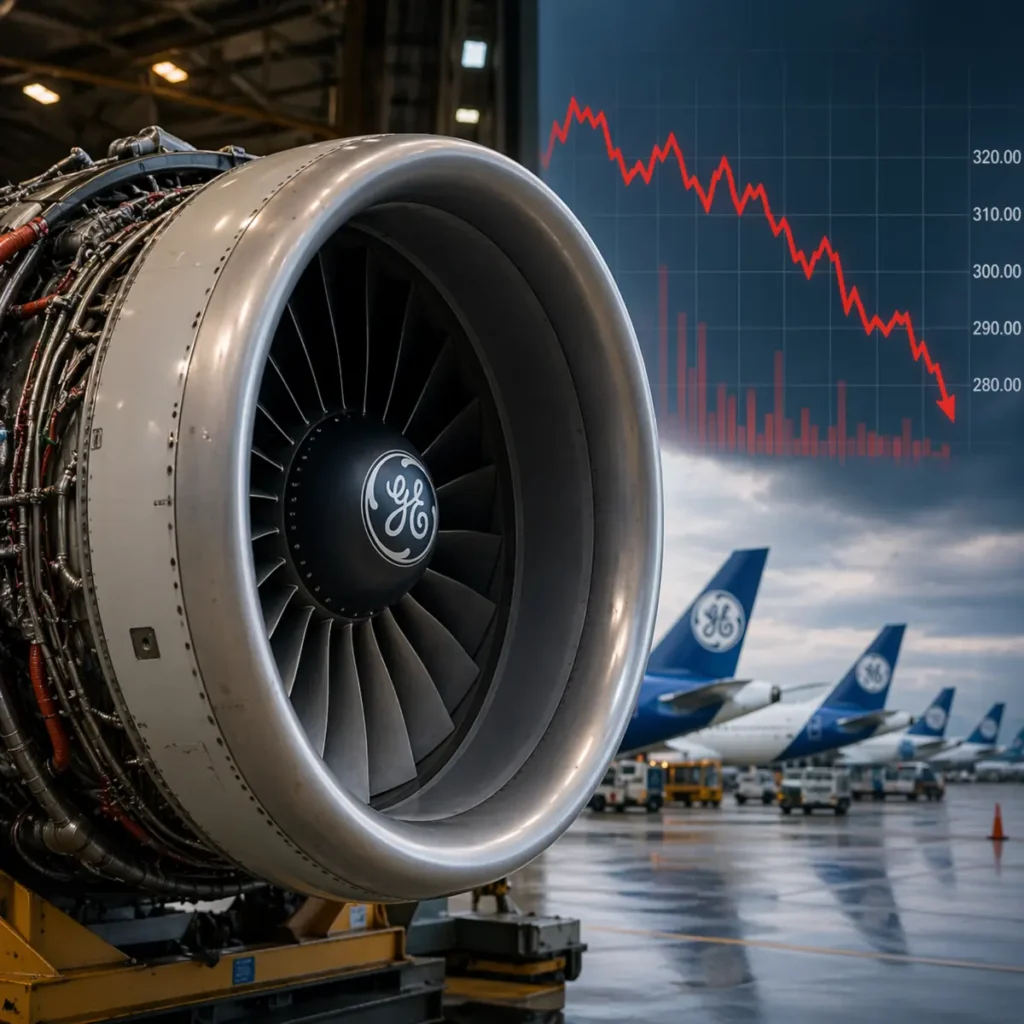

GE Aerospace stock pulled back sharply in early trading, sliding nearly 4% to around $291, even as the company delivered a powerful first-quarter earnings beat that outpaced Wall Street expectations across nearly every major metric. The reaction highlights a key shift in investor behavior: strong results alone are no longer enough when expectations are already elevated.
The aerospace giant reported adjusted earnings per share of $1.86, significantly above the $1.60 consensus estimate. Revenue performance was equally strong, with adjusted revenue reaching $11.61 billion, topping expectations of $10.71 billion. On a GAAP basis, revenue climbed to $12.4 billion, marking a 25% year-over-year increase, while adjusted revenue surged 29%.
At first glance, this was a textbook “beat-and-raise” style quarter — the kind that typically drives momentum stocks higher. Instead, the decline suggests investors are digging deeper into the underlying trends, particularly margins, forward assumptions, and macro risks.
Explosive demand and orders reinforce growth narrative
The most compelling part of GE Aerospace’s earnings report was the sheer strength in demand. Total orders reached $23 billion, representing an extraordinary 87% year-over-year increase. That surge reflects strong activity in commercial aviation, especially in engine maintenance and long-term service agreements.
Commercial engine services demand alone jumped 39%, driven by global airline activity and continued fleet utilization. GE secured major agreements during the quarter with American Airlines, United Airlines, and Delta Air Lines, covering more than 650 engines. These deals are critical because service contracts generate recurring, high-margin revenue over long periods.
The company also strengthened its European presence through a long-term materials agreement with Ryanair, adding further depth to its customer base. These strategic wins continue to reinforce GE Aerospace’s dominance in the global aviation services ecosystem.
Perhaps the most important long-term indicator remains backlog. GE Aerospace reported a commercial services backlog exceeding $170 billion, while total backlog surpassed $210 billion. For investors, backlog acts as a forward-looking revenue pipeline, offering strong visibility into future earnings.
Profit growth remains solid, but margin pressure emerges
Despite strong top-line performance, the key concern for investors appears to be margin compression. Adjusted operating profit rose to $2.5 billion, up 18% year over year, while GAAP net profit reached $2.2 billion. However, adjusted operating margin came in at 21.8%, down 200 basis points compared to last year.
This decline suggests that while GE Aerospace is growing rapidly, it is facing cost pressures or mix-related challenges that are limiting profitability expansion. In a high-expectation environment, margin direction often matters more than absolute earnings growth.
Cash generation remained a bright spot. Cash from operating activities rose to $1.9 billion, an increase of 21%, while free cash flow reached $1.7 billion, up 14%. Strong cash flow supports the company’s ability to reinvest in growth, return capital, and maintain balance sheet strength.
Valuation debate starts to take center stage
With the stock still trading at a trailing P/E ratio of around 36x, GE Aerospace is priced more like a high-growth technology company than a traditional industrial name. That premium valuation has been supported by strong execution, improving margins, and the structural growth story in aerospace services.
However, when valuation expands to these levels, expectations become significantly harder to beat. Even a strong earnings report can trigger selling if investors begin to question whether growth and margin expansion can continue at the same pace.
The market reaction suggests that some investors are reassessing whether the current valuation fully reflects potential risks, including cost inflation, supply chain constraints, and slower-than-expected aircraft utilization growth.
Macro and industry risks add to investor caution
Beyond company-specific factors, broader macroeconomic conditions are also influencing sentiment. Rising fuel costs, geopolitical tensions, and uncertainty around global travel demand are all variables that could impact airline activity — and, by extension, demand for engine services.
Investors are also closely watching aircraft departure growth, a key driver of maintenance demand. Any slowdown in global air traffic could directly affect service revenue growth, which is central to GE Aerospace’s business model.
These uncertainties are increasingly shaping how the market values aerospace stocks. Even companies delivering strong results are seeing more muted or negative reactions if forward visibility becomes less clear.
Management stays confident on full-year outlook
CEO H. Lawrence Culp Jr. struck a confident tone following the earnings release, emphasizing that the company is holding its full-year guidance and trending toward the high end of its range. He highlighted strong order growth, robust backlog, and continued demand in commercial aviation as key drivers supporting the outlook.
For investors looking to understand management’s perspective in detail, GE Aerospace’s official earnings webcast provides additional insights into demand trends and strategic priorities.
The long-term investment case remains intact. GE Aerospace continues to benefit from a powerful combination of recurring service revenue, global airline partnerships, and a massive installed base of engines. These factors create a durable competitive advantage that few industrial companies can match.
Still, the latest stock move underscores an important reality: when expectations are high, perfection becomes the benchmark. GE Aerospace delivered a strong quarter by most measures, but the market is now demanding more — particularly in margins and forward clarity. That shift in expectations is likely to define the stock’s next phase.

Make Swikblog your go-to source on Google for reliable updates, smart insights, and daily trends.