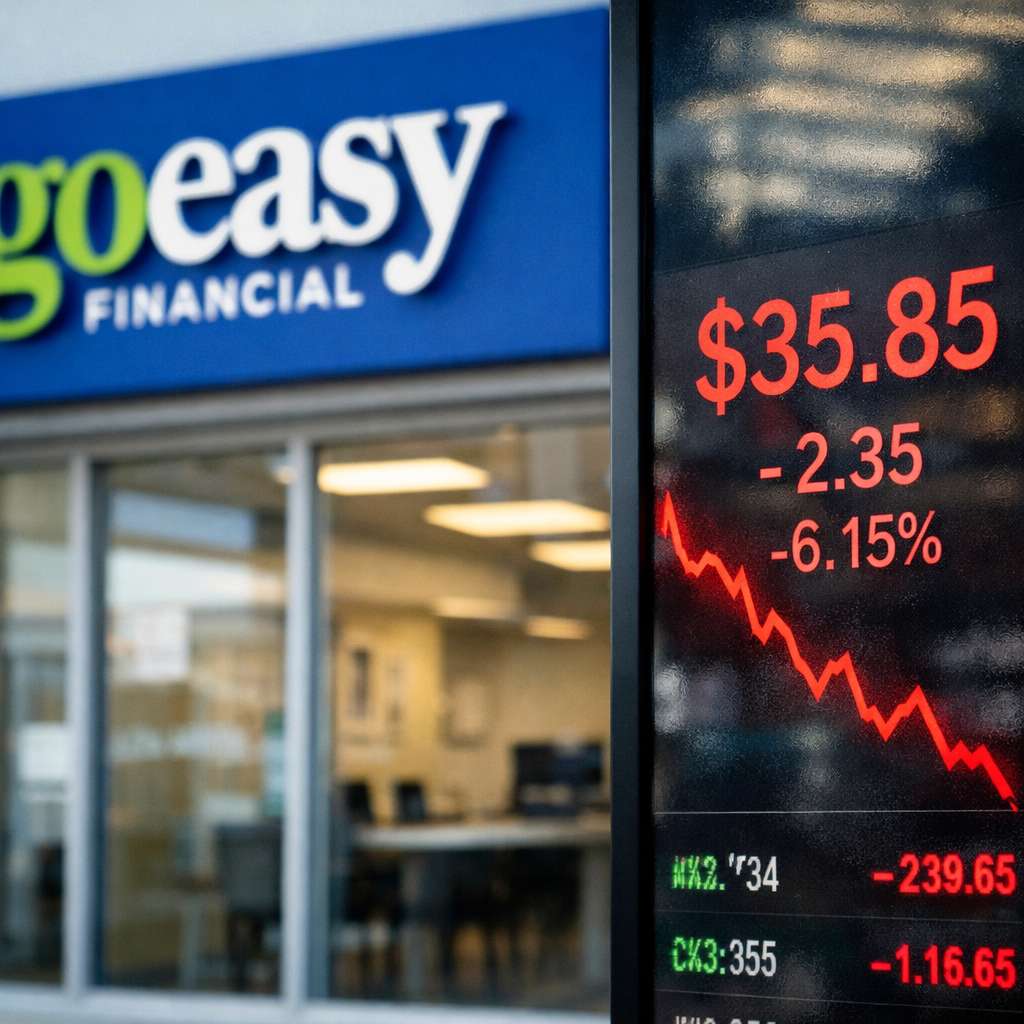

goeasy (GSY.TO) stock came under pressure after the Canadian non-prime lender reported a sharp fourth-quarter loss, triggering concerns around rising credit risk, accounting corrections and a sudden shift in capital strategy. The company’s latest update shows a business still growing on the surface, but facing significant stress underneath as defaults rise and profitability takes a hit.
The headline numbers tell the story. goeasy posted a net loss of $336.9 million in Q4 2025, a steep reversal from net income of $54.2 million in the same period a year ago. Diluted loss per share came in at $20.49, compared with earnings per share of $3.12 in Q4 2024. Even on an adjusted basis, the company reported a loss of $8.93 per share, down from adjusted earnings of $3.32. For investors, that swing from profitability to deep losses is the primary driver behind the stock’s decline.
What makes the situation more complex is that revenue itself held steady. goeasy generated $406.3 million in Q4 revenue, almost unchanged from $407.0 million a year earlier. Loan originations rose 17% year over year to $951.5 million, and the total loan portfolio reached $5.51 billion, up 20% from $4.60 billion. On paper, demand for credit remains strong, but the quality of that growth has come into question.
The biggest pressure point is credit performance. Net charge-offs surged to 23.8% of average gross consumer loans receivable in Q4, compared with just 9.2% a year ago. The spike was largely driven by the LendCare segment, where the company recognized $177.9 million in incremental late-stage loan charge-offs after determining recoveries were unlikely. Total net charge-offs for the quarter reached $331.1 million, highlighting a sharp deterioration in borrower repayment behavior.
In response, goeasy increased its allowance for credit losses significantly. The allowance rate rose to 9.57% at the end of 2025, up from 7.81% a year earlier. This reflects management’s expectation that elevated credit losses could persist, at least in the near term. For investors, rising provisions often signal that underlying credit conditions are worsening faster than anticipated.
Adding to the pressure, the company recorded a $159.6 million goodwill impairment related to its LendCare business. This non-cash charge effectively wipes out a large portion of the value previously assigned to that segment and raises questions about the long-term returns from the acquisition. Combined with higher bad debt expenses, which jumped to $418.5 million in the quarter, operating performance deteriorated sharply. goeasy reported an operating loss of $283.3 million, compared with operating income of $138.3 million in Q4 2024.
Another key issue weighing on sentiment is the correction of prior financial statements. The company disclosed errors related to the accounting treatment of certain customer payments in transit and restated its 2024 financials. While the updated figures have now been incorporated, restatements tend to undermine investor confidence and increase scrutiny around internal controls and reporting quality.
The impact of these developments is also visible at the full-year level. For 2025, goeasy reported total revenue of $1.70 billion, up 10.5% from $1.53 billion in 2024. However, profitability declined sharply. Operating income fell to $188.3 million from $584.0 million, and the company reported a full-year net loss of $178.4 million, compared with net income of $264.2 million the previous year. Adjusted net income dropped significantly to $50.1 million from $271.3 million, while adjusted earnings per share fell to $3.03 from $15.62.
Balance sheet trends also reflect growing pressure. Total assets increased to $5.76 billion, but shareholder equity declined to $850.4 million from $1.18 billion, driven by losses and impairments. The company’s leverage remains elevated, with a debt-to-adjusted tangible equity ratio of 4.81x. While goeasy reported liquidity of up to $983 million, a large portion of that is not immediately available, which reinforces the importance of careful capital management.
That concern is reflected in management’s decision to suspend the quarterly dividend and halt share repurchases indefinitely. These moves signal a clear shift in priorities toward preserving liquidity and maintaining financial flexibility during what the company describes as a “transitional period.” For many investors, especially income-focused holders, the dividend suspension is a significant negative signal.
To stabilize its financial position, goeasy has also amended key financing arrangements. The company secured covenant waivers and revised terms across its credit facilities, including adjustments to borrowing limits and higher pricing on debt. While these agreements ensure continued access to funding, they also come with tighter conditions and increased costs, which could weigh on future margins.
Management has outlined a reset strategy for 2026, focusing on tightening underwriting standards, improving credit performance, and aligning its capital structure. The company expects its loan portfolio to decline in the near term before returning to growth in the second half of the year. Net charge-offs are projected to improve to a range of 17.5% to 18.5% for full-year 2026, down from the elevated levels seen in Q4 2025.
Cost control is also part of the plan. goeasy implemented a workforce reduction affecting about 9% of employees, which is expected to deliver approximately $30 million in annual savings. Leadership changes have also taken place, with a new CEO and CFO stepping in to guide the company through this period of restructuring.
Despite the challenges, some structural positives remain. The company continues to see strong demand for non-prime credit, and its loan book has expanded meaningfully. However, the near-term outlook will depend heavily on whether credit losses stabilize and whether management can rebuild investor confidence after a quarter marked by losses, restatements and strategic shifts.
For investors tracking the stock, more details can be found in the official earnings release, while live price updates and market reaction are available on Yahoo Finance.
You may also like: Tesla Stock Surges 203% in Europe Sales — But Rising Risks Keep Investors Cautious

Make Swikblog your go-to source on Google for reliable updates, smart insights, and daily trends.