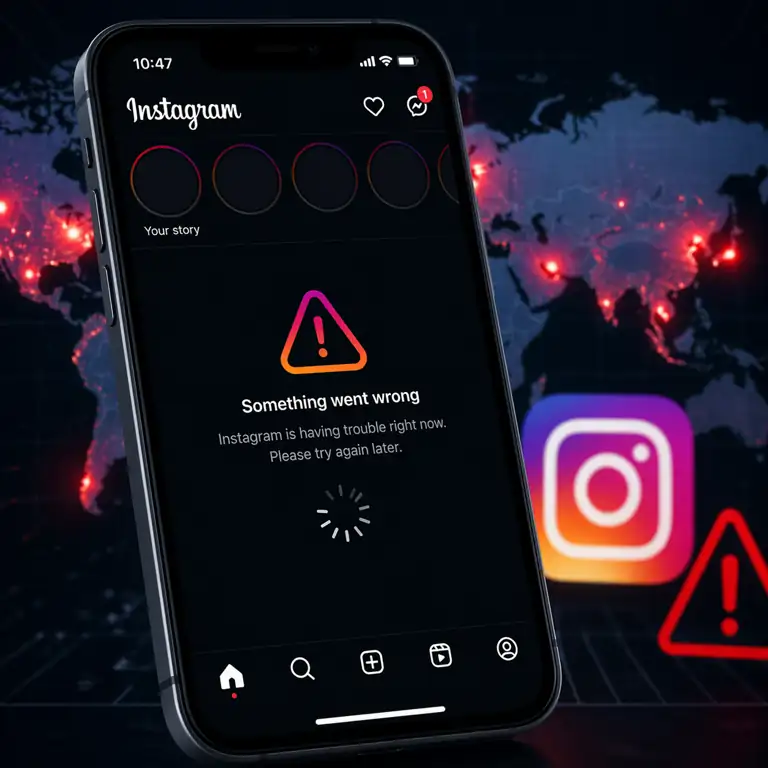

Instagram users across multiple regions had a rough Thursday after a bug disrupted one of the app’s most heavily used features: Stories. What looked at first like a sudden drop in views or a possible reach issue quickly turned into something much broader. Users in the United States, Europe and parts of Asia reported that new Stories were not appearing in the story bar at the top of the app, even though they had been posted successfully. In many cases, the Story could still be found by opening a user’s profile directly, but the normal colored ring and home-screen visibility were missing.
That distinction is important because Instagram Stories are built around instant visibility. A post that does not show up in the story tray is technically live, but functionally limited. For creators, brands and small businesses, that can mean a sharp drop in reach within minutes. For everyday users, it creates confusion because the content appears to exist, just not in the place where followers usually discover it.
The disruption was not limited to Stories. Users also described problems with direct messages, feed refresh failures, posting delays, login loops and occasional app crashes. Some said they received generic server errors, while others found the app would open but not update properly. Taken together, the reports pointed to a wider Instagram service problem rather than isolated account issues or a normal app glitch affecting only a handful of people.
Outage-tracking data added to that picture. As complaints spread, reporting platforms showed a clear spike in user-submitted problems tied to Instagram during the morning and early afternoon hours Eastern Time. Messaging failures, loading issues and crashes featured prominently in those reports. While the numbers varied by region, the pattern suggested the disruption was broad enough to affect users in several major markets at the same time. An authoritative reference point for users tracking service interruptions remained Downdetector’s Instagram outage page, which reflected the jump in complaints as the issue unfolded.
Why users immediately thought something was wrong with their accounts
One reason this problem drew so much attention is that Instagram visibility problems are often interpreted personally. If Story views fall suddenly, many users do not assume a platform issue first. They assume they posted at the wrong time, the algorithm changed, their audience lost interest, or their account has been restricted in some way. That is especially true for creators who monitor numbers closely and businesses that rely on Stories for traffic, offers and replies.
Thursday’s bug created exactly that kind of anxiety. Some users said their Story views stalled almost immediately. Others described engagement flattening so sharply that they worried they had been shadowbanned. But the consistency of reports across unrelated accounts suggested a very different explanation. This looked far less like an account-level penalty and far more like a distribution failure inside Instagram’s system, where new Stories were not being surfaced properly in the main viewing area.
That detail matters because it changes how the event should be understood. A Story that is only visible from a profile visit is not performing under normal conditions. Its distribution path is broken. Any resulting drop in views becomes a technical symptom, not a content verdict.
A wider outage can hit far more than casual posting
Instagram today is not just a photo-sharing app. It serves as a communication layer, a customer touchpoint, a marketing channel and, for many people, a daily work tool. When Stories, messages and feed loading all become unreliable at the same time, the impact reaches beyond simple inconvenience.
Small business owners often use Stories to announce limited-time offers, answer customer questions, share product links or push people toward a new post. Influencers and creators use them to keep audiences warm between feed uploads, direct traffic to brand collaborations and respond quickly to followers. Media pages use Stories to distribute headlines in real time. Even families and friends lean on them for informal updates and coordination. So when Stories stop surfacing correctly and messaging becomes unstable, the effect is immediate and practical.
Several users complained that scheduled plans and sales activity were interrupted during the disruption window. Others said they held back from posting anything important once it became clear the feature was not behaving normally. That was likely the right decision. During service disruptions, publishing time-sensitive material can backfire because the audience never sees it at the intended moment.
The outage also renewed a broader concern among users about platform stability. Similar complaints have appeared from time to time in recent weeks, and each new episode tends to feed the same debate: are frequent feature changes and increasingly complex systems making social apps more fragile? There is no confirmed evidence here tying this incident to any one cause, but repeated disruptions tend to shape user confidence even before a company explains what happened.
No clear explanation from Meta left users guessing
As complaints climbed, Meta had not offered a detailed public explanation for the disruption. That silence added to the uncertainty. In the absence of official guidance, users were left comparing screenshots, checking other social platforms and trying their own workarounds. Some restarted the app, some cleared cache, and some switched between Wi-Fi and mobile data. A few reported that the web version worked better than the app in certain moments, though that was not a universal fix.
Those are reasonable troubleshooting steps, but they can only do so much when the issue appears to be server-side. In situations like this, uninstalling and reinstalling the app may make users feel proactive, yet it rarely solves a platform-wide delivery problem. When Stories are failing to appear across many accounts and regions, the real fix usually has to happen on Instagram’s end.
Later reports suggested the situation began improving, with users saying Story behavior looked more normal again. That points to a temporary outage rather than a long-term feature change. Even so, the incident is a useful reminder that analytics from outage windows should be treated carefully. Weak Story performance during a confirmed disruption should not be used to judge content quality, account health or audience interest.
You may like: Ramipril shortage UK 2026 supply limit explained

Make Swikblog your go-to source on Google for reliable updates, smart insights, and daily trends.