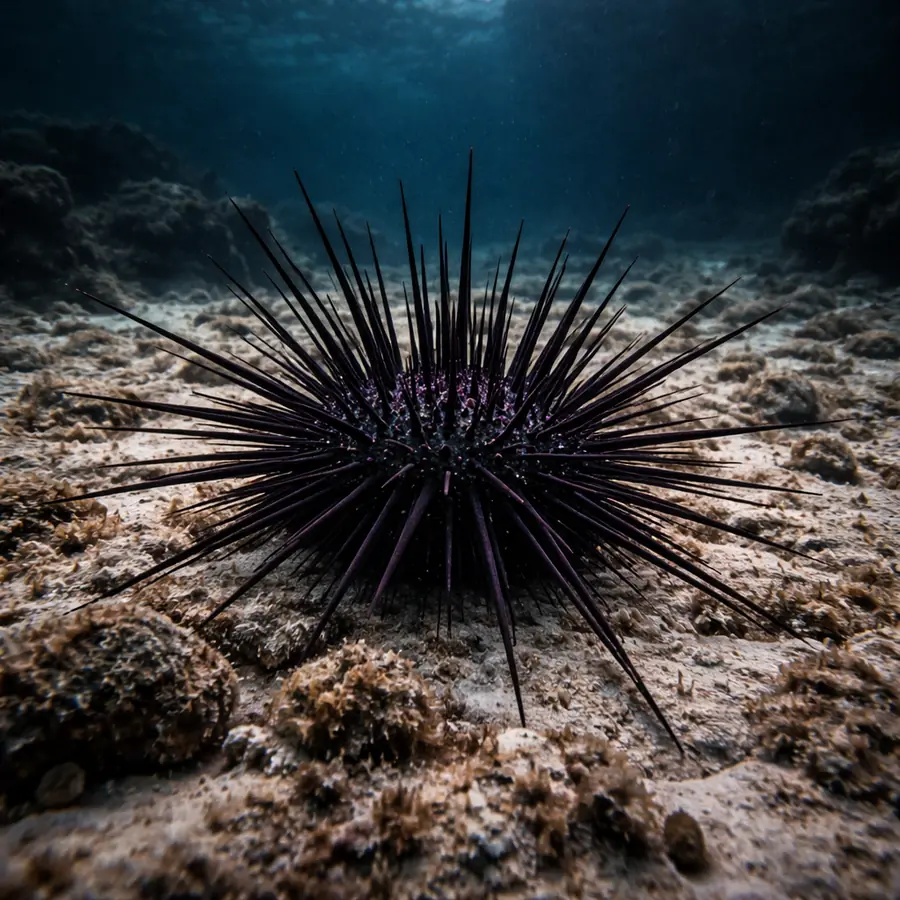

A single long-spined sea urchin found off Tasmania’s remote west coast has triggered fresh concern among scientists and fishers, marking the first time the invasive species has been recorded in the region. The discovery, made between Port Davey and Low Rocky Point, is now being seen as a warning sign of a much wider environmental shift unfolding across Australia’s southern waters.
Researchers say the sighting may appear minor, but its location is critical. Until now, the species had largely been concentrated along Tasmania’s east coast, with smaller populations in the south. Its arrival on the west coast — one of the state’s most valuable fishing zones — suggests the spread is continuing into new territory.
Growing spread linked to warming oceans
The long-spined sea urchin (Centrostephanus rodgersii) is native to New South Wales, but over recent decades it has expanded southward into Victoria and Tasmania. Scientists link this shift directly to climate change, with warming ocean temperatures and stronger currents pushing larvae further than ever before.
Tasmania’s waters are warming at nearly twice the global average, creating favourable conditions for the species to survive and multiply. The East Australian Current, which carries warmer water south, is also extending further than in previous decades, accelerating the spread.
What makes the species particularly damaging is its feeding behaviour. These urchins consume kelp — the foundation of underwater ecosystems — and leave behind barren, rocky seabeds that can stretch for kilometres. Once these “urchin barrens” form, recovery is slow and often uncertain.
Scientists estimate that the population in Tasmania has already grown to more than 20 million, with sightings increasing across southern and western reefs. Without active control measures, researchers warn that up to 50 per cent of Tasmania’s reefs could become barren within the next decade.
Threat to fisheries and economic impact
The spread of the urchins is not just an environmental issue — it is also an economic one. Kelp forests support key species such as abalone and rock lobster, both of which are central to Tasmania’s fishing industry. The state’s abalone fisheries are among the most valuable in the world, and any damage to these habitats could have long-term consequences.
Along parts of the east coast, the impact is already visible. Once-productive reefs have been stripped of vegetation, leaving ecosystems unable to support the same level of marine life. Fishers warn that if similar changes occur on the west coast, the effects could be far more significant.
Efforts to control the population have relied heavily on commercial divers, who have removed more than eight million sea urchins from Tasmanian reefs over the past eight years. Under the Centrostephanus Subsidy Program, divers receive an additional payment per kilogram to make harvesting viable.
Industry groups say this approach has been effective in reducing local populations and allowing kelp to recover in some areas. However, uncertainty remains over whether the program will continue, with no clear commitment yet from the state government for future funding.
Without these incentives, divers say large-scale removal may no longer be financially sustainable, potentially allowing the urchin population to expand unchecked.
At the federal level, a 2023 Senate inquiry recommended a $55 million investment over five years to address the growing problem, including reef restoration and support for a commercial urchin industry. While the government has acknowledged the issue, no major new funding has been committed so far.
Some experts believe the situation could also present an opportunity. Sea urchin roe is considered a premium seafood product and can sell for hundreds of dollars per kilogram in global markets. Expanding harvesting operations could help control populations while supporting local economies.
However, researchers caution that commercial harvesting alone is unlikely to solve the problem if environmental conditions continue to favour the species.
For now, the west coast sighting is being treated as an early warning rather than an immediate crisis. But scientists say it highlights the speed at which marine ecosystems are changing, and the need for faster, coordinated responses.
Further insights into ongoing marine research and ecosystem monitoring can be found through the Institute for Marine and Antarctic Studies, which continues to track the spread and impact of the species.
As ocean temperatures continue to rise, experts warn that similar shifts in species distribution are likely to become more common — making this latest discovery a signal of what may lie ahead for Australia’s coastal ecosystems.

Make Swikblog your go-to source on Google for reliable updates, smart insights, and daily trends.