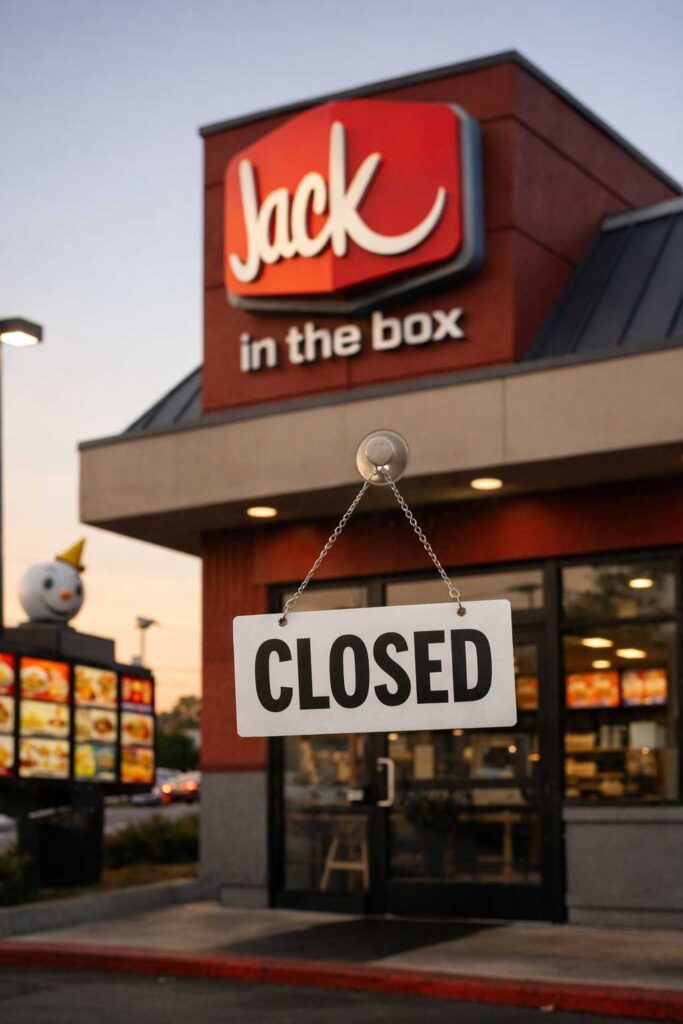

Jack in the Box is entering a critical transition phase in 2026, and the latest developments suggest the burger chain is taking aggressive steps to stay relevant in an increasingly competitive fast-food market. The company has not only sold its Del Taco business for roughly $119 million but is also preparing to close up to 100 locations as part of a broader restructuring strategy.
For longtime customers, the news raises an obvious question: is Jack in the Box shrinking or repositioning itself for a comeback? The answer appears to be a mix of both.
Jack in the Box plans up to 100 store closures
According to industry publication QSR, Jack in the Box ended its first quarter with 2,128 restaurants systemwide, including 1,979 franchised units and 149 company-operated locations. However, the company is now targeting just around 20 new openings in fiscal 2026 while planning between 50 and 100 closures, most of which will impact franchise stores.
This shift signals a clear change in direction. Instead of prioritizing expansion, the company is focusing on trimming underperforming locations and improving overall system efficiency. In a sector where margins are under pressure, fewer but stronger-performing stores can often deliver better long-term results.
Del Taco sale marks a major strategic reset
The decision to sell Del Taco for about $119 million is central to this transformation. By exiting the Mexican fast-food segment, Jack in the Box is simplifying its business model and doubling down on its core burger brand.
The move is part of a broader effort to reduce complexity, improve financial stability, and create a more focused growth strategy. Readers can explore the company’s official announcement in detail via the Del Taco sale release.
For management, this is not just about selling an asset—it’s about redefining what Jack in the Box stands for in a crowded and evolving market.
CEO says brand must ‘think outside the box’
CEO Lance Tucker has been candid about the challenges facing the company. In a recent conference call, he emphasized that Jack in the Box cannot compete head-to-head with fast-food giants purely on scale or aggressive discounting.
“We’ve always been smaller than some of these really big chains like McDonald’s or Taco Bell, Burger King, whoever it may be,” Tucker said. “I think in order for us to be successful when they’re out there with heavy value, we’ve got to have our own consistent value.”
That statement highlights one of the biggest pressures in the industry right now: value wars. Larger chains are rolling out aggressive deals to attract cost-conscious consumers, making it harder for smaller brands to compete without hurting profitability.
Tucker added that innovation will be key to differentiation. “We’ve got to lean into what really differentiates Jack, which is innovation… both within our limited-time offers and within our core menu.”
Competition is intensifying across fast food
The fast-food industry in 2026 is more competitive than ever. Major players like McDonald’s, Taco Bell, and Burger King continue to dominate with massive marketing budgets, global scale, and strong value positioning.
For Jack in the Box, this creates a difficult balancing act. The brand must offer competitive pricing while still maintaining margins and investing in innovation. Falling behind on either front could lead to further declines in traffic and relevance.
This is why the company’s restructuring is not just about cost-cutting. It is also about finding a sustainable way to compete in a market where consumer expectations are constantly evolving.
2026 is a ‘foundation year’ for long-term growth
Tucker has described 2026 as a year focused on laying the groundwork for future growth rather than delivering immediate expansion.
“2026 is about laying the foundation for sustainable long-term growth, which requires doing a lot of hard work right now,” he said. “We’re confident that the actions we’re taking will lead to a stronger, more stable platform.”
This includes improving franchise performance, refining the menu strategy, and building a more consistent value proposition that resonates with customers.
The company has also indicated that it is already seeing early signs that its strategy is working, although a full turnaround will take time.
What this means for customers and investors
For customers, the changes may mean fewer locations in certain areas, particularly where stores are underperforming. However, the goal is to create a better overall experience at the remaining restaurants through improved menus and stronger execution.
For investors, the strategy reflects a shift toward discipline and long-term sustainability. Instead of chasing rapid expansion, Jack in the Box is focusing on strengthening its core business and improving unit economics.
Additional financial and operational insights can be found in the company’s latest earnings report, which outlines performance trends and strategic priorities.
Ultimately, Jack in the Box is making a calculated bet: that a smaller, more focused system built on value and innovation can compete effectively against much larger rivals.
Whether that bet pays off will become clearer over the next year. For now, one thing is certain—the brand is no longer standing still. It is restructuring, refocusing, and trying to reinvent itself in a fast-changing fast-food landscape.

Make Swikblog your go-to source on Google for reliable updates, smart insights, and daily trends.