
Japan’s north-eastern coastline was placed on high alert on Monday after a powerful offshore earthquake triggered tsunami warnings, transport disruption and fresh safety checks at nuclear facilities, reviving memories of the country’s long history of seismic disasters and tsunami risk.
The earthquake, reported at magnitude 7.4 and later revised by some updates to 7.5, struck in waters off the Sanriku coast near Iwate prefecture. Japanese broadcaster NHK said the tremor occurred at a depth of around 10km, making it a shallow quake with the potential to generate dangerous sea surges along exposed parts of the Pacific coastline.
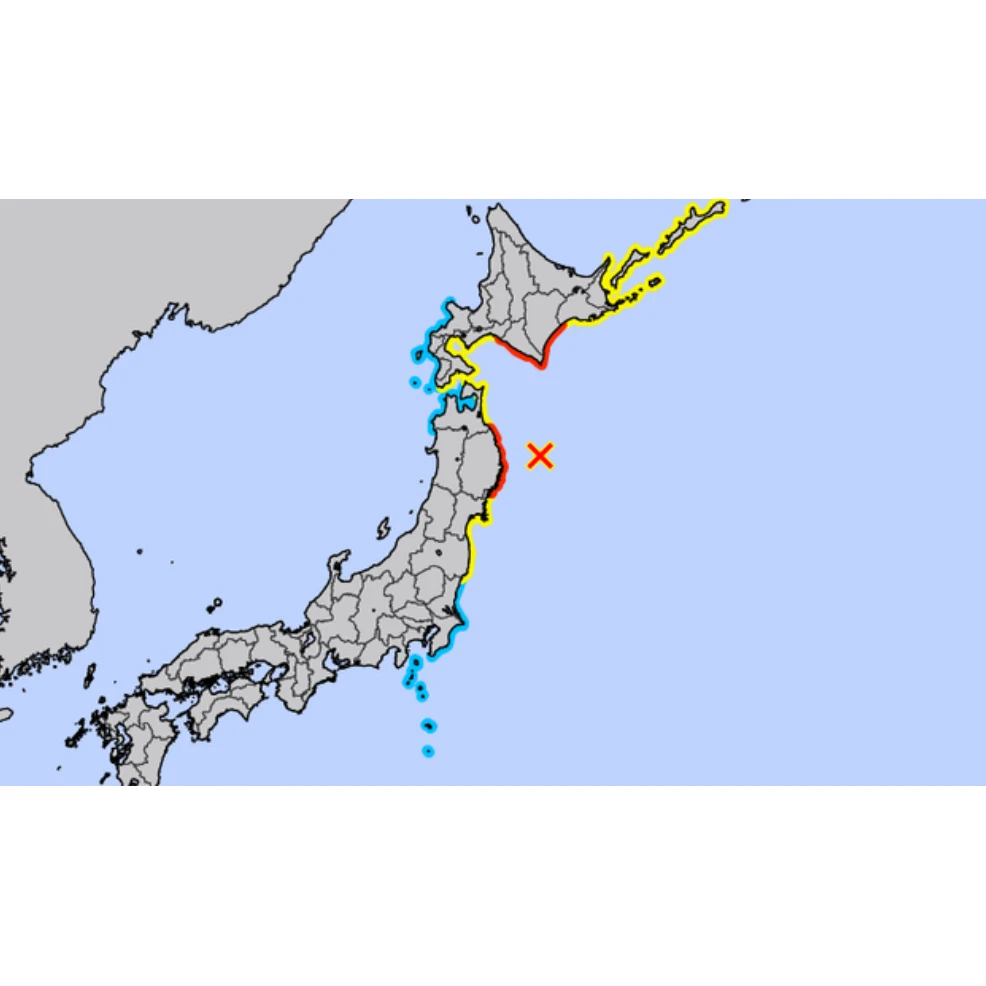
Officials moved quickly after the shaking began. Tsunami warnings were issued for Iwate prefecture, the Pacific coast of Aomori and central parts of Hokkaido, while advisories extended across broader coastal stretches including Miyagi and Fukushima. The warning map made clear that authorities were treating the event not simply as an offshore earthquake, but as a developing coastal emergency.
Prime Minister Sanae Takaichi urged residents in affected areas to seek higher ground immediately, reinforcing the seriousness of the alert. In Japan, such warnings are shaped by painful experience. Coastal communities know that when an undersea quake strikes at shallow depth, the first concern is not only structural shaking but what the sea may do next.
First tsunami waves reported as authorities warn bigger surges could follow
The threat became more urgent as the first tsunami waves began reaching shore. Local media reported that one wave measuring about 40cm was observed at Miyako port in Iwate prefecture. While that initial height was far below the worst-case forecast, Japanese authorities warned that waves could still rise to as much as 3 metres in some places, and that later surges can often prove more dangerous than the first arrival.
That point is critical in any tsunami event. A modest first wave can create the false impression that the danger has eased, but tsunami activity often unfolds in multiple stages, with repeated surges arriving over time. This is why emergency officials consistently tell residents to stay away from beaches, ports, river mouths and low-lying waterfront areas until all warnings have been formally lifted.
NHK also reported that a tsunami had been observed around 50km off the coast near Aomori, adding to fears that more parts of the north-east coastline could see strong wave action. The earthquake itself was widely felt, including in Tokyo, hundreds of miles from the epicentre, according to reports carried by international media. On Japan’s own seismic intensity scale, the quake registered 5+, indicating strong shaking capable of disrupting infrastructure and prompting immediate checks.
Even for a country as earthquake-prone and prepared as Japan, a shallow offshore quake of this size demands caution. Location matters as much as magnitude. When a powerful tremor strikes under the sea near vulnerable coastlines, tsunami risk becomes part of the emergency within minutes.
Rail disruption and nuclear plant inspections add to concerns
One of the first signs of disruption came on the transport network. Bullet train operations between Tokyo and Aomori were halted after the earthquake as a precaution, reflecting Japan’s strict safety protocols whenever strong tremors affect key rail corridors. High-speed rail operators regularly suspend service after major seismic events until track integrity and operating conditions can be confirmed.
Authorities also launched inspections at nuclear facilities in the broader region. NHK reported that the Onagawa nuclear power plant was being checked for abnormalities after the quake. Separate reports said no abnormalities had been found so far at plants in Aomori and Miyagi prefectures, while the operator of Fukushima Daini also said there were no immediate issues there.
Checks were still continuing at the Fukushima Daiichi plant, the site of the 2011 meltdowns that followed the devastating earthquake and tsunami along Japan’s east coast. Any offshore quake in north-east Japan inevitably draws attention to Fukushima because of that history. Although there was no immediate indication of a serious nuclear incident this time, the inspections underline how central plant safety remains during large seismic events.
For official updates on earthquake and tsunami alerts, readers can follow the Japan Meteorological Agency. More developing international coverage is also available through our world news section.
Why this quake is being watched so closely
Japan sits on the Pacific Ring of Fire, where several tectonic plates meet and shift, making the country one of the most earthquake-prone places in the world. Tremors are frequent, but not every earthquake triggers this level of concern. What makes this event more serious is the combination of offshore location, shallow depth, tsunami warnings and the region’s historical sensitivity after the 2011 disaster.
The 2011 earthquake and tsunami remain one of the defining tragedies in modern Japanese history, leaving nearly 20,000 people dead or missing and triggering a nuclear crisis that reshaped policy, infrastructure planning and public awareness. This latest quake is significantly smaller, but the response shows how deeply those lessons have been embedded into national emergency systems.
Warnings were pushed out quickly, rail services were paused, nuclear inspections began almost immediately and coastal residents were told not to wait for visible danger before moving to safer ground. That speed of response reflects an understanding built over decades: when the sea is involved, hesitation can be deadly.
For people in affected areas, the most important guidance remains simple. Stay away from the coast, do not go near the shoreline to watch the waves and do not return until local authorities say the risk has passed. Earthquakes may last only seconds, but the hazards they create can continue for hours. In this case, the first waves hitting the coast were only the beginning of the story.

Make Swikblog your go-to source on Google for reliable updates, smart insights, and daily trends.