A powerful offshore earthquake struck northern Japan late Monday, prompting an immediate tsunami warning across multiple coastal prefectures. According to the Japan Times, the quake — initially measured at magnitude 7.6 — hit northeast of Honshu, sending strong tremors through Aomori, Iwate and Hokkaido.
The Japan Meteorological Agency (JMA) has warned of possible tsunami waves reaching up to 3 metres, urging residents in low-lying areas to evacuate immediately. Local authorities have activated disaster-response teams, with coastal sirens and public broadcast systems warning people to move to higher ground.
According to AP News, the earthquake struck at a depth of approximately 50 km and was centred offshore — increasing the risk of water displacement and follow-on waves. Early reports indicate no major structural damage yet, but officials caution that assessments are ongoing and aftershocks remain likely.
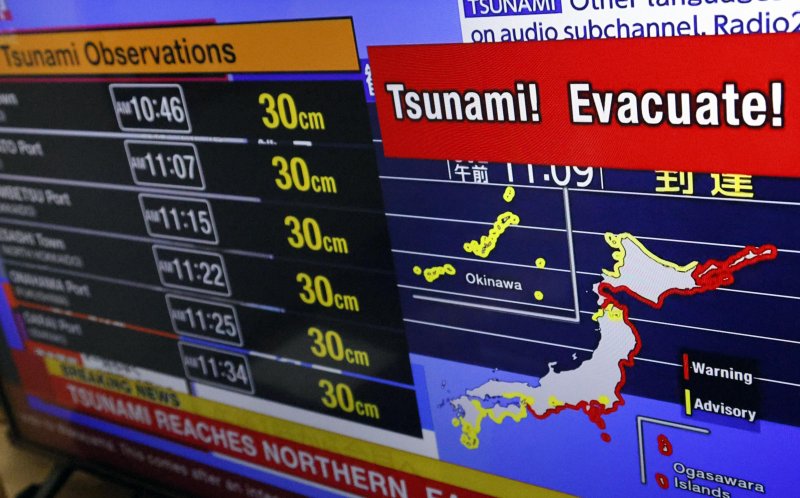
Evacuations and Disaster Response
Trains in northern Japan were briefly halted as operators checked rail integrity, while airports are assessing runway safety. Emergency shelters have opened across Aomori and Iwate, where residents are being provided blankets, water and portable heaters as night temperatures drop.
Authorities warned that even small initial waves can precede far larger surges. “Do not return to the coast until the warning is lifted,” JMA officials said during a televised briefing.
Communities on High Alert
Japan, one of the world’s most earthquake-prone countries, remains highly sensitive to offshore quake activity following past disasters. Monday night’s tremor reignited fears in coastal towns still rebuilding from earlier seismic events.
Social media footage showed residents running inland, car sirens blaring, and warning boards urging people upward. Local broadcasters have shifted to continuous coverage, directing residents to evacuation routes and emergency shelters.
Context: Why This Quake Is Serious
Because the epicentre was offshore and moderately shallow, a tsunami threat was triggered instantly. Areas on Japan’s northern coast are particularly vulnerable due to geography and proximity to complex fault lines.
Officials say monitoring will continue for several hours, as tsunamis can arrive in multiple waves over long periods.
You may also like: Northern Lights Alert: US Auroras Forecast

Make Swikblog your go-to source on Google for reliable updates, smart insights, and daily trends.