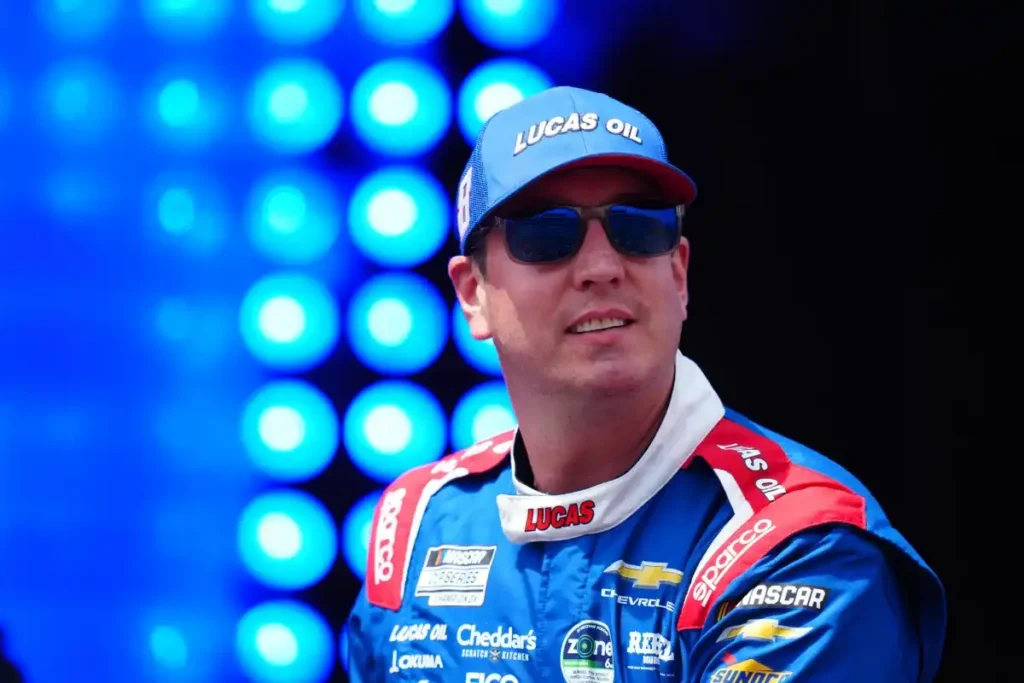

Kyle Busch’s sudden death at 41 has left NASCAR facing one of its darkest moments in recent memory. The two-time Cup Series champion, still active, still competitive and still connected to every major conversation around the sport, died after what his family described as a severe illness, according to reports citing a joint statement from NASCAR, Richard Childress Racing and the Busch family.
The news was especially difficult to absorb because Busch had not faded from the racing scene. He was still part of the weekly rhythm of NASCAR, still wearing the No. 8 colors for Richard Childress Racing, and still capable of producing the kind of performance that made him famous. Just days before his death, Busch won at Dover Motor Speedway, taking his 69th career Truck Series victory and adding another line to a record book he had already rewritten.
Busch’s career was built on numbers that will be difficult for any modern driver to chase. Across NASCAR’s three national series, he collected 234 wins, including 63 in the Cup Series, 102 in the second-tier national series and 69 in Trucks. He also made 762 Cup Series starts and won Cup championships in 2015 and 2019, establishing himself as one of the defining drivers of the post-2000 NASCAR era.
But Busch was never just a statistics story. Known as “Rowdy,” he brought edge, emotion and tension to almost every race weekend. Fans either cheered him loudly or hoped someone else would beat him, but very few ignored him. That rare ability to create reaction made him one of NASCAR’s most valuable personalities at a time when the sport needed drivers who could pull viewers into the drama.
His style was demanding and often unforgiving. Busch raced with the confidence of a driver who believed every lap could be won, whether he was fighting for a Cup trophy, an Xfinity win or a Truck Series victory. Rivals did not always enjoy racing against him, but many respected the standard he set. Competing with Busch usually meant racing against one of the sharpest minds and quickest hands in the garage.
The reaction from inside NASCAR showed how deeply his death was felt. Denny Hamlin said he could not comprehend the news, while Brad Keselowski described it as absolute shock. Mark Martin said he was speechless. Ricky Stenhouse Jr. remembered Busch as a competitor who forced others to become better. AJ Allmendinger called him one of the best to ever race.
Tributes also reached beyond stock car racing. Formula 1 described Busch as a true competitor and champion, while figures from IndyCar and international motorsport shared condolences. Speedway Motorsports CEO Marcus Smith remembered him as “a champion among champions,” pointing to his victories at major venues, including Charlotte Motor Speedway, where Busch won the 2018 Coca-Cola 600.
Indianapolis Motor Speedway president Doug Boles also highlighted Busch’s place in Brickyard history. Busch won back-to-back Brickyard 400 races in 2015 and 2016 and swept both the Cup and second-tier NASCAR races at Indianapolis in those years, an achievement that underlined his dominance across different formats.
Away from the Cup garage, Busch had become closely associated with family and grassroots racing. He leaves behind his wife Samantha, son Brexton and daughter Lennix. Brexton’s own racing journey had become a familiar part of Busch’s public life, giving fans a softer view of a driver often defined by intensity on the track.
Read More
Busch’s passing also comes at a time when NASCAR is navigating major business and competitive changes. Swikblog recently covered the wider tension around team ownership and the charter model in its report on the Michael Jordan NASCAR antitrust lawsuit and charter dispute, a backdrop that shows how much the sport continues to depend on star power, team stability and loyal fanbases.
For official updates, readers can follow NASCAR.com and the latest reporting from The Associated Press.
Busch’s legacy will not be measured only by trophies. It will live in the arguments he started, the races he stole, the fans he inspired and the competitors he pushed harder than they wanted to go. NASCAR lost more than a champion; it lost one of the rare drivers who made every race feel bigger the moment he entered it.

Make Swikblog your go-to source on Google for reliable updates, smart insights, and daily trends.