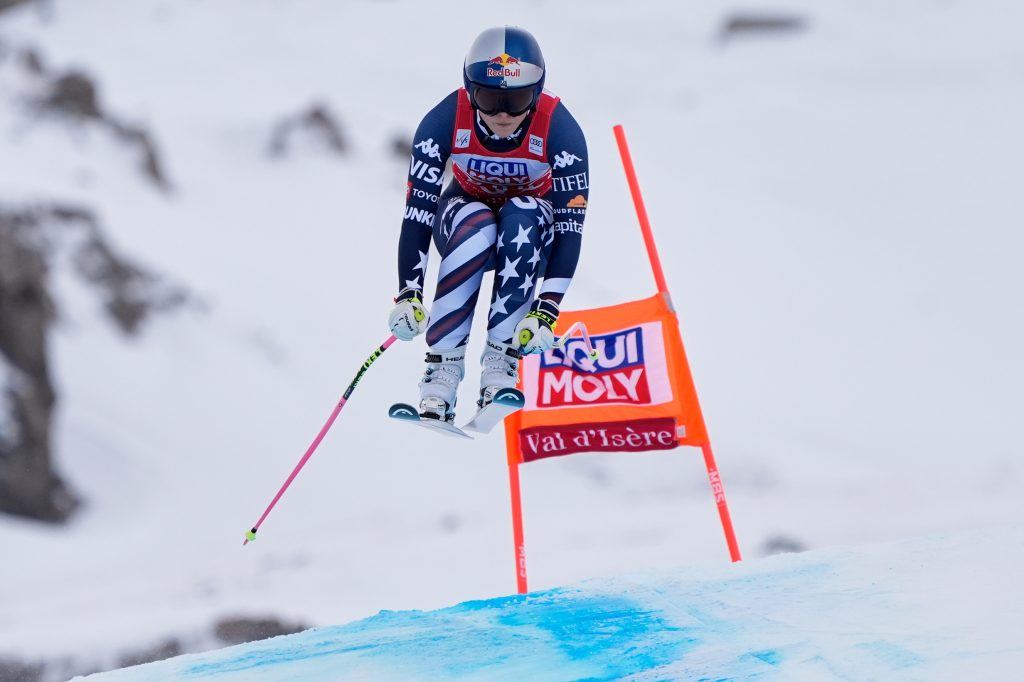

Vonn is stacking results fast — and the timing, with Milan-Cortina 2026 on the horizon, is turning every finish into a headline.
By Swikblog Desk • Updated: Dec 21, 2025
The world’s best alpine skiers are used to pressure — but Val d’Isère has a way of adding its own. The terrain looks like it was designed to punish hesitation. The weather can change mid-run. One gust at the wrong moment and the “perfect line” becomes a rumor. And yet, in that kind of chaos, Lindsey Vonn just keeps showing up near the top.
On Sunday, Vonn finished third in the women’s World Cup super-G at Val d’Isère, making it back-to-back podiums after another third-place finish the day before. The win went to Italy’s Sofia Goggia, with New Zealand’s Alice Robinson in second — a podium that felt like a collision of power, precision, and pure belief.
For Vonn, it was more than “another good day.” It was her 142nd career World Cup podium — the kind of number that usually belongs in a museum, not on a results sheet next to athletes half her age.
The run: fast enough to scare the clock — not quite enough to win
Super-G is a cruel discipline because it looks simple until you try to ski it: one run, high speed, fewer turns than giant slalom, and almost no time to “fix” a mistake. In Val d’Isère, conditions turned that cruelty up a notch. Strong gusts interrupted rhythm, and the race was even delayed briefly as the wind pushed through the course.
Vonn’s speed was real — among the best on the day — with her run reportedly peaking around 115 kph. The difference was in the margins: a fraction late here, a slightly conservative line there, and suddenly the top step is gone. She finished 0.36 seconds behind Goggia, which in skiing is both “close” and “miles away.”
Goggia’s win also carried a storyline of its own. She’s been flying this season but hadn’t been able to convert that speed into the victory her skiing suggested. This time, she did — and it looked like the kind of performance that doesn’t just win a race, it resets momentum. (If you want the official race wrap and context, the FIS write-up is worth a read: FIS race report on Goggia’s Val d’Isère super-G win.)
Why this podium feels louder than a podium
Here’s the part casual fans may miss: it’s not just that Vonn is getting podiums. It’s how quickly they’re arriving. This early stretch has been a blur of racing, travel, and high-stakes runs — and Vonn is still landing in the top three. That is what makes the comeback feel “real,” not nostalgic.
It also shifts the conversation from “Can she return?” to “How far can she take it?” And that question matters because the target isn’t vague. Vonn’s comeback has been publicly tied to one thing: Milan-Cortina 2026. The Olympics site has framed her return as a deliberate, emotionally charged mission — not a victory lap. Olympics.com’s feature on Vonn’s return makes it clear how much Cortina itself has pulled her back into the sport.
And if you’re wondering what makes the story travel beyond ski circles: it’s the contrast. A 41-year-old icon. A field packed with fearless speed specialists. A sport that doesn’t care about legacy when the gates are coming at you. That’s the kind of narrative that spreads — because it’s not only about skiing. It’s about stubbornness, timing, and the audacity to try again.
What happens next
After Val d’Isère, the World Cup calendar moves toward a brief break, and then the season’s next chapters begin to stack up. The bigger picture — discipline standings, form, and health — will keep tightening as the tour rolls into January. But for Vonn, the immediate takeaway is simple: she’s not “building back” quietly. She’s building back on the podium.
If this is the base layer of her Olympic season, the rest of winter now feels like a live experiment: can she turn consistent top-three speed into a peak that lands at exactly the right time — when medals are on the line?
One thing is already clear: Val d’Isère didn’t hand her a feel-good story. It handed her a test. And she passed it — again.
You May Also Like
More trending sports stories on Swikblog

Make Swikblog your go-to source on Google for reliable updates, smart insights, and daily trends.