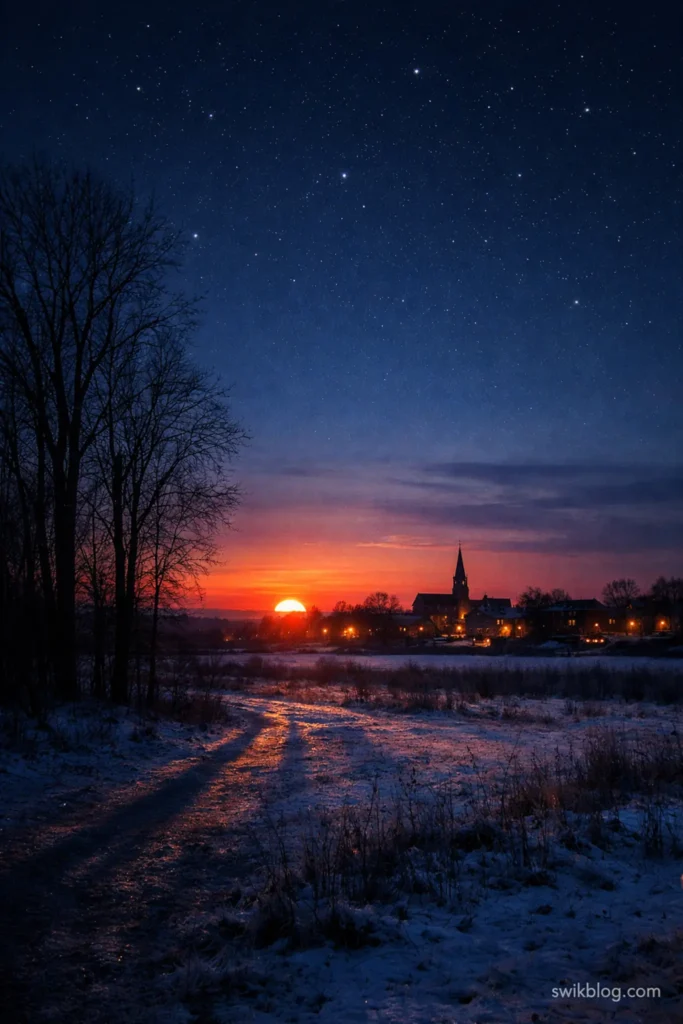

The winter solstice marks the shortest day and longest night of the year in the Northern Hemisphere — and quietly signals the return of longer days ahead.
By Swikblog Desk | December 21, 2025
If today felt shorter than usual, there’s a reason. Tonight marks the longest night of the year for millions across the Northern Hemisphere. It’s the point on the calendar when daylight reaches its minimum — and darkness stretches its longest.
This annual moment is known as the winter solstice, an astronomical turning point that has been observed for thousands of years. While it may feel symbolic or poetic, the solstice is rooted firmly in science — and it marks the moment when the seasonal trend quietly begins to reverse.
What does “longest night of the year” actually mean?
The phrase refers to the day with the fewest hours of daylight. In practical terms, that means the Sun spends less time above the horizon than on any other day of the year, making nighttime longer than usual.
How dramatic the change feels depends on where you live. Locations farther north experience very short days and long nights, while places closer to the equator see only subtle seasonal differences.
Why the winter solstice happens
Contrary to popular belief, the solstice has nothing to do with Earth being farther from the Sun. Instead, it’s caused by the planet’s axial tilt.
Earth tilts at about 23.5 degrees as it orbits the Sun. In December, the Northern Hemisphere tilts away from direct sunlight, causing the Sun to follow a lower and shorter path across the sky. This results in shorter days, longer shadows, and colder temperatures.
NASA explains that while the Northern Hemisphere experiences its darkest day, the Southern Hemisphere simultaneously enjoys its longest day of the year. You can read more about the science behind the solstice on NASA’s official website.
Does the Sun really “stand still”?
The word “solstice” comes from Latin and roughly translates to “Sun stands still.” Around this time of year, the Sun’s position at sunrise and sunset changes very little from day to day, creating the illusion that it has paused in the sky.
After the solstice, the Sun’s path slowly begins to climb higher again, bringing longer daylight hours — although the change is subtle at first.
What changes after tonight?
From tomorrow onward, daylight gradually increases. While you may not notice the difference immediately, the shift is real and measurable. Over the coming weeks, sunsets will inch later, mornings will brighten earlier, and winter will slowly move toward spring.
Interestingly, the earliest sunset and latest sunrise don’t always fall exactly on the solstice due to the way clock time aligns with Earth’s orbit — a detail tracked precisely by astronomers.
For exact solstice timings by location, tools like Timeanddate.com provide minute-by-minute global data.
Why this night still matters
Long before modern calendars, cultures around the world marked the solstice as a moment of transition — the end of growing darkness and the beginning of returning light. That sense of renewal still resonates today.
The longest night of the year is a reminder that even at the darkest point of the calendar, the direction is already changing. From here on, the days slowly grow brighter again.

Make Swikblog your go-to source on Google for reliable updates, smart insights, and daily trends.