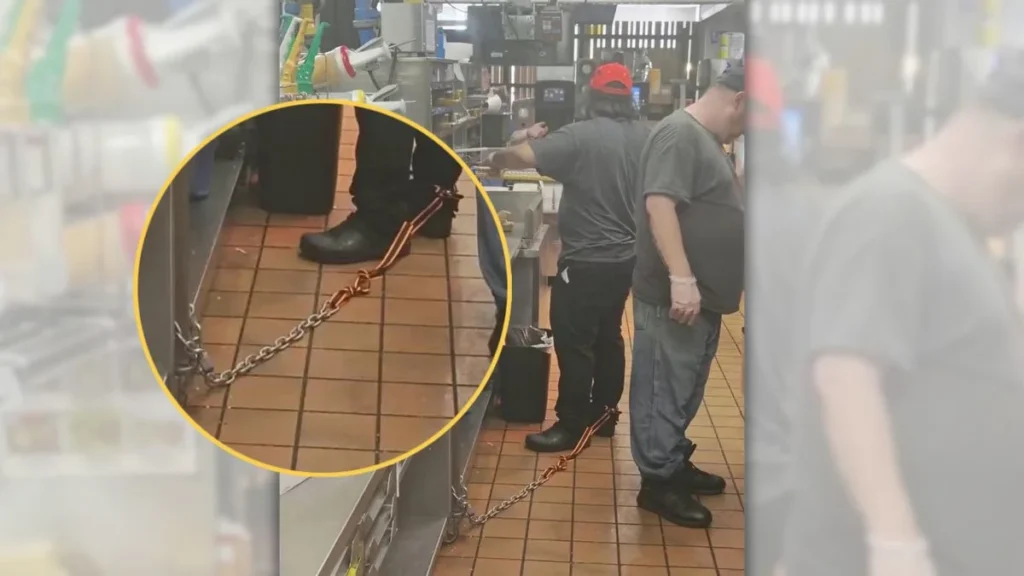

A viral photo appearing to show a McDonald’s employee chained to a kitchen workstation is likely authentic, but the alarming explanation attached to it remains unproven. No reliable evidence shows that the worker was forcibly restrained, punished by the restaurant or employed through a prison work-release program.
The picture shows three people working inside a fast-food kitchen. One employee appears to have a black-and-orange ankle strap attached to a metal chain running toward a food preparation station.
As the image spread across Instagram, TikTok, Facebook, Reddit, X and YouTube, posts claimed it showed employee abuse or prison labor. Those descriptions circulated without identifying the worker, restaurant or person who took the photograph.
Is the McDonald’s chained-worker photo real?
Snopes examined the earliest-known version and found no visible evidence that the original photograph was generated by artificial intelligence or digitally manipulated.
Details inside the kitchen supported the conclusion that it was taken at a McDonald’s restaurant. A preparation guide visible in the image included menu names such as Snack Wrap, McCrispy Deluxe and McChicken.
Confirming that the picture is probably genuine does not verify the captions attached to it. Investigators could not establish where it was taken, why the employee was wearing the device or whether the chain could be removed voluntarily.
Because the central allegation could not be independently confirmed, Snopes did not rate it as either true or false.
Where did the photograph come from?
An early Instagram repost received hundreds of thousands of interactions, but markings on the upload suggested it had been copied from another social media platform.
The investigation later led to TikTok account @technojuice. In comments, the account holder claimed to have uploaded the original image and suggested that the situation had been misunderstood.
The user reportedly said the post was deleted after people began tagging McDonald’s corporate accounts and restaurant managers became unhappy. A separate comment described the removed upload as humorous, prompting speculation that the chain may have been part of a workplace joke.
That explanation remains unverified. The employee has not been publicly identified, and no directly involved manager has provided an on-record account of what occurred.
Was the worker involved in a prison labor program?
Some social media posts connected the photograph to Alabama because the state has previously allowed incarcerated people to work for private employers. An Associated Press investigation into Alabama prison labor documented the broader system, but it did not connect this particular worker or restaurant to such a program.
The Alabama Department of Corrections was contacted during the fact-checking process. Investigators found no information showing that the pictured employee was incarcerated, and there is no confirmed evidence that the photograph was taken in Alabama.
The prison-labor explanation should therefore be treated as an unsupported theory rather than an established fact.
Did McDonald’s identify the restaurant?
Investigators contacted McDonald’s Corporation and called several restaurants near a location seen in an earlier @technojuice video. Some employees said the image was not taken at their branch, while others declined to discuss it.
No restaurant was conclusively identified. As of July 31, 2026, no later verified statement from McDonald’s, an identified franchise or a government agency had publicly explained the chain.
Claims that the device included a removable carabiner could not be confirmed from the picture alone.
AI-generated copies added to the confusion
After the original became popular, altered versions began appearing online. Some extended the visible kitchen area and contained distorted packaging, unreadable labels or other signs of artificial generation.
Those later images should not be confused with the earliest-known photograph. Checking the original crop, background and upload history is important because an authentic image can still be paired with an inaccurate caption.
Other unusual McDonald’s posts have created similar uncertainty about their context, including the viral McMullet Burger and where it was available.
Why the source of a viral claim matters
Official campaigns normally provide published details that can be checked against company announcements. The Ronald McDonald prize-cards campaign in the UK, for example, had identifiable promotion terms and supporting information.
The chained-worker photograph arrived without comparable evidence. Its unknown location, deleted original post and absence of a statement from the employee leave its meaning unresolved.
Read More
What the available evidence shows
The original photograph appears genuine and was probably taken inside a McDonald’s kitchen. However, its surrounding circumstances have not been verified.
There is currently no proof that McDonald’s forcibly chained the employee, used the device as workplace discipline or employed the worker through a prison program. Until a directly involved source provides verifiable information, those claims should remain classified as unconfirmed.

Make Swikblog your go-to source on Google for reliable updates, smart insights, and daily trends.