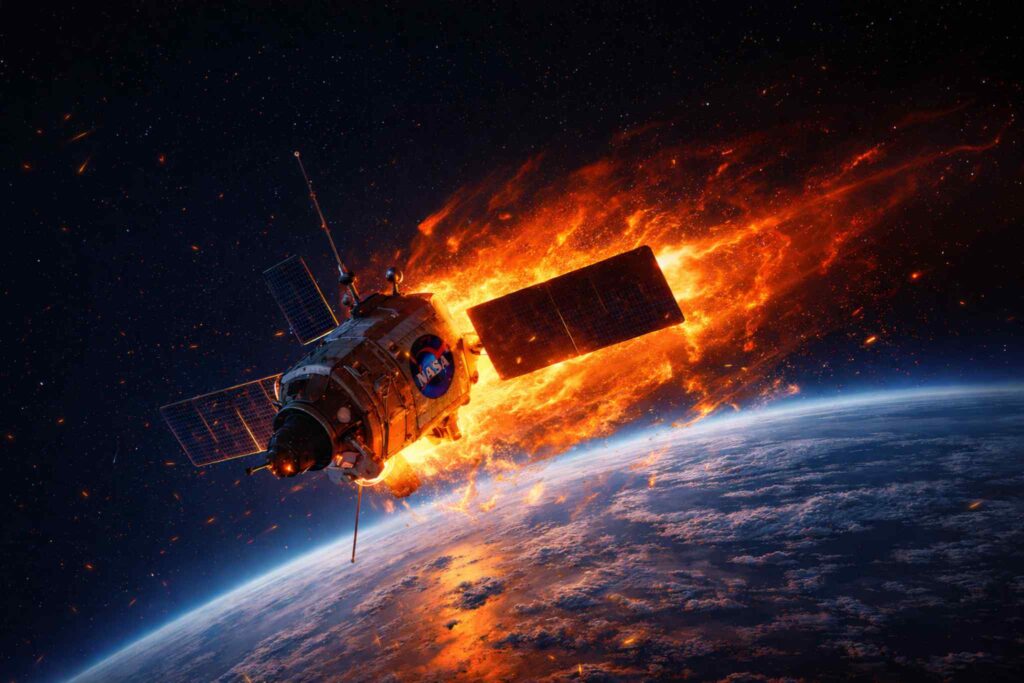

NASA is tracking the imminent atmospheric re-entry of its retired Van Allen Probe A spacecraft, a roughly 1,300-pound satellite that spent years studying Earth’s radiation belts. The spacecraft is expected to descend through the atmosphere around March 10, according to tracking estimates from U.S. Space Force monitoring systems. While most of the structure is projected to burn up during re-entry, some components could survive the descent, prompting continued observation by aerospace agencies.
The spacecraft’s return marks the final stage of a mission launched in August 2012 to investigate the dynamic radiation zones surrounding Earth. Known as the Van Allen radiation belts, these charged particle regions are critical to understanding space weather events that can disrupt satellites, communications infrastructure, and navigation systems.
Satellite Re-Entry Window Narrowing
As of current tracking forecasts, the spacecraft is expected to re-enter Earth’s atmosphere around 7:45 p.m. EDT on March 10, with an uncertainty window of roughly 24 hours. NASA says the probability of injury or damage on the ground remains low, estimating the risk at approximately 1 in 4,200.
Space agencies monitor objects during orbital decay using radar networks, telescopes, and atmospheric modeling. Because the final descent depends on atmospheric density and solar activity, precise landing predictions typically become clearer only hours before re-entry.
Most spacecraft structures disintegrate due to extreme friction heating during atmospheric entry. Temperatures can exceed 1,500 degrees Celsius as objects travel through denser layers of the atmosphere. Dense materials such as titanium tanks or reinforced components sometimes survive the breakup phase.
Solar Activity Accelerated Orbital Decay
Originally, scientists projected the spacecraft would remain in orbit until around 2034. However, stronger-than-expected solar activity altered those calculations. Increased solar radiation heats and expands Earth’s upper atmosphere, increasing drag on satellites in low orbit.
NASA confirmed that the Sun reached a solar maximum phase during the current solar cycle in 2024, intensifying space weather conditions. These changes expanded atmospheric density at higher altitudes, accelerating orbital decay for several aging spacecraft.
The Van Allen Probe A was one of the missions affected by this shift, reducing its orbital lifespan by nearly a decade.
Mission That Changed Radiation Belt Science
Van Allen Probe A and its twin spacecraft, Van Allen Probe B, were designed to operate directly within the radiation belts — an environment where most spacecraft minimize exposure due to damaging charged particles.
The mission provided unprecedented long-term measurements of how particles move, accelerate, and dissipate inside these belts. Among its most significant findings was the detection of a temporary third radiation belt that can appear during periods of intense solar storms.
These observations have helped researchers improve forecasting models for space weather events that affect satellites, astronauts, and technological infrastructure on Earth.
Data from the mission continues to be used by scientists studying magnetospheric dynamics and solar-terrestrial interactions. NASA notes that archived observations remain valuable for predicting how future solar storms could impact orbital systems.
Low Risk to Public Safety
Despite the attention surrounding the event, experts emphasize that uncontrolled spacecraft re-entries are relatively common and rarely pose meaningful risk. The majority of objects burn up before reaching the surface, and Earth’s oceans cover more than 70 percent of the planet.
Monitoring networks run by agencies including NASA and the U.S. Space Force track orbital debris to ensure updated predictions are issued when necessary. Aviation and maritime authorities can also receive temporary alerts if debris paths intersect with transportation routes.
Additional information about the mission and tracking updates can be found through NASA’s official mission pages and monitoring systems operated by the U.S. Space Force.
Growing Focus on Space Debris Management
The Van Allen Probe A re-entry also highlights the growing challenge of orbital congestion. Thousands of inactive satellites and fragments currently circle Earth, creating potential hazards for operational spacecraft.
Space agencies and private launch providers are increasingly designing satellites with controlled de-orbit systems to reduce debris risks. New mission planning guidelines now prioritize end-of-life disposal strategies to ensure spacecraft burn up safely or are guided toward remote ocean zones.
As global satellite launches accelerate, orbital sustainability has become a major focus for governments, commercial space companies, and international regulators.
End of a Historic Mission
Although the spacecraft’s re-entry marks the end of its physical presence in orbit, its scientific legacy continues. The Van Allen Probes program produced some of the most detailed measurements ever collected inside Earth’s radiation belts, reshaping scientific understanding of how these energetic particle regions behave.
Nearly 14 years after launch, the spacecraft’s return underscores both the lifecycle of satellites in orbit and the expanding importance of space weather research in protecting modern technological infrastructure.

Make Swikblog your go-to source on Google for reliable updates, smart insights, and daily trends.