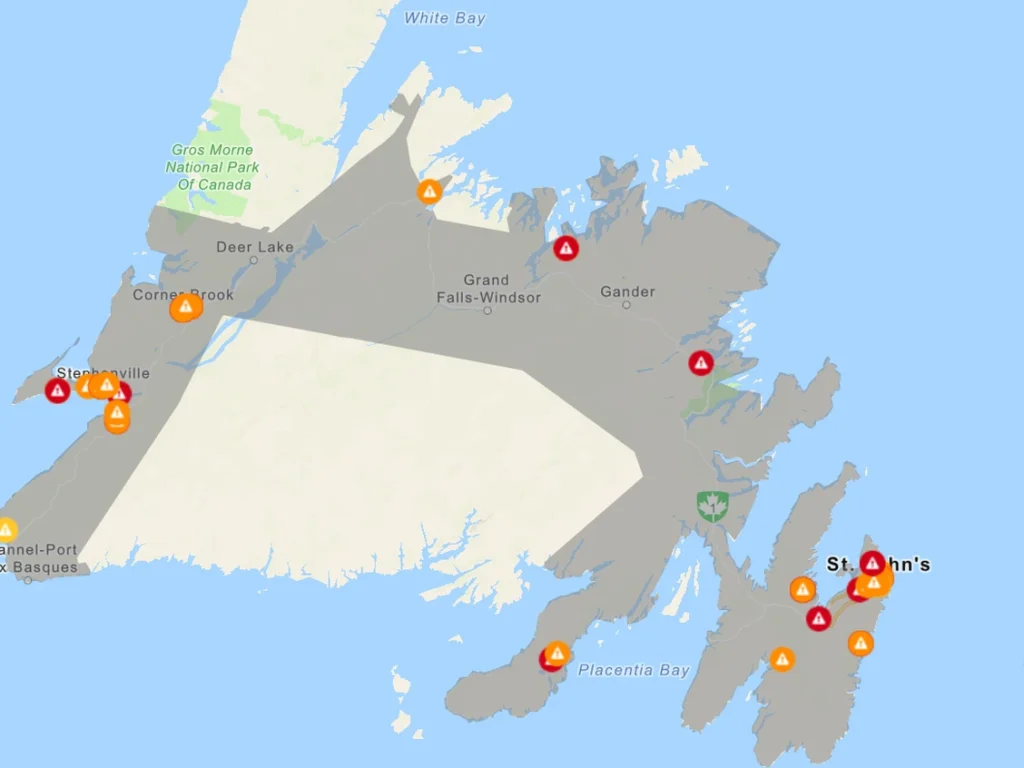

Thousands of homes and businesses across Newfoundland were plunged into a sudden outage Friday after a disruption on the Labrador-Island Link triggered a widespread loss of electricity supply. The interruption rippled across the island — from the Avalon Peninsula through central and western Newfoundland — leaving communities from St. John’s to Port aux Basques without power as crews worked to stabilize the system and restore service.
Newfoundland Power said the outage was tied to a loss of supply from NL Hydro. The timing and footprint of the interruption pointed to a system-wide event rather than localized storm damage or a single distribution fault, which is why the impacts appeared simultaneously across multiple regions. Reports indicated the outage began at about 11:20 a.m., and by midday there was no confirmed estimate for full restoration in some areas as work continued across the grid.
What caused the outage
The core issue was described as a trip on the Labrador-Island Link transmission line, an essential part of Newfoundland and Labrador’s power system that moves electricity between Labrador and the island. When a major transmission asset trips, protective systems act quickly to prevent equipment damage and wider cascading failures. That protection is critical — but it can also mean large sections of the grid drop offline at once while operators rebalance supply and demand.
In the early hours of the restoration effort, messaging emphasized that the outage was expected to be brief for many customers, with restoration already underway in several pockets. Even so, the scale of the disruption meant that different regions could return at different speeds depending on how the system was re-energized and how local distribution networks responded once bulk transmission supply was stabilized.
For more detail on the transmission trip and the early restoration timeline, see this report from CBC News.
Where power was out across Newfoundland
Outage reports stretched across a broad sweep of the island. Newfoundland Power indicated impacts spanning the Avalon Peninsula and Burin Peninsula, through parts of the north coast and central Newfoundland, and west toward Channel–Port aux Basques. When outages appear in multiple, far-flung regions at once, it typically reflects a disruption at the transmission or system-operations level rather than a neighborhood-level issue.
In practical terms, that means customers in very different communities can lose power at the same time — and also that restoration can look uneven, with some areas returning quickly while others remain out until grid operators complete system checks and bring additional segments online safely.
Why the Labrador-Island Link matters
The Labrador-Island Link is a key component of how electricity is moved across the province. Major transmission pathways like this are built to carry large amounts of power reliably, but they also operate with strict safeguards. A “trip” can occur for a range of reasons — including protection responses to abnormal conditions — and the system is designed to isolate issues fast.
Because this link is central to moving supply, a trip can create an immediate imbalance. Operators must then stabilize frequency and voltage while coordinating step-by-step restoration. That methodical approach can feel slow from the outside, but it’s intended to prevent repeated trips or additional interruptions as power is brought back.
What to expect during restoration
Large-scale restoration tends to happen in phases. First, operators work to confirm the fault condition has cleared or is contained. Next, they re-energize the backbone of the system and bring supply back to regional networks. Finally, local distribution circuits are restored, sometimes with brief flickers or staggered returns as equipment is tested and loads come back online.
That’s why some customers may see power return quickly while others wait longer — not necessarily because one neighborhood is being prioritized over another, but because the grid must be rebuilt in a stable sequence. In some cases, service can return and then drop again briefly if protective equipment detects instability and trips as a safety measure.
What residents can do while waiting
If you’re without electricity, the safest approach is to assume power can return at any moment. Keep at least one light switch on so you’ll know when service is restored, and unplug sensitive electronics where possible to reduce the risk of damage if power comes back with a surge. If you rely on medical devices that require electricity, consider backup arrangements immediately and keep communication lines open with caregivers or local supports.
For food safety, refrigerators typically keep food cold for about 4 hours if unopened, and freezers can hold temperature longer if they remain closed. Avoid opening doors repeatedly. If you use generators, operate them outdoors only, away from windows and vents, to prevent dangerous fumes from entering the home.
Why this outage is trending
The scale and suddenness of the outage pushed it to the top of real-time searches because it affected multiple regions at once, disrupted workplaces and schools, and raised immediate questions about the cause and restoration timing. Searches for terms like “Newfoundland power outage,” “NL power outage,” and “Labrador-Island Link trip” typically spike when a transmission-level event interrupts service across a wide area.
As restoration continues, the most useful updates are usually those that confirm which regions are back online, whether additional trips occur during re-energizing, and whether an estimated time of restoration becomes available for the last remaining affected areas.
You May Also Like

Make Swikblog your go-to source on Google for reliable updates, smart insights, and daily trends.