
Written by Swikblog Technology Desk
Nvidia has reached a technology licensing agreement with AI chip startup Groq, a move that highlights how the artificial intelligence race is increasingly being fought over speed, efficiency and real-time performance rather than just the ability to train ever-larger models.The deal, described by both companies as non-exclusive, allows Nvidia to license Groq’s inference technology while Groq continues operating as an independent company. Inference refers to the stage where AI systems generate answers, predictions or content for users — the part of AI people interact with directly — and it is rapidly becoming the most commercially important segment of the market as companies roll out AI tools at scale.
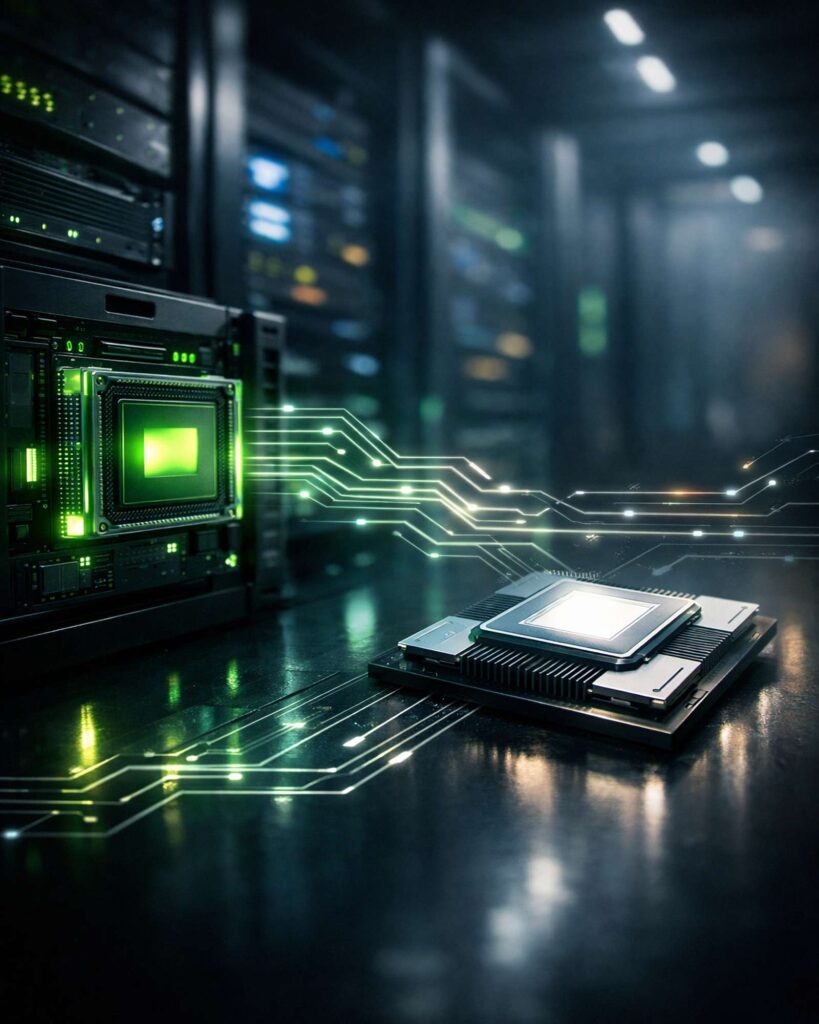
Groq said the agreement is aimed at accelerating high-performance AI inference globally. The startup has built its reputation around specialised chips known as Language Processing Units, or LPUs, which are designed specifically for inference rather than training. These chips prioritise predictable performance and ultra-low latency, relying heavily on on-chip memory to deliver fast and consistent response times — a key advantage for real-time applications such as chatbots, copilots and automated decision systems.
Alongside the technology licence, the agreement includes a significant talent shift. Groq founder Jonathan Ross, president Sunny Madra and several senior engineers are set to join Nvidia, where they will work on advancing and scaling the licensed inference technology. Groq has confirmed that it will continue operating independently under new leadership, with Simon Edwards appointed as chief executive, and will maintain its existing products and cloud-based services.
The structure of the arrangement stops short of a full acquisition, reflecting the intense regulatory scrutiny surrounding large technology deals. While Nvidia and Groq have not disclosed financial terms, market reports have pointed to a possible transaction value of around $20bn, a figure that would make it one of Nvidia’s largest deals to date. Both companies have declined to publicly confirm that valuation.
The licensing-plus-talent approach mirrors a growing trend among big technology firms, which are increasingly opting for partnerships and selective hiring rather than outright acquisitions in order to reduce antitrust risk. For Nvidia, the move strengthens its position as AI demand shifts toward deploying models efficiently at scale, complementing its dominance in AI training hardware with a sharper focus on inference performance.
Groq, meanwhile, gains a powerful partner while remaining independent in a fiercely competitive chip market. The company has positioned the deal as an opportunity to expand the reach of its inference-first technology while continuing to develop its own offerings, as competition intensifies among chipmakers racing to power the next generation of real-time AI services.
Details of the agreement were outlined in Groq’s official announcement, while reporting by Reuters highlighted the executive departures and the broader strategic context surrounding the deal. Additional reporting from Bloomberg also described the agreement as a non-exclusive licence focused on inference technology rather than a full takeover.

Make Swikblog your go-to source on Google for reliable updates, smart insights, and daily trends.