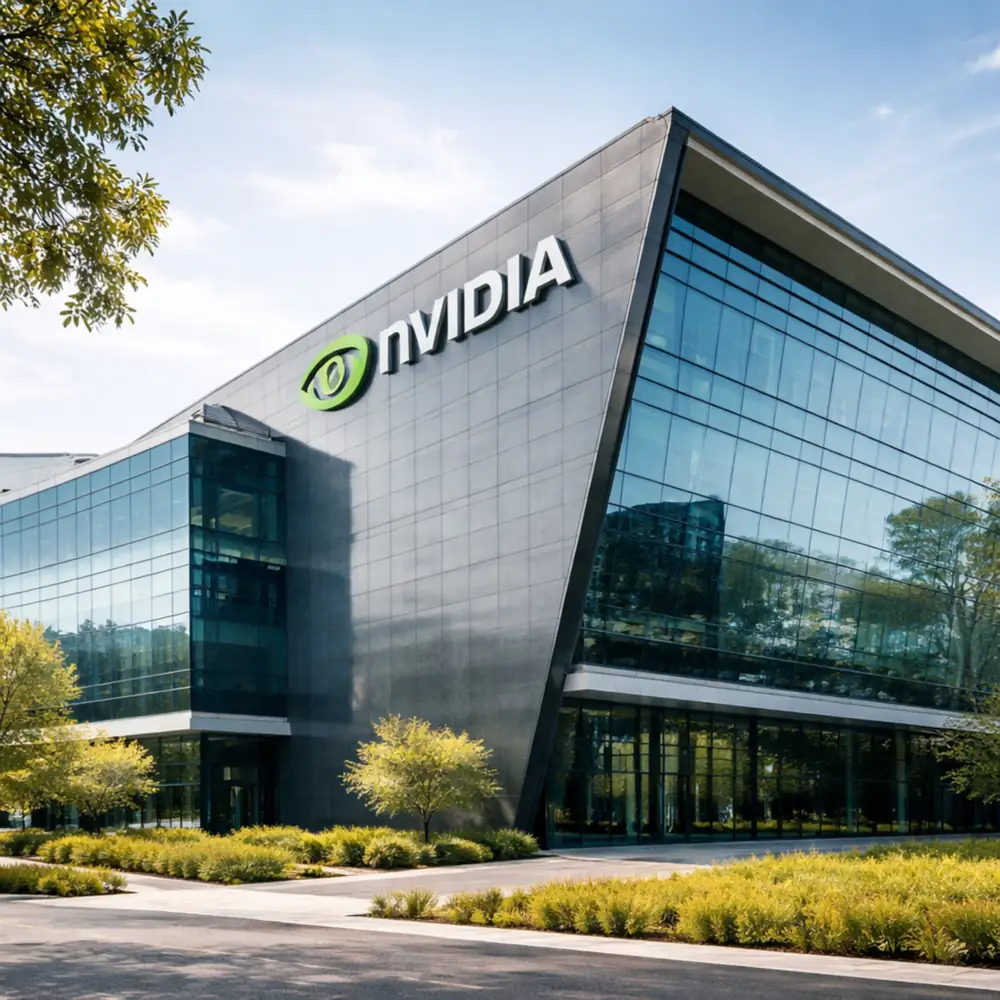

Nvidia stock gained 1.68% in the latest trading session, reaffirming its position as the dominant force in artificial intelligence chips even as rivals AMD and Intel posted stronger short-term gains. While AMD shares have surged 38% and Intel jumped 56% over the past month, analysts are increasingly warning that the rally in competing semiconductor stocks may be driven more by hype than by sustainable technological advantage.
The latest move in Nvidia (NVDA) reflects a broader shift in investor focus—from short-term momentum trades to long-term AI infrastructure leadership. Despite trailing its rivals in recent percentage gains, Nvidia continues to be viewed as the foundational player powering the global AI boom, with its next-generation Blackwell Ultra platform expected to extend that lead even further.
Wall Street analysts have doubled down on this view. Oppenheimer’s Rick Schafer recently reiterated an “Outperform” rating on Nvidia with a $265 price target, describing the company as an “AI castle on a hill.” The phrase captures what many investors now believe: Nvidia is not just ahead—it is structurally positioned above competitors, with advantages that are difficult to replicate.
At the heart of that dominance is performance efficiency. Nvidia continues to lead in performance-per-watt across both AI training and inference workloads, a critical metric as data centers face mounting power constraints. Hyperscalers like Meta and Google are increasingly prioritizing efficiency over raw hardware costs, giving Nvidia a clear edge in large-scale deployments.
The company’s upcoming Blackwell Ultra GB300 NVL racks are expected to play a major role in sustaining that leadership. Analysts have described the platform as being “two generations ahead” of competing solutions, offering capabilities that could redefine AI infrastructure economics. The system is engineered to handle next-generation, billion-parameter models with significantly improved throughput and efficiency.
One of the most striking claims surrounding Blackwell Ultra is its ability to deliver up to a 50x increase in AI factory output compared to Nvidia’s previous Hopper generation. In addition, the architecture incorporates advanced liquid cooling technology designed to cut electricity costs by as much as 40%, addressing one of the biggest bottlenecks in AI scaling today: energy consumption.
These innovations are not just technical milestones—they are financial drivers. As AI workloads expand, the total cost of ownership becomes a decisive factor for enterprise and cloud customers. Nvidia’s ability to reduce operating costs while increasing performance strengthens its value proposition and deepens its relationship with large buyers.
Meanwhile, the recent rally in AMD and Intel stocks has been largely fueled by optimism around CPU demand in AI servers. Intel, in particular, recently recorded its best nine-day streak on record, signaling renewed investor interest. However, analysts caution that this surge may be driven more by speculative positioning than by a meaningful shift in competitive dynamics.
AMD has also gained traction with its Instinct MI355X accelerators, particularly among cost-conscious customers. Yet the company still lacks the full-stack ecosystem that Nvidia offers. Nvidia’s CUDA software platform, combined with its NVLink high-speed interconnect technology, creates a powerful network effect that makes switching away from its ecosystem both costly and complex.
This ecosystem advantage is one of the key reasons why Nvidia continues to command strong investor confidence. Unlike competitors that primarily sell hardware, Nvidia delivers an integrated platform spanning chips, networking, software tools, and system-level optimization. That integration not only enhances performance but also locks in customers over the long term.
From a valuation standpoint, Nvidia is also drawing attention. The stock is currently trading at approximately 17 times its projected 2027 earnings, below the semiconductor sector average of around 20 times. This suggests that, despite its leadership position, Nvidia is not being priced at a premium relative to slower-growing peers—a factor that could attract further institutional interest.
Investor sentiment remains overwhelmingly positive. Nvidia holds a Strong Buy consensus rating based on 41 Buy, 1 Hold, and 1 Sell recommendation over the past three months. The average 12-month price target of $273.57 implies roughly 37.9% upside, reinforcing the belief that the stock still has significant room to run.
Looking ahead, Nvidia’s product roadmap continues to strengthen its long-term outlook. The company is already preparing its next architecture, Rubin, expected to launch in late 2026. This rapid innovation cycle makes it increasingly difficult for competitors to catch up, as each new generation builds on an already substantial lead.
The broader AI market also remains a powerful tailwind. Demand for high-performance computing, generative AI models, and data center expansion continues to grow at an accelerated pace. As one of the few companies capable of delivering end-to-end AI infrastructure, Nvidia is uniquely positioned to capture a large share of that growth.
For investors, the key takeaway is that Nvidia’s recent 1.68% gain reflects more than just daily market movement. It highlights a deeper conviction that the company’s technological edge, ecosystem strength, and forward-looking strategy are setting it apart in an increasingly competitive semiconductor landscape.
While AMD and Intel may continue to benefit from short-term momentum, the long-term narrative appears firmly in Nvidia’s favor. As the AI race intensifies, the company’s ability to stay multiple steps ahead could determine not just its own trajectory, but the direction of the entire semiconductor industry.
For more insights on global markets and semiconductor trends, visit Yahoo Finance.
You may like: Ford EV sales drop 70% as Toyota surges ahead in U.S. market

Make Swikblog your go-to source on Google for reliable updates, smart insights, and daily trends.