
NYT Connections for June 28, 2026, puzzle #1113 was tricky because several words looked obvious at first but had stronger second meanings. The yellow and green groups were manageable, but the blue and purple sets punished anyone who solved too quickly.
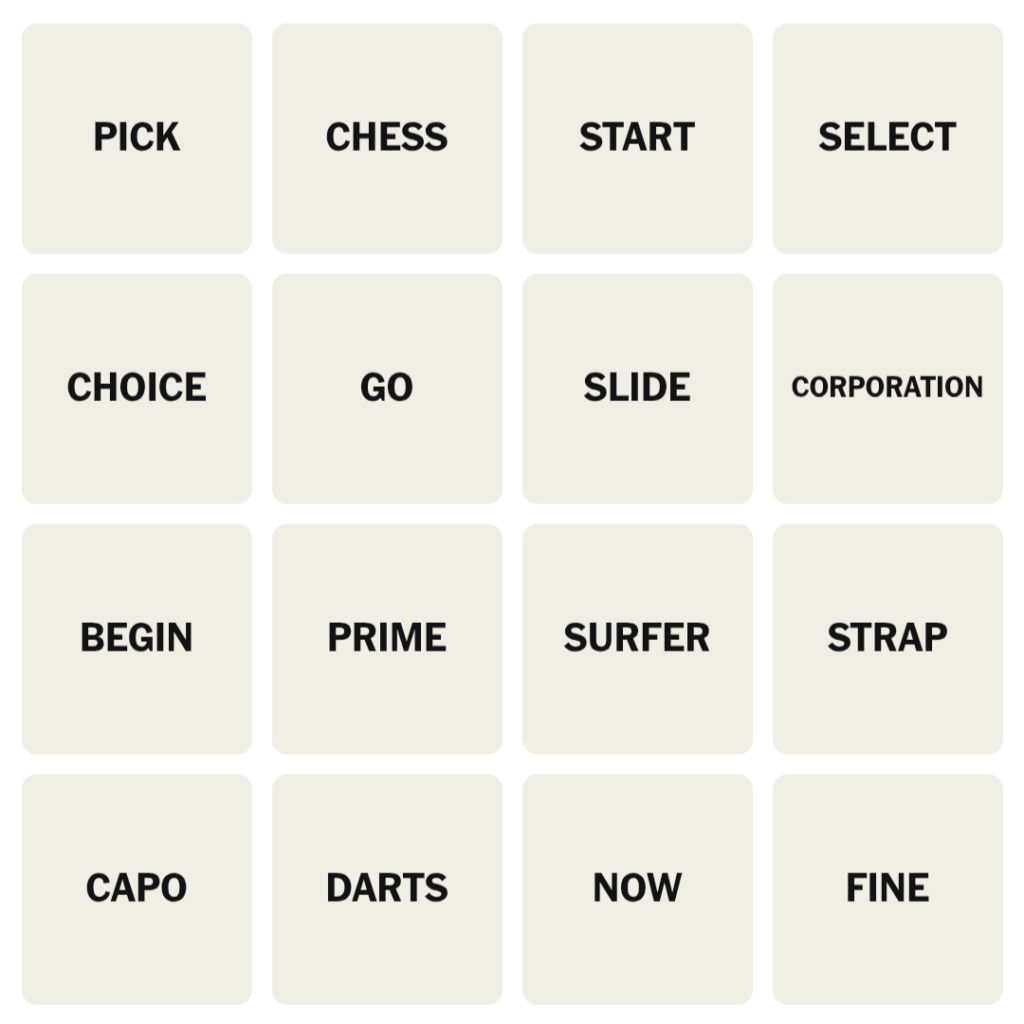
The main traps were “choice,” “select,” and “pick,” which seemed ready to form a selection group, and “slide,” which could be mistaken for movement rather than guitar gear. The purple group was the hardest because its answers came from very different areas but all connected through the idea of a board.
NYT Connections June 28 Hints
Yellow hint: These words describe something that is excellent or better than ordinary.
Sharper clue: Think premium quality, top grade, or specially preferred.
Trap to avoid: Do not pull in “pick” just because “choice” and “select” can relate to choosing.
Green hint: These are words that can signal the start of something.
Sharper clue: Imagine a race official, a countdown, or someone giving permission to begin.
Trap to avoid: “Now” may look too plain, but it works as a command to commence.
Blue hint: These are things a guitarist may use while playing.
Sharper clue: Look for guitar accessories, not guitar brands or music genres.
Trap to avoid: “Pick” and “slide” both have everyday meanings, but here they point to music equipment.
Purple hint: Each word connects to something that has a board.
Sharper clue: Think across games, sports, business, and surfing.
Trap to avoid: Do not force these into one topic. The shared link is hidden in the compound or related phrase.
Common wrong paths: The most tempting false group is “choice,” “select,” “pick,” and possibly “prime,” because all can feel connected to choosing the best option. That fails because “pick” is part of the guitarist-accessory group. Another wrong path is grouping “begin,” “start,” “go,” and “slide” as action or movement words, but “slide” works as guitar gear. The purple group is also easy to miss because “corporation” does not look like it belongs with “chess,” “darts,” or “surfer” until you think of a corporate board.
Today’s NYT Connections Answers
Yellow Group
Green Group
Blue Group
Purple Group
Solving lesson: Today’s puzzle rewarded players who waited before committing to obvious pairs. When a word has both a common meaning and a specialized meaning, such as “pick” or “slide,” it is worth checking whether a more specific category is hiding elsewhere on the board.
After solving, players can use the Connections Bot to review their result, get a numeric score, and see how their guesses shaped the board. Registered New York Times Games players can also track progress such as completed puzzles, win rate, perfect scores, and streaks.
For official gameplay and post-game analysis, players can visit the New York Times Connections page.

Make Swikblog your go-to source on Google for reliable updates, smart insights, and daily trends.