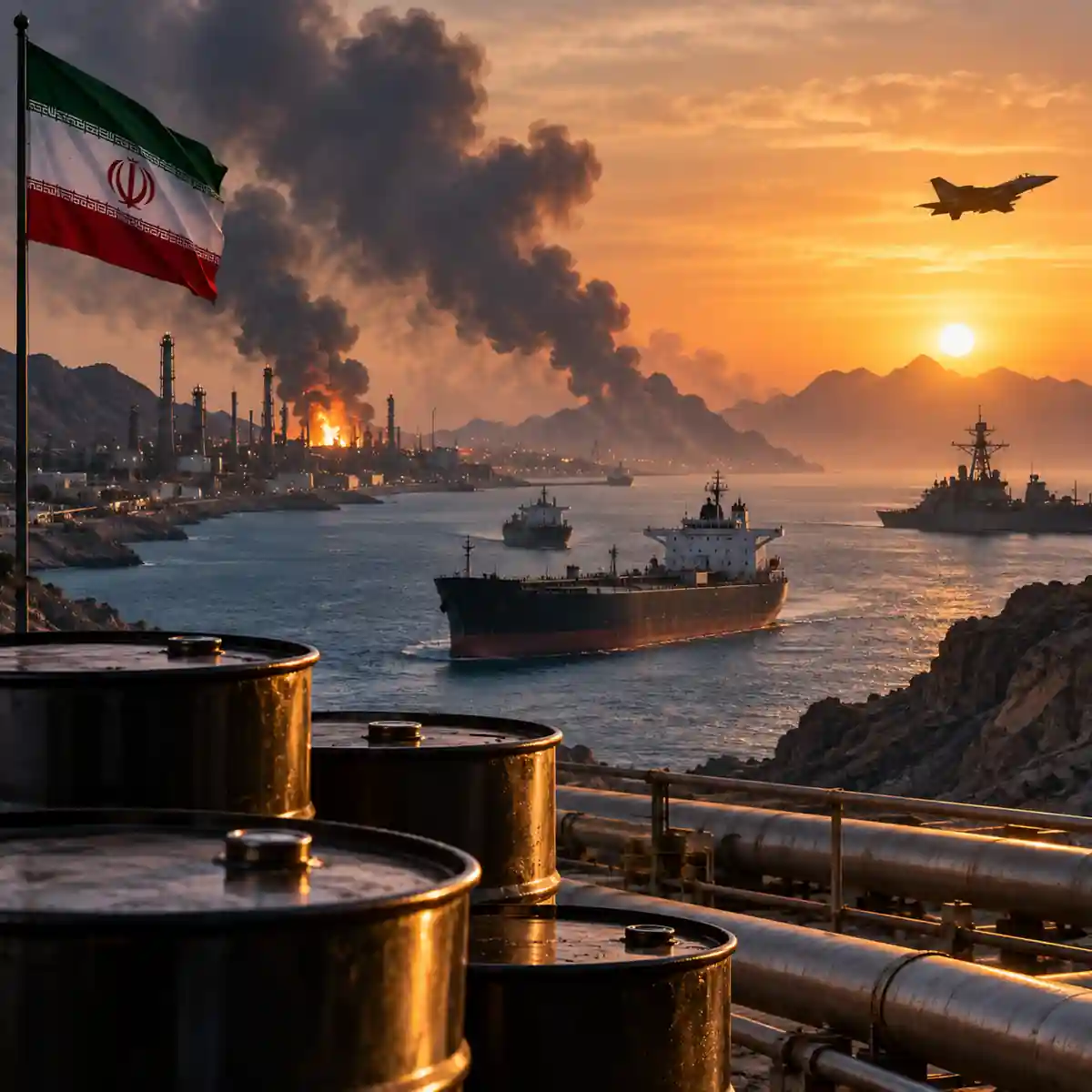
Oil prices steadied in volatile trading as markets absorbed a major geopolitical development: the United States signaling potential protection for tankers crossing the Strait of Hormuz. The announcement from President Donald Trump eased immediate fears of a prolonged shipping disruption, helping calm crude markets that had surged earlier in the week as conflict risks escalated in the Middle East.
U.S. benchmark West Texas Intermediate (WTI) crude futures traded around $74.56 per barrel, holding near session lows after retreating from recent highs near $77. Meanwhile, global benchmark Brent crude hovered close to $81 per barrel after briefly spiking above $84 during the peak of market panic. The pullback reflects investors reassessing worst-case supply disruption scenarios as Washington signals direct intervention to protect global energy shipping routes.
Hormuz chokepoint drives global oil risk
The Strait of Hormuz remains one of the most critical energy corridors in the world. Roughly 20% of global oil and LNG supplies move through the narrow waterway each day, linking Middle Eastern producers with major consumers across Asia, Europe, and North America.
Over the past several days, tanker traffic through the region dropped dramatically as shipowners halted voyages due to escalating military threats and soaring insurance premiums. Maritime data providers reported that transit activity nearly stopped as insurers tightened war-risk coverage and ship operators chose to wait for security guarantees before resuming shipments.
In response to the crisis, the White House signaled it could provide political risk insurance and financial guarantees for vessels transporting energy cargo through the Gulf. The administration also suggested the possibility of U.S. Navy escorts for tankers if security conditions deteriorate further.
The move represents one of the most direct government interventions into global shipping security in years and highlights how quickly geopolitical tensions can reshape energy markets.
Markets shift from supply fears to policy response
Energy traders initially priced in the possibility of a prolonged disruption to Middle East oil flows when tensions escalated earlier in the week. If shipments through the Strait of Hormuz were halted for an extended period, analysts warned that millions of barrels per day of crude could be stranded, pushing global oil prices sharply higher.
However, the White House proposal changed the market narrative from pure supply risk to policy response. By offering insurance guarantees and potential naval escorts, the administration is attempting to restore confidence among shipping companies and insurers that cargoes can move safely.
Strategists say the signal alone helped stabilize markets.
“The reassurance that policymakers are actively addressing the shipping crisis has reduced some of the extreme risk premium in crude prices,” analysts noted, though they cautioned the solution may only be temporary.
Insurance crisis complicates tanker movements
Despite the policy announcement, the biggest obstacle for global oil flows may still be the maritime insurance market. War-risk insurance premiums for vessels operating near conflict zones have surged dramatically, and some insurers have refused to offer coverage for ships planning to cross the Strait.
Without insurance, tanker operators face enormous financial risks if vessels are damaged or seized, making many voyages economically impossible.
Industry specialists say shipping companies are now waiting for clearer details about the proposed U.S. guarantees before committing to new voyages. Questions remain about how quickly the policy can be implemented and what specific risks the coverage would include.
Even if escorts are provided, each transit could become a highly visible military operation, potentially raising tensions rather than easing them.
WTI and Brent reflect regional risk dynamics
The divergence between the two major crude benchmarks also reflects the geography of the crisis.
Brent crude, which prices a large share of internationally traded oil cargoes, remains more sensitive to disruptions in Middle Eastern shipping lanes. That explains why Brent held above $80 even as WTI slipped back toward the mid-$70s.
WTI crude, tied more closely to North American supply dynamics, has a larger domestic buffer thanks to U.S. production and inventories. This structural difference often causes Brent to rise faster during geopolitical shocks affecting seaborne oil trade.
Still, analysts caution that a prolonged shutdown of the Strait of Hormuz could rapidly lift both benchmarks. With global spare production capacity limited and demand still resilient, even temporary supply disruptions can quickly ripple across international markets.
Key levels traders are watching
For now, traders are focusing on several critical price levels and geopolitical triggers.
WTI crude is stabilizing near the $74 region, with intraday trading between $74.23 and $77.23. A break above the upper end of that range could signal renewed supply fears, while sustained movement below $74 would indicate markets believe shipping flows will resume normally.
Brent crude continues to hold the geopolitical premium near $81 per barrel, a level that reflects ongoing uncertainty about tanker movements through the Gulf.
The next major catalyst will likely come from real-world shipping activity. If escorted tankers successfully cross the Strait without incident, risk premiums in oil prices could ease further. But any escalation or attack on vessels could quickly push crude prices higher again.
Energy analysts continue to monitor the strategic importance of the corridor, which the U.S. Energy Information Administration describes as the world’s most important oil transit chokepoint because of the enormous volume of global supply that passes through it daily.
Until shipping flows normalize and insurers regain confidence in the route, oil markets are likely to remain highly sensitive to headlines from the Middle East. For investors, that means volatility in crude prices—and energy stocks—may remain elevated in the weeks ahead.

Make Swikblog your go-to source on Google for reliable updates, smart insights, and daily trends.