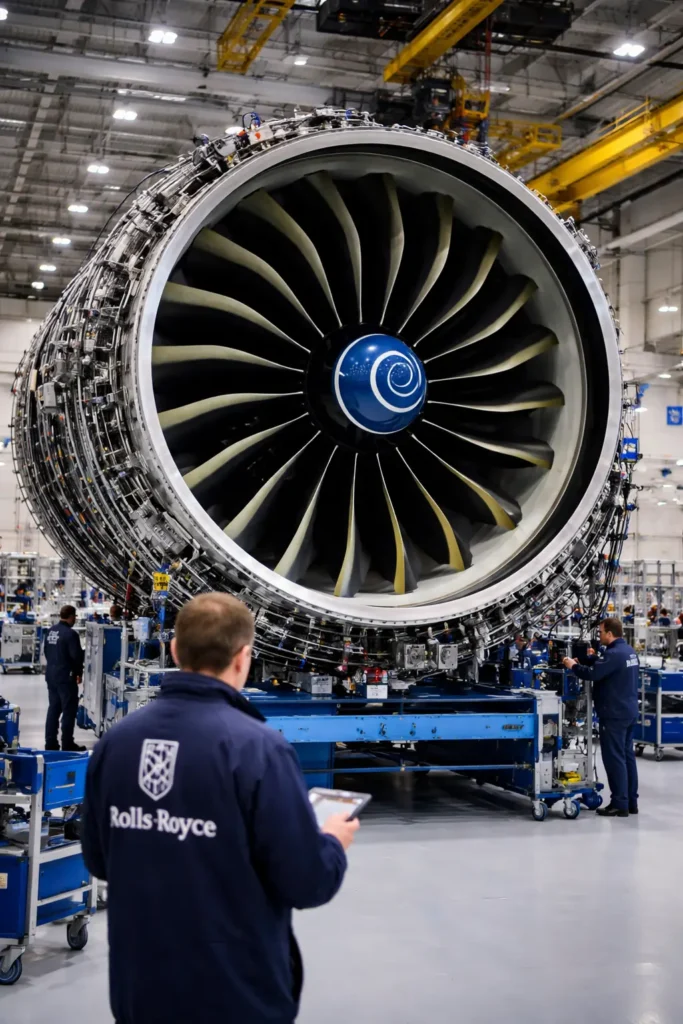

Rolls-Royce shares have fallen back below the £12 level after a sharp pullback of nearly 10% in recent weeks, leaving investors questioning whether this is a temporary dip or the start of a deeper correction. The stock, which traded around £13.10 ahead of its February results, has slipped to roughly £11.8–£11.9, reflecting growing market caution despite strong underlying performance.
This drop comes after an extraordinary rally. Rolls-Royce shares have surged around 87% over the past year and nearly 965% over the last five years, making it one of the FTSE 100’s most remarkable turnaround stories. But such a rapid rise has also pushed expectations — and valuations — to demanding levels.
Strong numbers, but expectations are even higher
On paper, the business continues to deliver. Rolls-Royce reported 2025 underlying operating profit of £3.5bn, up 38% year-on-year, beating analyst expectations. Free cash flow came in strong, and earnings per share reached around 29.5p. Management also upgraded its medium-term targets, with projections for operating profit to reach £4.9bn–£5.2bn by 2028 and free cash flow of £5bn–£5.3bn.
These numbers reinforce confidence in the company’s turnaround strategy, driven by cost-cutting, improved execution, and stronger performance across civil aerospace, defence, and power systems. The company has also stepped up shareholder returns, with buybacks expected to support the share price further.
Yet despite this, the market reaction has been muted. One reason is valuation. Even after the recent fall, Rolls-Royce trades at a price-to-earnings ratio of around 31 times — more than double its long-term average of 15. That suggests much of the good news may already be priced in.
Why the stock is falling despite good news
The biggest concern right now is not the company’s performance, but its exposure to external risks — particularly in civil aerospace. Around 60% of Rolls-Royce’s profits are linked to aircraft engine sales and long-term servicing agreements tied to flight hours. This makes the company highly sensitive to global aviation trends.
Recent geopolitical tensions in the Middle East have added fresh uncertainty. Airspace disruptions, rising oil prices, and higher fuel costs are already impacting airline operations. If flight activity slows or ticket demand weakens, Rolls-Royce’s high-margin service revenues could come under pressure.
There are also concerns that the conflict could worsen supply chain challenges, potentially increasing costs and delaying key projects. At the same time, higher fuel prices could reduce disposable income and dampen global travel demand over the coming months.
This explains why investors have started to reassess the stock, even as defence spending remains a strong long-term tailwind. While Rolls-Royce is well positioned to benefit from rising military budgets, defence still accounts for a smaller portion of earnings compared to civil aerospace.
£17 upside or 900p downside?
Analyst opinions highlight just how divided the market is. One bullish forecast suggests the shares could rise as high as £17.40 — implying a potential 46% upside from current levels. On the other hand, a bearish view sees the stock falling to around 900p, a drop of roughly 24%.
In reality, the consensus sits somewhere in between. The average analyst price target is about £14.42, suggesting around 20% upside over the next 12 months. This reflects confidence in the company’s long-term growth, but also acknowledges the risks in the near term.
For investors, this wide range of outcomes underlines a key shift. Rolls-Royce is no longer a cheap turnaround story. It is now a premium-priced stock where future performance needs to justify its valuation.
Dip to buy or warning sign?
The recent drop below £12 may offer a more attractive entry point compared to recent highs, especially for long-term investors who believe in the company’s growth story. Rolls-Royce continues to benefit from strong defence demand, improving aerospace recovery, and emerging opportunities such as small modular reactors.
However, the risks cannot be ignored. If geopolitical tensions escalate further or aviation demand weakens more than expected, the stock could remain under pressure. With expectations already high, even a slight slowdown in growth could trigger further downside.
For now, Rolls-Royce sits at a critical juncture. The fundamentals remain strong, but the market is clearly becoming more cautious. Whether this proves to be a buying opportunity or the start of a broader correction will depend on how the company navigates an increasingly uncertain global environment.
You may like: Shell Share Price Jumps as Oil Surges Above $111 on Trump Iran Deadline

Make Swikblog your go-to source on Google for reliable updates, smart insights, and daily trends.