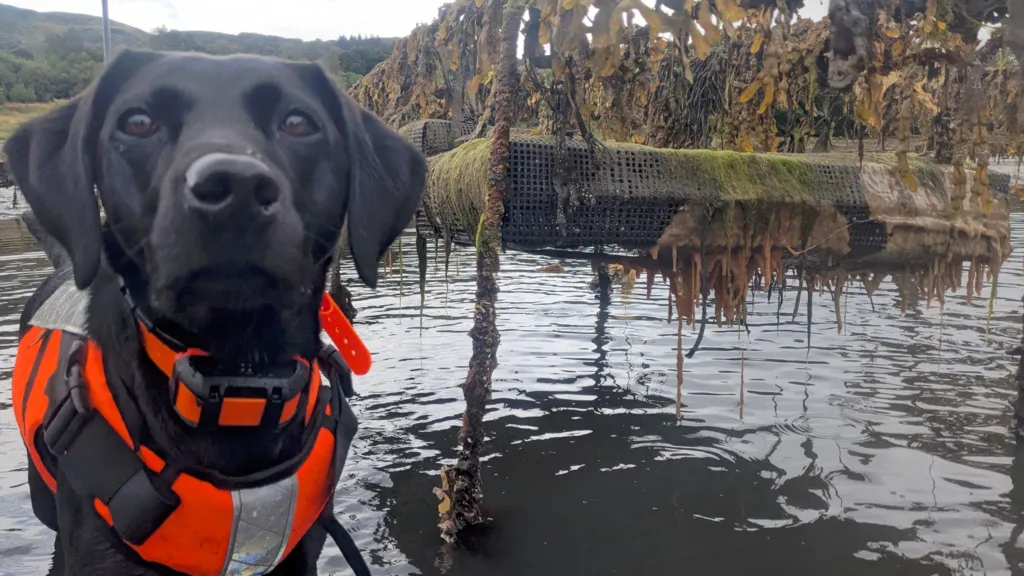

A six-year-old black Labrador from the Scottish Highlands has been named Animal of the Year 2026 for an unusual mission: hunting down an invasive marine creature nicknamed “sea vomit” that threatens Britain’s coastal wildlife and shellfish farms.
The dog, named Sgiath (pronounced “Skee-ah”), received the honor from the International Fund for Animal Welfare (IFAW) at its 26th annual Animal Action Awards in London on Thursday, October 15, 2026.
Working with her owner, marine ecologist Dr. Texa Sim, Sgiath has helped identify hundreds of colonies of carpet sea squirt, a fast-spreading organism that can smother native marine life and damage coastal infrastructure.
Meet Sgiath, the Scottish Labrador Behind the Award
Sgiath lives near Glencoe in the Scottish Highlands with Dr. Sim, a marine ecologist originally from Glasgow who has raised her since puppyhood.
Before becoming a marine detection specialist, the black Labrador was trained as a mountain rescue dog, learning to locate missing hikers across challenging Highland terrain.
Her intelligence and ability to recognize scents inspired Sim to explore whether those skills could also help protect marine ecosystems.
From Mountain Rescue to Hunting ‘Sea Vomit’
The project began while Sim was working on native oyster restoration along Scotland’s west coast. She wanted a faster way to identify invasive organisms that often remain hidden among seaweed and marine equipment.
Sim trained Sgiath to recognize the scent of carpet sea squirt, scientifically known as Didemnum vexillum.
During an early training exercise, Sgiath successfully identified the target organism among several similar scents, demonstrating the potential of the approach.
According to BBC News, Sgiath is believed to be the UK’s first dog trained to detect carpet sea squirt.
How Sgiath Detects the Invasive Sea Creature
Sgiath accompanies Sim during low-tide coastal surveys, searching around oyster cages, seaweed-covered rocks and other marine structures.
Unlike mountain rescue work, where she barks to alert her handler, Sgiath uses a quiet signal when detecting the marine organism.
Known as a “passive indication,” the behavior involves becoming still or staring toward the suspected colony.
Her scent-detection ability helps researchers locate organisms that may be difficult to identify visually and could otherwise require specialist examination or DNA testing.
Planet Zoo 2: Aquariums, Flying Animals and Latest Release Date Updates
Jonathan the 193-Year-Old Tortoise: The Truth Behind Viral Death Rumors
The Invasive ‘Sea Vomit’ Threatening UK Coastlines
Carpet sea squirt is a colonial marine animal that forms thick, slimy growths across underwater surfaces. Its appearance, often orange or cream-colored, explains its unpleasant nickname.
Scientists believe the species originated around Japan. It was first recorded along southern England and Wales in 2008 before spreading to other coastal locations.
The organism can cover native wildlife, compete for space and interfere with oyster farms, aquaculture pens, pontoons and boat propellers.
Marine biologist Dr. Martyn Kurr of Bangor University has warned that invasive species can disrupt marine ecosystems and create expensive maintenance problems.
Managing marine invaders costs millions of pounds annually across Europe.
Warming Seas Could Increase the Threat
Researchers are concerned that warmer seawater could create favorable conditions for invasive organisms to spread more widely around Britain’s coastline.
Early detection is particularly important because established colonies can be difficult to manage.
Sgiath does not remove the organisms herself. Instead, she helps scientists identify suspected colonies so conservation teams can investigate and consider appropriate action.
Marine conservation also requires careful management of wildlife interactions, as illustrated by the leopard seal incident at Tauranga’s boat ramp, where authorities protected a wild marine animal while managing public access.
IFAW Honors Sgiath for Pioneering Conservation Work
IFAW recognized Sgiath at its October 15 awards ceremony for demonstrating how trained dogs can contribute to marine conservation.
Sharon Livermore, IFAW’s director of marine conservation, praised her pioneering role in expanding the use of detection dogs beyond traditional search-and-rescue work.
Dr. Sim has emphasized that detection dogs cannot eliminate invasive marine species alone, but their abilities could help conservationists respond before infestations become widespread.
Life Beyond the Coastline
When she is not searching beaches or training for mountain rescue, Sgiath enjoys spending time at home with Sim and another Labrador named Uisage.
Both dogs respond to rewards including treats and play. Sgiath also enjoys relaxing under her dog blanket between assignments.
Her achievement highlights the versatility of working dogs and the growing importance of conservation research, including wildlife recovery initiatives such as India’s Kuno cheetah conservation programme.
Although Sgiath has helped locate hundreds of invasive colonies, publicly available reports do not establish an exact detection accuracy rate or financial savings. Her work nevertheless offers scientists another promising tool for protecting vulnerable coastal ecosystems.

Make Swikblog your go-to source on Google for reliable updates, smart insights, and daily trends.