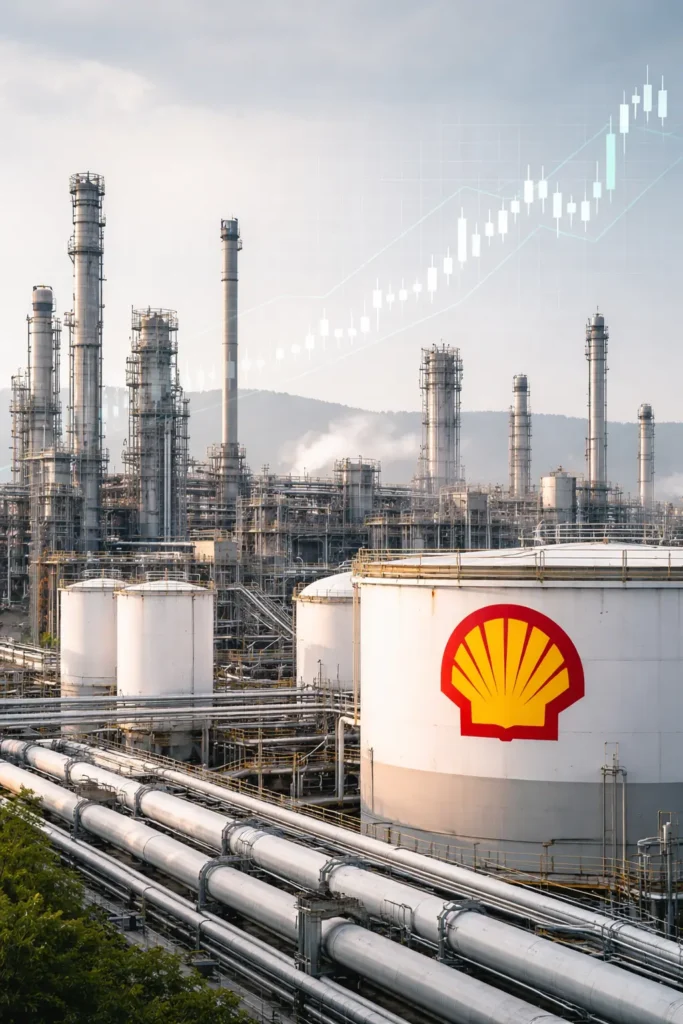

Shell shares today fall to £34.55, down 0.55%, even as the energy major pushes ahead with a strategic divestment that could reshape its long-term growth trajectory. The decline comes after Shell confirmed the sale of its Jiffy Lube International unit and subsidiary Premium Velocity Auto to Monomoy Capital Partners, a move that highlights the company’s ongoing focus on capital discipline and portfolio optimization.
While the immediate price reaction appears negative, the underlying strategy signals a deeper transformation within Shell’s business model. The company is steadily exiting non-core, lower-return segments while redirecting capital toward higher-margin opportunities, particularly in liquefied natural gas (LNG) and core oil and gas operations.
Jiffy Lube Sale Signals Capital Recycling Strategy
The divestment of Jiffy Lube is not just a routine asset sale. It represents Shell’s broader effort to streamline operations and improve return on invested capital. Retail automotive service businesses like Jiffy Lube are capital-intensive and offer relatively lower returns compared to upstream and integrated gas segments.
Importantly, Shell is not completely exiting the value chain. The company will retain a long-term supply agreement with Jiffy Lube, ensuring continued demand for its lubricants. This allows Shell to maintain revenue streams while freeing up capital and management bandwidth.
For investors, this hybrid approach — exiting ownership while retaining commercial ties — is a key signal of smarter capital allocation. It shows Shell is prioritizing efficiency without sacrificing market presence.
LNG Demand Outlook Remains the Core Growth Driver
The bigger story behind Shell’s strategy lies in LNG. The company has reiterated strong long-term demand projections, expecting global LNG demand to grow between 54% and 68% by 2040, and potentially 45% to 85% by 2050 from current levels of around 422 million metric tons.
Shell has refined its 2040 forecast range to 650–710 million metric tons annually, reinforcing confidence in LNG as a key energy source in the global transition. Asia is expected to drive nearly 70% of incremental demand growth, supported by rapid industrialization, urbanization, and a shift away from coal-based energy systems.
LNG is increasingly being positioned as a “transition fuel,” offering lower emissions compared to coal while providing the flexibility needed to support renewable energy systems. Shell’s strong presence in this segment, combined with its global infrastructure and trading capabilities, positions it as a major beneficiary of this long-term trend.
Operational Momentum Supports Growth Outlook
Shell’s LNG business has already demonstrated strong performance, with sales rising 11% in 2025. This growth was supported by record cargo deliveries and the ramp-up of major projects such as LNG Canada.
Looking ahead, the company aims to grow LNG sales by 4% to 5% annually through 2030. This steady growth target adds visibility to future earnings and supports Shell’s broader strategy of building resilient cash flows across commodity cycles.
However, Shell also acknowledges potential challenges, including geopolitical risks and increasing scrutiny from climate-focused investors regarding the alignment of LNG expansion with long-term net-zero goals.
Valuation: Cheap or Fully Priced?
Shell’s valuation presents a mixed picture. According to Simply Wall St, the shares are trading at approximately 59.4% below their estimated fair value, suggesting significant upside potential based on intrinsic valuation models.
However, analyst consensus tells a slightly different story. The current share price of £34.55 is around 6.8% above the average analyst target of £32.53. This indicates that while long-term valuation models see upside, the shares may already be fairly valued or slightly stretched in the near term.
The company’s price-to-earnings (P/E) ratio stands at 14.7, compared to the industry average of around 11.4. This premium suggests investors are assigning higher expectations to Shell’s future growth, particularly in LNG and integrated energy operations.
Dividend Risk Remains a Key Watchpoint
One of the key risks highlighted in the analysis is Shell’s dividend track record. While the company remains a strong income-generating name with a yield of around 3.2%, its dividend history has shown periods of instability.
For income-focused investors, this is an important factor to monitor. Any changes in dividend policy as Shell continues its portfolio restructuring could impact investor sentiment and share performance.
Why the Shares Fell Despite Positive Strategy
The 0.55% decline in Shell’s share price today likely reflects short-term market dynamics rather than a fundamental shift in outlook. The shares are trading near their 52-week highs, which limits immediate upside unless there is a strong earnings surprise or major catalyst.
Additionally, investors may be adopting a wait-and-watch approach to see how Shell deploys the capital from the Jiffy Lube sale. The success of this strategy will depend heavily on whether the company can generate higher returns from reinvested capital.
Broader market factors, including oil price fluctuations and global economic uncertainty, may also be influencing short-term price movements.
What Investors Should Watch Next
Going forward, three key factors will determine Shell’s investment outlook. First, how effectively the company allocates capital from asset sales into high-return projects. Second, the continued performance and expansion of its LNG business. Third, any updates to dividend policy and shareholder returns.
If Shell can successfully execute on these fronts, the long-term investment case could strengthen significantly despite short-term volatility.
Investors can explore more about Shell’s strategy and operations on its official website, while broader energy market insights are available through the International Energy Agency.
In summary, today’s dip to £34.55 may not reflect weakness but rather a pause as markets digest a strategic shift. Shell’s continued focus on LNG growth and capital efficiency suggests that the real story lies not in the short-term price movement, but in how the company is positioning itself for the future of global energy.
You may like: BMO stock gains attention as US expansion adds 145 branches across California and Arizona

Make Swikblog your go-to source on Google for reliable updates, smart insights, and daily trends.