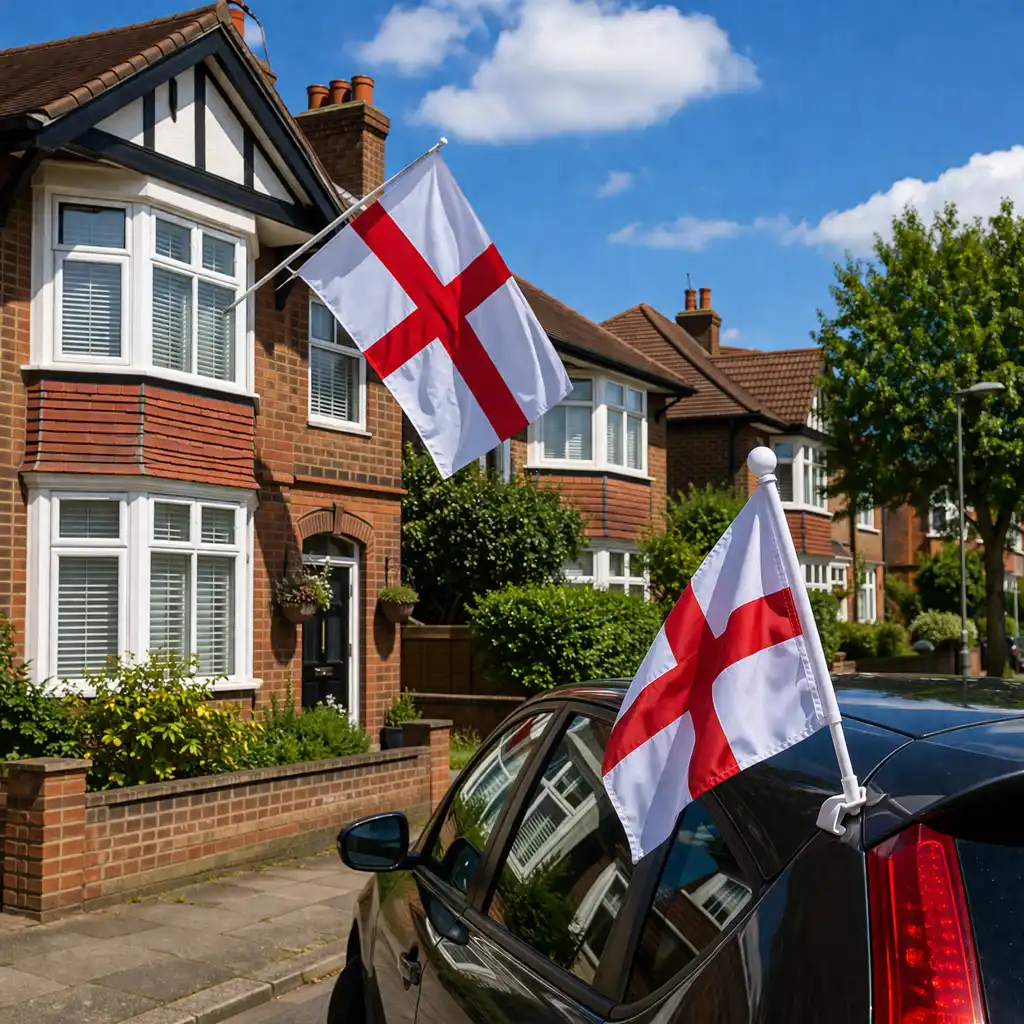

St George’s Day 2026 is approaching on April 23, and across England many households and drivers are preparing to display the St George’s Cross. But alongside the celebrations, fresh warnings have been issued about UK flag rules, with experts highlighting that Britons could face fines of up to £2,500 for breaching planning regulations — and up to £1,000 for unsafe displays on vehicles.
The renewed attention comes as the England flag becomes more visible in public spaces, from homes and rooftops to car windows. While flying the national flag is widely encouraged, legal guidance shows that how and where it is displayed still matters.
Flag Rules at Home and the £2,500 Fine Risk
In the UK, flags are often treated as a form of advertisement under planning law. While the government has relaxed restrictions in recent years to allow more freedom in displaying national flags, certain limits remain in place.
Homeowners are generally allowed to fly the England flag without permission if it is mounted on a vertical flagpole on the roof. In these cases, there are no strict size limits, provided the display is safe and maintained properly.
However, stricter rules apply if the flag is attached to other parts of a building. For example, if a flagpole projects from a wall rather than the roof, the flag must not exceed two square metres in size. In some controlled areas, such as Areas of Outstanding Natural Beauty, additional permission may also be required.
Authorities can take action if a flag breaches these regulations. While most cases are resolved through warnings or requests to remove the flag, failure to comply could result in fines of up to £2,500 under planning laws. The penalty may increase further if the issue continues after formal notice.
Guidelines also state that flags must be kept in good condition, must not pose a safety risk, and should not obscure official signs or create hazards in public spaces.
Full details of the official guidance can be found on the UK Government website.
Read the official UK flag flying rules
Car Flags and the £1,000 Driving Fine
Drivers displaying England flags on vehicles face a different set of rules, primarily focused on safety. The Highway Code makes it clear that drivers must always have a full and unobstructed view of the road and surrounding traffic.
This means that any flag attached to a car must not block windows, mirrors, or create blind spots. Even a small obstruction could be considered a risk, particularly when reversing or changing lanes.
Experts also warn that flags can act as a distraction. Movement, flapping noise, or the visual presence of a flag may take a driver’s attention away from the road, even briefly. If this distraction contributes to dangerous driving or an accident, it could lead to serious consequences.
In such cases, motorists could face fines of up to £1,000, along with three penalty points on their licence. Authorities may also take action if a flag is not securely fixed and poses a risk to other road users.
According to safety guidance, distractions while driving can be visual, physical, or cognitive. Something as simple as adjusting a loose flag or reacting to its movement could reduce a driver’s focus at a critical moment.
How Flags Should Be Displayed Properly
Guidance from flag experts also outlines how flags should ideally be positioned. On vehicles, flags are typically recommended to be mounted on a staff fitted to the front-right wing, the centre of the bonnet, or the roof. If two flags are used, the more important flag should be placed on the right side.
For painted or fixed designs, the correct orientation of the flag should be maintained depending on the side of the vehicle, ensuring the flagpole appears in the proper direction.
While these rules are often associated with official or ceremonial use, they highlight the importance of displaying flags in a respectful and consistent way.
What Britons Should Keep in Mind
Despite the warnings, there is no restriction on celebrating St George’s Day or showing national pride. In fact, the government has made efforts to make flag flying more accessible in recent years.
However, the key message ahead of April 23 is that celebrations should not ignore existing laws. For homeowners, this means checking how the flag is mounted and ensuring it meets size and placement rules. For drivers, it means making sure any flag does not interfere with visibility or control of the vehicle.
The recent headlines around fines appear to have been driven by increased awareness rather than widespread enforcement. Still, with more people choosing to display flags, authorities are reminding the public that safety and compliance remain essential.
As St George’s Day approaches, the sight of England flags is expected to return to streets, homes, and cars across the country. For most people, there will be no issue — but understanding the rules could help avoid unnecessary penalties while still enjoying the d
You may like: Miley Cyrus engagement rumors spark fresh interest in Maxx Morando

Make Swikblog your go-to source on Google for reliable updates, smart insights, and daily trends.