
Wall Street snapped sharply higher on Monday after President Donald Trump said the United States and Iran had held “very good and productive” talks, giving investors fresh hope that the Middle East conflict may not spiral further into a deeper energy shock. The shift in tone sparked a powerful relief rally across stocks, while oil prices fell hard and volatility cooled after a tense stretch that had pushed investors toward recession fears.
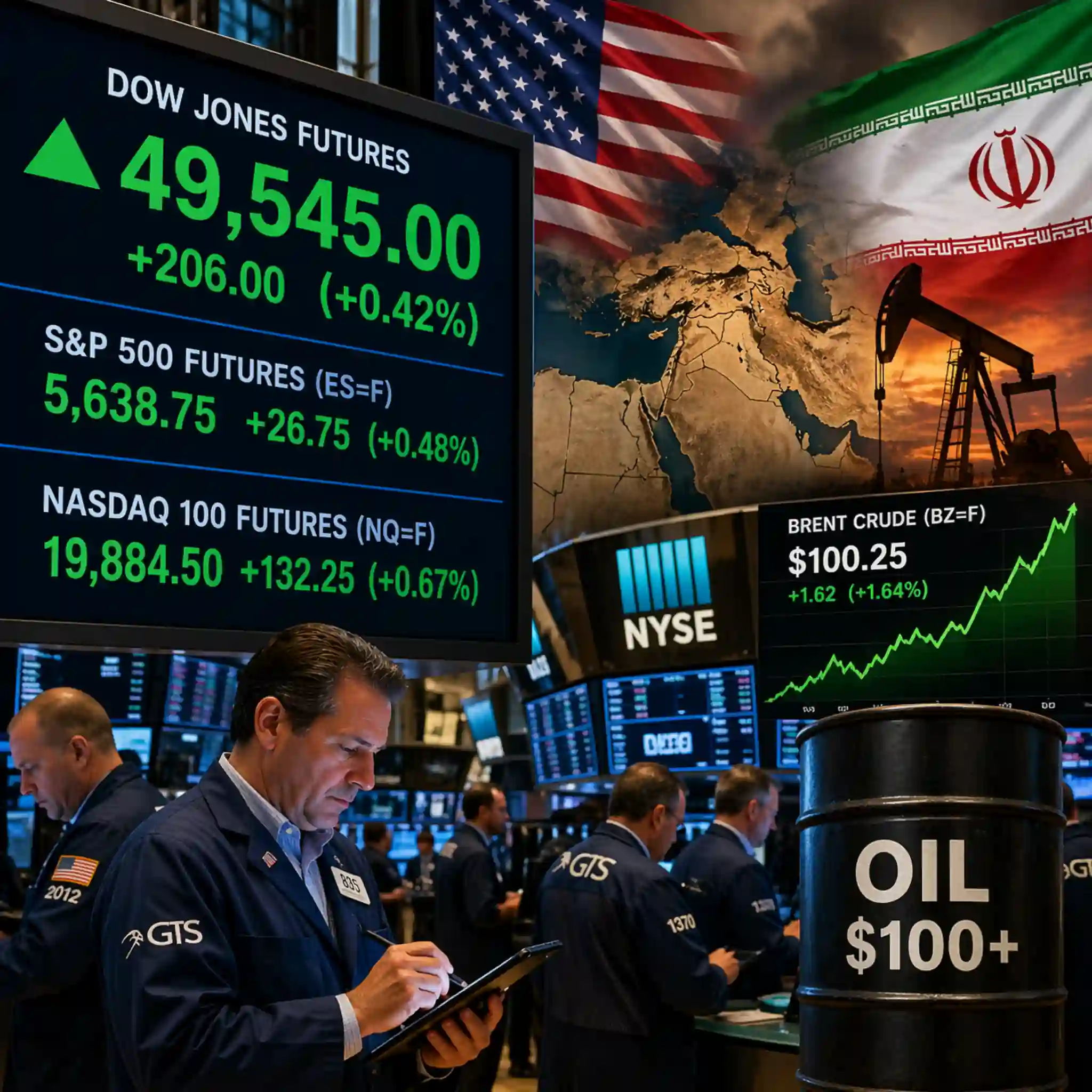
By late morning in New York, the Dow Jones Industrial Average had jumped 960 points, or 2.1%. The S&P 500 rose 1.8% and the Nasdaq Composite gained 2%. Earlier in the session, Dow futures had briefly surged by more than 1,000 points after Trump’s comments hit the market.
The move marked a major turnaround from the market mood before the open. Futures had been pointing lower as traders braced for more damage from surging crude prices and uncertainty around the duration of the Iran conflict. Instead, Trump’s announcement that strikes on Iranian power plants and energy infrastructure would be postponed for five days gave markets the one thing they had been missing: a credible hint of de-escalation.
Trump’s Iran comments flip the market narrative
Trump said the U.S. and Iran had held talks over the last two days and described them as constructive, adding that discussions would continue throughout the week. He also said later Monday that both sides want to “make a deal” and could connect by phone the same day.
That message immediately changed the direction of risk assets. For markets that had been under pressure from the possibility of widening attacks and tighter energy supply, the pause in planned strikes was enough to trigger a broad rebound. Even so, the relief trade lost a little momentum later in the morning after Iranian state media said there were no direct talks between Washington and Tehran, a reminder that the situation remains fluid and headline-driven.
Oil tumbles as fear premium unwinds
The biggest move came in crude. West Texas Intermediate futures fell more than 10% to around $87 a barrel, while Brent crude dropped more than 11% to roughly $99 a barrel. Earlier live market updates also showed WTI near $92.29 and Brent around $105.09 as prices moved sharply lower through the session.
The selloff in oil mattered because energy prices had become the market’s main pressure point. Investors had feared that prolonged hostilities, along with the threat to the Strait of Hormuz, would keep fuel costs elevated, tighten financial conditions and weigh on global growth. Monday’s oil reversal eased some of those immediate worries and opened the door to a rally in sectors that had been hit hardest by the energy spike.
Airlines, banks, industrials and tech lead the rebound
The rally was broad and forceful. Airline stocks were among the clearest winners as fuel-cost pressure eased, with Delta Air Lines up 4% and United Airlines up 5%. Cruise operators also rebounded strongly in premarket action, with Carnival and Royal Caribbean both jumping on hopes that lower oil and reduced geopolitical stress would support travel demand.
Financials participated as well. JPMorgan Chase climbed more than 2% and Morgan Stanley rose 3%. Industrial names tied to economic activity gained ground, with Caterpillar up 3% and Deere adding 1%. Technology also joined the bounce, with Apple and Nvidia both higher by around 2%.
Not every corner of the market shared in the upside. Energy stocks moved lower as crude retreated, with names such as Occidental Petroleum, EOG Resources and Chevron falling in premarket trading alongside the drop in oil.
More than 90% of S&P 500 stocks moved higher
Monday’s rebound was not a narrow bounce concentrated in a few mega-cap names. It was a market-wide move. All 11 sectors of the S&P 500 traded higher in morning trading, and more than nine out of every 10 stocks in the index advanced.
On the New York Stock Exchange, advancers led decliners by roughly 7 to 1, with 2,181 stocks higher against just 395 lower. That breadth showed how aggressively investors rotated back into risk once oil began falling and the geopolitical narrative softened.
VIX drops, Treasury yields retreat and bitcoin rebounds
Other asset classes reflected the same shift in mood. The Cboe Volatility Index fell back below 30 to around 25.45 after earlier topping 30, which had been its highest reading since March 9. That drop suggested investors were rapidly unwinding some of the fear premium built into the market.
In bonds, the two-year Treasury yield dropped as low as 3.801% after trading above 4.01% earlier. It was later around 3.867%. Because the two-year yield is especially sensitive to Federal Reserve expectations, the move showed traders stepping back from some of the rate anxiety that had intensified during the oil spike.
Interest-rate futures also shifted. Trading pointed to about 58% odds that the Fed funds rate will remain unchanged at 3.50% to 3.75% by the October policy meeting, up sharply from less than 8% a month earlier.
Bitcoin joined the rebound in risk assets. The cryptocurrency rose more than 3% and traded near $70,298 after briefly moving above $71,000. Earlier in the day, it had dipped below $68,000.
Industrial metals and risk sentiment recover
The easing in oil prices also helped industrial commodities recover. Copper rose nearly 3%, while palladium added just under 1%. Both metals had been hit hard last week as traders worried that a prolonged energy shock would weaken growth, consumer spending and manufacturing demand. Copper had fallen nearly 7% for the week, while palladium had lost 8.5%.
The rebound in those metals added to the sense that Monday’s rally was not just about equities, but a wider reset in growth fears as energy markets calmed down.
Europe and Asia showed how tense markets had become
The strength on Wall Street came after a difficult session across global markets. In Asia, the selloff was steep. Japan’s Nikkei 225 fell 3.5% to close at 51,515.49, while the broader Topix dropped 3.4% to 3,486.44. South Korea’s Kospi plunged 6.5% to 5,405.75, and the Kosdaq lost 5.6% to 1,096.89. Australia’s S&P/ASX 200 slipped 0.74%, Hong Kong’s Hang Seng fell 3.5%, and mainland China’s CSI 300 dropped 3.3%.
Europe had also opened under pressure before recovering later. The pan-European Stoxx 600 was reported down sharply in morning trade as the Iran conflict weighed on sentiment, although later market tables showed major regional indexes back in positive territory, including the DAX up 2.60%, the CAC 40 up 2.11%, the FTSE MIB up 2.21%, and the IBEX 35 up 2.45%.
That swing underscored just how fast sentiment changed once traders began to price in even a temporary pause in escalation.
The market was badly in need of relief
The rebound came after a bruising run for U.S. stocks. Before Monday’s turnaround, both the Dow and the Nasdaq were threatening to enter correction territory, each sitting about 9.8% below their record highs through Friday. The S&P 500 was down 7% from its high.
Last week alone, the Dow and Nasdaq each fell around 2%, while the S&P 500 lost 1.5%. For the Dow, it was the first four-week losing streak since 2023. Energy had been the one major bright spot during the war-driven selloff, rising 5.9% since the conflict began and up a striking 31.8% year to date.
That backdrop explains the force of Monday’s move. Investors had been bracing for worsening supply disruption, higher inflation risk and a fresh drag on growth. Once crude reversed, a heavily pressured market reacted like a coiled spring.
Relief rally now, but uncertainty has not disappeared
Monday’s gains were dramatic, but the underlying story is not settled. The conflict had entered its fifth week, and the outlook still depends on whether diplomatic progress turns into something durable. There are still open questions around the Strait of Hormuz, regional energy infrastructure, refining capacity, LNG flows and the broader strategic aims of the U.S., Iran, Israel and Gulf allies.
For now, markets are trading the possibility that oil may not stay pinned at crisis levels and that a deeper economic shock could be avoided. That is enough to support a strong rebound in stocks, especially in beaten-down cyclical sectors. But the size of Monday’s reaction also shows how fragile sentiment remains. If oil turns higher again or talks break down, volatility could return just as quickly.
Fresh live coverage from CNBC has tracked the rapid swings in stocks, oil, yields and investor sentiment as the Iran headlines continue to drive markets.

Make Swikblog your go-to source on Google for reliable updates, smart insights, and daily trends.