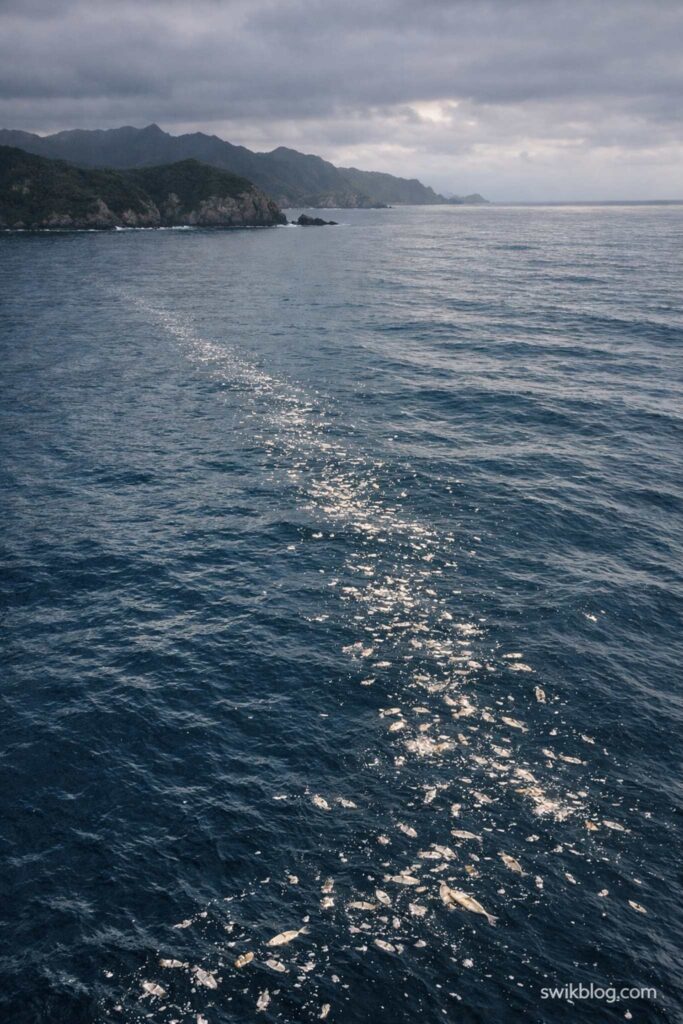

A viral video filmed near Great Barrier Island has triggered an official probe and renewed questions about what happens out of sight in one of New Zealand’s most loved marine playgrounds.
Updated: January 6, 2026
The Hauraki Gulf is where many New Zealanders go to feel the ocean at its best — clear water, reef edges, kingfish runs, and snapper grounds that have anchored family fishing stories for generations. That’s why the images coming out of the waters off Great Barrier Island (Aotea) this week landed so hard: a long, drifting trail of dead fish, filmed from a boat and shared online, now sits at the centre of an investigation by Fisheries New Zealand.
In the footage, the spearfisher who recorded the scene points out multiple species floating belly-up at the surface, including what appear to be boarfish and pufferfish, alongside smaller fish that look like juvenile snapper. The dead fish appear scattered in a line across open water, creating the impression of a moving “wake” — the kind of pattern that immediately makes people ask whether something was dumped, rather than a natural die-off.
What authorities say they’re checking
Fisheries New Zealand has said it is investigating after receiving a complaint, and that it has identified a commercial vessel that was operating in the area at the time. The crucial point now is evidence: officials can cross-check where a vessel was, what it reported catching, and what onboard camera footage shows.
That matters because public reaction often moves faster than formal findings. A clip can go viral in minutes — but confirming what caused the fish to end up dead on the surface takes more than a screenshot and a gut feeling. Investigators typically look for consistent timelines and patterns: whether the fish match species commonly taken as bycatch, whether there were any reported gear issues, whether a vessel’s track and speed align with the drift line, and whether the footage shows any discarding.
Why “dead fish trails” ignite anger so quickly
To many recreational fishers and coastal communities, scenes like this don’t just look wasteful — they feel personal. People invest time, money, and emotion into the idea that fisheries are managed fairly, that rules mean something, and that the next season will still have fish. When a video suggests undersized fish may be part of the floating mix, it hits a nerve: the public expectation is that juvenile fish should be protected so they can grow and replenish stocks.
Great Barrier Island sits in a region that’s regularly discussed in debates about marine protection and fishing pressure. The Hauraki Gulf is productive, but it’s also busy — commercial fishing, recreational fishing, tourism, and shipping routes all intersect here. That makes trust especially fragile. One disturbing image can bring years of simmering tension back to the surface.
What the law says about dumping and penalties
New Zealand’s fisheries rules are complex, and not every dead fish at sea points to an offence. Some discarding can be permitted in specific circumstances, and some fish may die due to predation, disease, temperature stress, or natural events. But if investigators determine that fish were unlawfully disposed of, the legal consequences can be serious.
The Fisheries Act 1996 sets out offences and penalties, including provisions that can carry substantial fines and potential imprisonment for serious breaches. For a plain-English overview of how fisheries offences and penalties are commonly applied, Community Law also outlines typical outcomes and enforcement powers in its guidance on fisheries offences and penalties.
In practical terms, the investigation will focus on what can be proven. That’s why onboard cameras, reporting systems, and vessel tracking have become central to modern fisheries enforcement — they reduce the “he said, she said” element and let investigators test claims against timestamps and recorded activity.
The unanswered question: dumping, die-off, or something else?
Right now, there are multiple plausible explanations — and that uncertainty is exactly why Fisheries New Zealand’s process matters. If the fish were discarded by a vessel, investigators will need to establish which vessel, what was discarded, and whether it breached the rules. If the fish were already dead due to another cause, authorities may look for other signals: water conditions, reports from other boats, or patterns of similar sightings.
For locals and regular Gulf fishers, the bigger issue isn’t only what happened in one stretch of water on one day. It’s what the incident represents: anxiety about the health of local fisheries, frustration about perceived inequities between commercial and recreational access, and fear that the Gulf’s recovery — already a long-running conversation — could be slipping further out of reach.
What happens next
The next updates will likely come in one of three forms: Fisheries New Zealand confirming no offence was found; announcing enforcement action if evidence supports it; or releasing broader guidance if the event points to an issue that needs public awareness (for example, if a natural die-off is suspected and there are health warnings).
Until then, the clip will keep circulating — and so will the anger it sparked. But the most important thing for readers is separating what’s visible from what’s verified. Viral video can reveal a problem. It can’t, on its own, deliver the full chain of responsibility.
Read more on Swikblog: Latest stories | Trending: North London Derby
Sources: Public reporting and official legislation links. This article will be updated if Fisheries New Zealand releases confirmed findings.

Make Swikblog your go-to source on Google for reliable updates, smart insights, and daily trends.