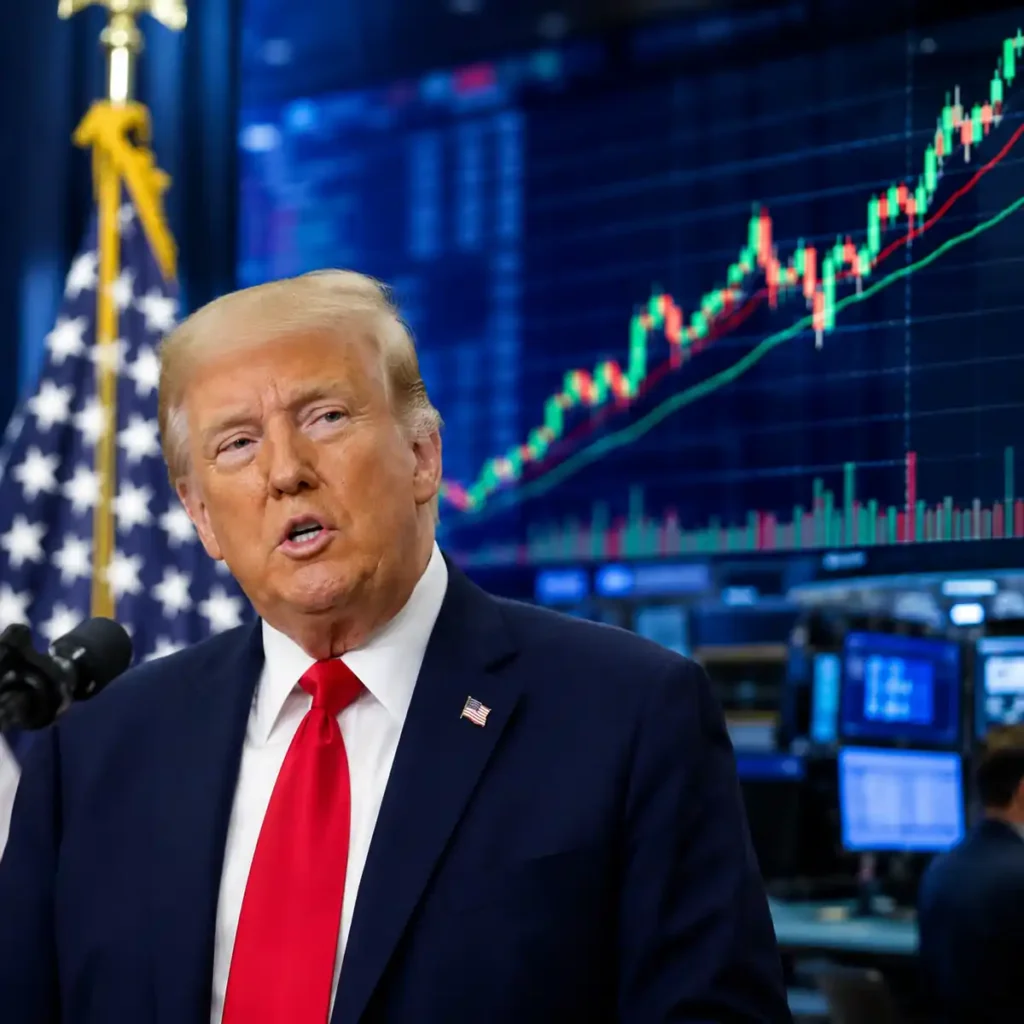

WASHINGTON — President Donald Trump says the U.S. stock market has further to climb, making a bullish call at the White House as investors weigh a strong year for stocks against expensive oil, elevated Treasury yields and uncertainty over the Federal Reserve.
President Trump Participates in a Rose Garden Dinner https://t.co/1oz95lUonI
— The White House (@WhiteHouse) September 2, 2026
The prediction came Wednesday as Wall Street broke a three-session losing streak. It was also delivered against an increasingly political backdrop: Trump is preparing an aggressive campaign push in roughly 35 competitive races that could help decide control of Congress in November.
Trump’s message: stocks can go higher
Trump told Republican lawmakers gathered for a White House Rose Garden dinner that he expects the stock market to continue rising. His confidence follows sizable gains across major U.S. indexes during 2026.
Investors should treat the comment as a presidential outlook, not a signal that further gains are assured. Markets respond to government policy, but earnings, inflation, interest rates, energy costs and economic growth can quickly change the direction of stocks.
BREAKING: 🇺🇸 President Trump says the stock market is hitting new records every day and it will go even higher. pic.twitter.com/4HTKyFeL3f
— Bull Theory (@BullTheoryio) September 2, 2026
Wall Street’s numbers tell a bigger story
Stocks were higher on September 2 after three straight sessions of losses. The S&P 500 rose 0.5% to 7,666.60, the Dow Jones Industrial Average gained 0.6% to 53,061.95 and the Nasdaq Composite added 0.5% to 26,217.83.
Small companies had an even stronger session. The Russell 2000 jumped 1.1% to 2,953.17.
The year-to-date numbers help explain Trump’s optimism. Through Wednesday, the S&P 500 had gained about 12% in 2026, while the Dow was up 10.4%, the Nasdaq 12.8% and the Russell 2000 19%, according to Associated Press market data.
Three forces could challenge Trump’s prediction
First is interest rates. The 10-year Treasury yield was around 4.78% Wednesday. Higher yields can increase borrowing costs and make bonds more attractive compared with stocks, creating pressure for companies carrying expensive valuations.
Second is oil. Brent crude settled around $95.63 a barrel as geopolitical tensions involving Iran continued to influence energy markets. Persistently high crude prices can push transportation and production costs higher and complicate the inflation outlook.
The changing supply picture is also putting greater attention on Trump’s Venezuela oil strategy and what it could mean for U.S. gas prices.
Third is the Federal Reserve. Investors are watching employment and inflation data for clues about the next interest-rate decision. If inflation proves difficult to control, expectations for tighter monetary policy could become another obstacle for stocks.
Trump Patriot Passport: How to Get One, Cost, Eligibility and Locations
AI remains one of Wall Street’s strongest engines
Technology helped drive Wednesday’s recovery, with Nvidia gaining more than 3%. The move showed again how strongly artificial-intelligence spending and semiconductor companies can influence the broader market.
The durability of that investment boom is therefore increasingly important. Evidence that TSMC’s chip-equipment requirements are rising with AI demand provides another indication of how much infrastructure is being built around the technology.
At the same time, heavy reliance on a small number of large technology companies creates risk. Weak earnings or reduced AI spending from major companies could quickly weigh on indexes where those stocks have significant influence.
Why Trump’s 35-race campaign plan matters
Trump’s stock-market prediction was made during a gathering focused heavily on the November 2026 midterms.
He told Republicans that control of Congress could come down to approximately 35 competitive races and said he intends to campaign aggressively in those battlegrounds, particularly during the final 30 days before Election Day.
His attention is expected to center on House and Senate races, including closely watched contests in Alaska and Texas.
That political fight has financial-market relevance. A change in control of either chamber could affect Trump’s ability to pursue tax, spending, regulatory and energy policies during the remainder of his term.
What investors need to know now
Trump’s forecast comes from a position of market strength: major indexes have recorded substantial gains this year and Wall Street has continued to benefit from enthusiasm around AI.
But the next move is unlikely to depend on one statement from Washington. Investors now have several concrete indicators to watch — inflation, jobs, Treasury yields, oil prices, corporate earnings and Federal Reserve policy — while November’s election adds another layer of uncertainty.
The key question is therefore not simply whether Trump expects stocks to rise. It is whether economic growth and corporate profits can remain strong enough to support higher prices while investors navigate expensive energy, elevated borrowing costs and an increasingly intense election season.

Make Swikblog your go-to source on Google for reliable updates, smart insights, and daily trends.