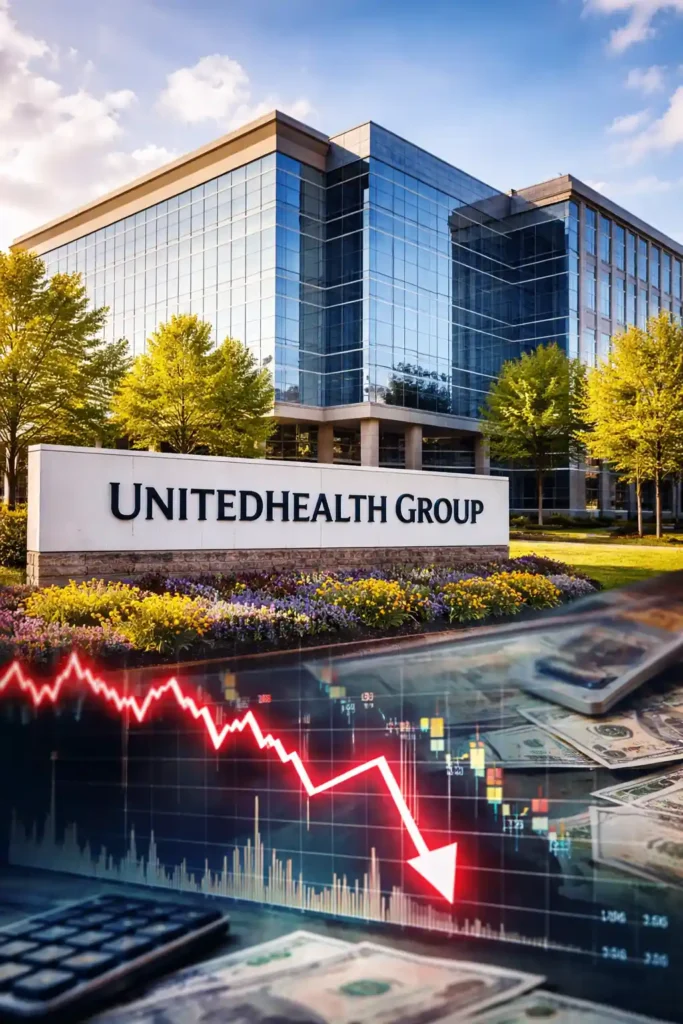

UnitedHealth Group (NYSE: UNH) traded lower in the latest session, with shares recently around $283.77, down $6.23 or 2.15% on the day. The slide adds to a rough start to 2026, with the stock down close to 14% year to date as investors digest a softer revenue outlook, a reset in analyst expectations, and fresh attention on regulatory headlines.
The market’s reaction reflects a familiar pattern for mega-cap healthcare names: a modest earnings beat is rarely enough when forward numbers disappoint. UnitedHealth’s fourth-quarter update delivered a narrow profit beat, but the top-line story and forward guide carried more weight in the weeks that followed.
Guidance reset drives the tone
UnitedHealth’s 2026 revenue outlook is the central pressure point. Management guided to full-year 2026 revenue of $439 billion, roughly $15 billion below what analysts had been projecting. For a company long associated with steady expansion, that gap matters—particularly because it raises the prospect of the first annual revenue decline in more than three decades if the forecast holds.
Quarterly performance added context. UnitedHealth posted fourth-quarter revenue of $113.2 billion versus expectations of $113.8 billion. In absolute terms, that miss is not enormous. In narrative terms, it reinforced concerns that growth is slowing at a time when medical cost trends and reimbursement scrutiny remain front-of-mind for investors.
Wall Street trims targets, keeps faith in the franchise
Following the outlook, analysts moved quickly to adjust valuation frameworks. Mizuho reduced its price target to $350 from $430, keeping an Outperform stance while acknowledging that any earnings recovery could take longer than previously assumed. Truist’s David MacDonald lowered his target to $370 from $410 while maintaining a Buy rating, reflecting updated estimates after the quarterly report and guidance.
The message is not that the business model is broken; it is that the path back to prior growth expectations has become less linear. That distinction matters for a stock that historically traded with a premium profile built on reliability.
Insider tax transactions draw attention, not alarms
Investor focus has also drifted toward insider activity flagged in recent reporting. UnitedHealth insiders executed five tax payment transactions on February 13, 2026 totaling $325,009.32, implying an average transaction size of about $65,001.86. The transactions involved senior officers and were tied to common stock.
Transaction values reportedly ranged from $36,829.36 to $94,374.05, and each transaction involved the disposition of common stock at about $293.19 per share. These were characterized as tax-related share dispositions and were not flagged as anomalous. For markets, that usually lands as a “watch, not worry” datapoint—still notable given the broader drawdown, but structurally different from discretionary selling tied to sentiment.
Regulatory overhang stays in the frame
UnitedHealth is also navigating heightened scrutiny tied to Medicare billing practices, a backdrop that can affect investor confidence even without immediate financial restatements. The company’s exposure to government programs and reimbursement mechanisms is a core part of its scale advantage, but it also creates sensitivity to compliance headlines, audit chatter, and policy shifts. Add leadership turnover concerns into the mix, and the stock can carry a heavier risk premium than it did during more stable periods.
For investors, the key question is not a single headline; it is the cumulative impact on valuation. In periods of uncertainty, the market tends to pay less for each dollar of expected earnings until visibility improves.
Optum and the platform thesis
UnitedHealth’s long-term story still leans on its multi-engine structure. Beyond its insurance operations, the company’s Optum businesses remain central to the platform narrative: care delivery, pharmacy services, and data-driven healthcare operations. In a market where employers, payers, and providers are increasingly looking for integrated solutions, that breadth can be a strategic moat.
At the same time, integrated models can become harder to value during guidance resets. When the top-line target steps down, investors tend to scrutinize segment-level assumptions more closely—membership trends, medical cost ratios, pharmacy dynamics, and the pace of technology-enabled efficiencies.
A growth market backdrop, even amid stock pressure
A separate thread supporting the longer-duration thesis is the growth outlook for healthcare finance solutions and related operational platforms. Industry projections point to a market expanding from $139.25 billion in 2025 to $151.63 billion in 2026, and reaching $207.81 billion by 2030. Digital financing, AI-enabled automation, and revenue-cycle efficiency themes continue to pull investment into the sector, even as individual stocks trade on nearer-term earnings visibility.
UnitedHealth’s scale and ecosystem positioning keep it close to these structural currents. The near-term challenge is that markets are currently paying for execution and certainty, not optionality.
Levels investors are watching
With shares around $283.77, UNH sits below the roughly $293 level tied to the recent tax-related transactions. The stock’s tone suggests investors want clearer confirmation that 2026 guidance is conservative rather than foundational. Upcoming updates will be judged heavily on revenue trajectory, medical cost trends, and the degree of confidence management conveys about the second-half setup.
For real-time pricing and session moves, investors often track the UNH quote on Yahoo Finance.
UnitedHealth remains a bellwether for US managed care. When guidance weakens, the market tends to re-rate quickly. When visibility returns, the stock has historically regained its footing just as fast. The next few quarters will shape whether this drawdown stays a temporary reset—or evolves into a longer consolidation phase for one of healthcare’s most closely followed names.
Author: Swikriti
You May Also Like
- PayPal Stock Today Surges 7% on Takeover Interest After 46% Decline
- Volvo Car Stock Today: EX30 Battery Recall Impacts 40,000 SUVs

Make Swikblog your go-to source on Google for reliable updates, smart insights, and daily trends.