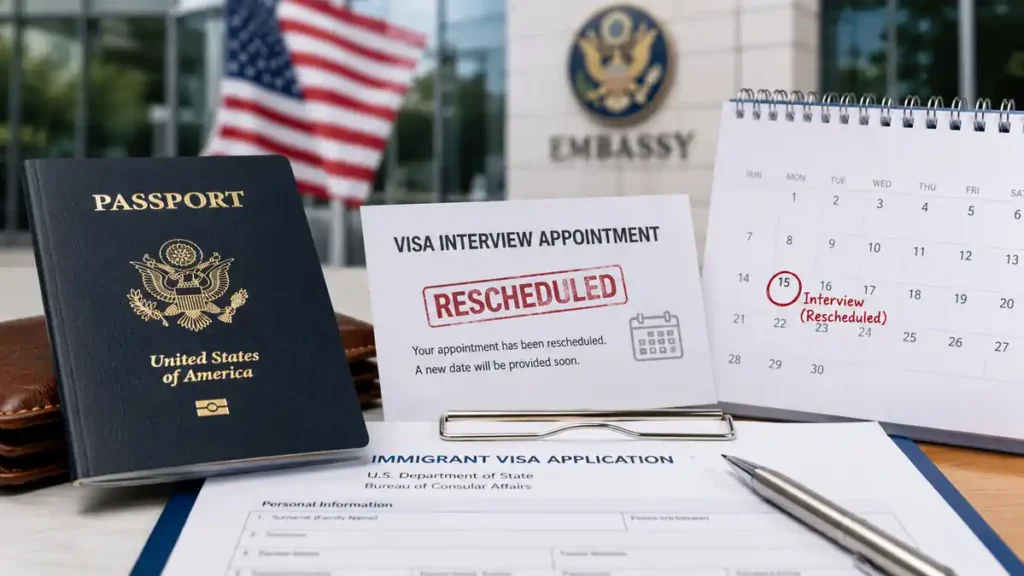

U.S. visa applicants around the world are facing appointment disruptions after the State Department launched a global training programme for consular officers, prompting some scheduled immigrant visa interviews to be postponed or rescheduled. The move comes as the Trump administration increases scrutiny of legal immigration and strengthens checks used during visa decisions.
Applicants with affected interviews have reportedly been told that new dates will be provided later. The State Department has not announced a worldwide date for normal appointment schedules to resume, making official embassy or consulate notices especially important for people with upcoming interviews.
Why are U.S. visa appointments being rescheduled?
The State Department began the global training initiative in August 2026 to provide consular officers with more detailed instruction and promote consistent visa adjudication. One area receiving increased attention is whether an immigrant visa applicant could become a “public charge” under U.S. immigration law.
This does not mean a person is disqualified simply because they may use any public service. Consular officers assess cases under applicable immigration rules and individual circumstances. Applicants should rely on official U.S. State Department public charge guidance rather than unofficial interpretations circulating online.
Who is affected by the 2026 visa appointment disruption?
The clearest reported impact is on immigrant visa applicants who already had interviews scheduled at U.S. embassies and consulates. These categories generally include people seeking permanent residence through qualifying family, employment and other immigrant pathways.
Some headlines have described the development as a worldwide halt to U.S. visa appointments. Applicants should be cautious with that wording. A B1/B2 visitor, F-1 student or H-1B worker should not assume an appointment has been cancelled unless the relevant embassy, consulate or official scheduling system confirms a change.
Court ruling changed an earlier 75-country restriction
The disruption follows a major federal court decision on August 21. U.S. District Judge Jeannette Vargas struck down a State Department policy that had suspended immigrant visa issuance for nationals of 75 countries.
The ruling removed the blanket nationality-based restriction but did not automatically approve affected applications. Individual eligibility, financial evidence, security checks, medical requirements and other immigration rules still apply. The court decision affecting immigrant visa applicants from 75 countries explains how the ruling changed the earlier restrictions.
The court also set aside refusals based solely on the challenged policy and asked both sides to submit proposals by September 11 addressing remaining issues.
US Proposes $103,265 H-1B Visa Fee: Who Pays and Who Is Exempt?
F-1 Visa September 3 Hearing: What International Students Need to Know
H-1B fee proposal is a separate issue
The appointment disruption comes amid another immigration debate involving a proposed $103,265 fee on certain H-1B petitions. H-1B is a non-immigrant work category, so the fee proposal should not be confused with the current immigrant visa interview disruption.
The proposed charge is not a blanket fee on every H-1B holder and is not currently in effect. It follows an earlier push for a $100,000 fee that faced court action, while the newer DHS proposal is proceeding through its own rulemaking process.
Visa enforcement has expanded beyond new applications
The Trump administration has also increased scrutiny of people who already hold U.S. visas. The State Department has said more than 175,000 visas were revoked during a broader enforcement campaign involving alleged criminal activity, fraud, visa violations and security concerns.
Those revocations are separate from an interview postponement. The 2026 U.S. visa revocation crackdown affecting more than 175,000 visas explains the wider enforcement action involving existing visa holders.
What should applicants do if they already have an interview?
Applicants should monitor the email address used for their visa case and check the official appointment portal or embassy instructions before travelling. If an interview is rescheduled, follow the notice rather than paying third parties claiming they can secure an earlier appointment.
Applicants should also keep passports, civil documents, financial evidence and other required paperwork current. Requirements can vary depending on the visa category and the embassy or consulate handling the application.
When will U.S. visa interviews resume?
No confirmed global restart date has been announced. Appointment availability may differ by embassy, visa category and local workload while consular officers complete the training programme.
A postponement should not be treated as a visa denial. It is an appointment scheduling action, while the final visa decision remains a separate determination based on the applicant’s individual eligibility and the rules applying to that visa category.

Make Swikblog your go-to source on Google for reliable updates, smart insights, and daily trends.