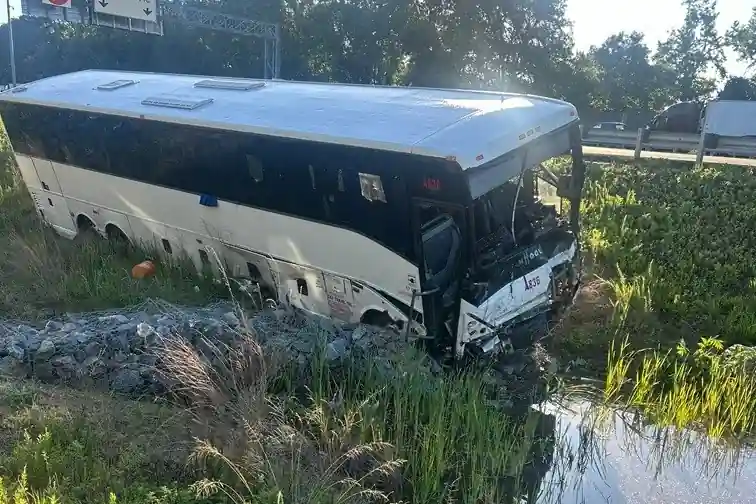

A routine overnight slowdown on Interstate 95 became a mass-casualty emergency early Friday when a passenger bus plowed into a line of vehicles approaching a construction zone in Virginia. Five people died and 34 others were taken to hospitals, including three who were critically injured.
The collision occurred around 2:35 a.m. in Stafford County, near Quantico and approximately 45 miles south of Washington, D.C. Virginia State Police said the bus struck six vehicles after failing to slow with the traffic ahead.
What authorities have confirmed
Five fatalities • 34 people hospitalized • Three critically injured • Six vehicles hit • Investigation active • Charges pending
Victims were traveling in vehicles struck by the bus
Police confirmed that all five people killed were inside the vehicles hit by the bus. Their identities were not immediately released because authorities were still notifying relatives.
Emergency crews transported 34 people from the crash scene to hospitals. Three were reported to be in critical condition, but officials had not provided detailed updates about the remaining patients.
Authorities also had not confirmed how many passengers were aboard the bus, who operated it or where it was traveling. Those unanswered questions are expected to become important parts of the investigation.
Southbound I-95 remained closed for hours
The scale of the wreck brought southbound traffic to a standstill. Police closed the affected lanes while firefighters, paramedics, towing crews and investigators worked among the damaged vehicles.
Motorists were diverted from the interstate, creating extensive delays along one of the East Coast’s busiest travel corridors. I-95 regularly carries local commuters, interstate travelers and commercial traffic through Virginia.
Investigators had to document the positions of the vehicles, collect physical evidence and arrange for the damaged bus and cars to be removed before the highway could fully reopen.
Why did the bus fail to slow down?
That is now the central question facing Virginia State Police. Traffic ahead of the bus was slowing near an upcoming work zone, but the bus did not reduce its speed in time and struck the vehicles in front of it, according to the preliminary police account.
Investigators are likely to review the bus’s speed, braking activity and mechanical condition. They may also examine the driver’s actions, hours behind the wheel, visibility, road conditions, construction warnings and any available onboard data or camera footage.
Police had not said whether distraction, fatigue, impairment or a vehicle defect contributed to the collision. Until investigators release further evidence, none of those possibilities should be considered a confirmed cause.
Virginia State Police said charges were pending, although no specific charge or individual had been publicly named. A final charging decision may depend on the results of vehicle inspections, interviews and reconstruction of the crash.
Work-zone slowdowns leave little room for error
Construction zones can produce sudden braking as lanes narrow, traffic merges or vehicles encounter workers and equipment. The risk can be greater overnight because darkness reduces visibility and some drivers may have slower reaction times.
The National Highway Traffic Safety Administration’s work-zone guidance urges motorists to reduce their speed, avoid distractions and maintain additional space from the vehicle ahead.
Those precautions are particularly important for buses and other large vehicles, which generally require more distance to stop than passenger cars. When traffic is already backed up, one delayed reaction can involve several vehicles and cause catastrophic injuries.
Information families and travelers are waiting for
The investigation remains in its early stages. Authorities have yet to release the victims’ names, the bus operator’s identity, a complete account of the people aboard or an explanation for why the driver failed to respond to slowing traffic.
Further updates could also clarify the conditions of those hospitalized and whether state or federal transportation agencies will participate in examining the bus and its operating records.
Related Updates
NTSB report details the investigation into the Wimberley plane crash
For drivers, the immediate lesson is to begin slowing before reaching a work zone rather than waiting until traffic is visibly stopped. Extra following distance can provide the few additional seconds needed to prevent a rear-end collision, especially during overnight travel.

Make Swikblog your go-to source on Google for reliable updates, smart insights, and daily trends.